By Preserve Gold Research
A world war rarely announces itself on the first day. It arrives the way floods do, with one overtopping moment after another, each rationalized in isolation until the map begins to change. In the case of Iran, the risk is that the conflict begins to behave like a systemic shock, pulling at alliances, energy corridors, and great-power rivalries that were already under strain long before the first missile flew.
Open conflict among the United States, Israel, and Iran has already created cross-border and cross-domain pressures once considered hypothetical. Strikes span multiple territories. Maritime confidence is eroding. External powers are positioning themselves strategically on the sidelines.
A “true world war scenario” wouldn’t need a formal declaration that suddenly pulls the planet into a single battlefield. It would look more gradual and more structural. Analysts warn the conflict could lock in multiple fronts and draw major powers into roles they couldn’t easily exit without sacrificing credibility.
The most plausible path toward that outcome runs through a combination of five escalation triggers. The first is a sustained expansion of the direct confrontation between the United States and Iran. Repeated attacks on American forces or regional bases could provoke responses that Tehran interprets as a threat to regime survival.
At the same time, the war could widen through the involvement of Gulf states, whose territory already hosts a dense network of bases, ports, and energy infrastructure tied to Western security. Strikes against oil facilities or population centers in countries such as Saudi Arabia or the United Arab Emirates could quickly transform defensive cooperation into visible participation.
A second geographic front could solidify along Israel’s northern border if escalation with Hezbollah evolves into a prolonged Lebanon theater, destabilizing the country internally and drawing additional actors into the fighting. Meanwhile, sustained interference with shipping through the Red Sea approaches or the Strait of Hormuz could convert private maritime risk into a matter of national security as governments feel compelled to protect trade routes. The conflict could also take on a different posture altogether if major powers such as China or Russia moved beyond diplomacy.
Taken together, these triggers compress decision timelines while making it harder to control escalation. What may have started as a regional dispute now has the potential to become a contest over the reliability of global arteries and the credibility of major-power deterrence.
When a regional war becomes systemic
To dig deeper into this transformation, it helps to separate two ideas that are often blurred together. The first is geographic expansion, where wars spread to more front lines, draw in more participants, and produce more casualties. The second is systemic expansion, when a conflict begins to pressure the mechanisms that keep a globalized economy and a fragile international order functioning day to day. A war reaches a different level of consequence when those systems are tested.
In the twenty-first century, systemic stress usually moves through chokepoints, markets, and institutions. The Strait of Hormuz is one of the clearest examples of a physical bottleneck that the global economy can’t easily maneuver around. The IEA describes the strait as one of the world’s most critical oil transit chokepoints, making even short-lived disruptions major market disruptors. The EIA similarly notes that most volumes that transit the strait have little alternative means of exiting the region. It’s why investor psychology changes so quickly around conflicts in the Gulf.
Systemic war also spreads through private business decisions. Shipping firms reroute vessels while insurers withdraw coverage. Refiners and utilities scramble for replacement cargoes. The conflict then manifests as higher prices and shortages. In early March, major carriers began diverting vessels away from Suez-linked routes and the Bab el-Mandeb area as regional security deteriorated. Reports of conflict-related surcharges and broader service disruptions followed.
At some point, governments backstop what private actors won’t. But that carries its own risk. Once states underwrite risk or provide escorts, treasuries, regulators, and state enterprises fight the war alongside traditional actors.
Recent U.S. policy has focused on mitigating energy price spikes amid war and shipping disruptions that are driving prices higher. Washington has also supported maritime trade via insurance and reinsurance mechanisms intended to stabilize Gulf shipping. But the more governments assume risk, the harder it becomes to “step back” later without clear economic consequences at home.
Modern world war scenarios don’t require every major power to send troops. When one conflict drains air-defense resources or escorts needed elsewhere, when Pacific rivalry continues amid Middle East conflict, or when sanctions transform trade routes, leaders face choices within a broader competitive context.
The direct U.S.–Iran ladder
Analysts say the most immediate escalation trigger is sustained direct combat between U.S. and Iranian forces that moves from limited exchanges toward a campaign each side interprets as existential. This ladder can be climbed intentionally, but it’s also climbed through force-protection dynamics. The more U.S. forces are at risk, the more pressure grows to suppress launchers, command nodes, and supply networks. The more Iran’s deterrent is degraded, the greater the incentive it has to demonstrate that it still retains escalation options.
Geography makes this ladder harder to control. U.S. military facilities are distributed across the region, and many lie within the range of Iranian retaliation. Al Udeid Air Base in Qatar serves as the forward headquarters for U.S. Central Command and hosts a substantial American troop presence. Bahrain hosts the headquarters of the U.S. Navy’s Fifth Fleet.
Integration, which normally strengthens defense, can become destabilizing once fighting begins. In January, U.S. Central Command announced the creation of a coordination cell at Al Udeid to deepen integrated air and missile defense with regional partners. Integrated defenses make attacks harder to execute. But they can also lower the political barrier to deeper involvement, because operational systems begin treating the region as a single battlespace. If Tehran interprets that integration as collective participation, the list of potential targets expands, and shared facilities become more exposed to large-scale retaliation.
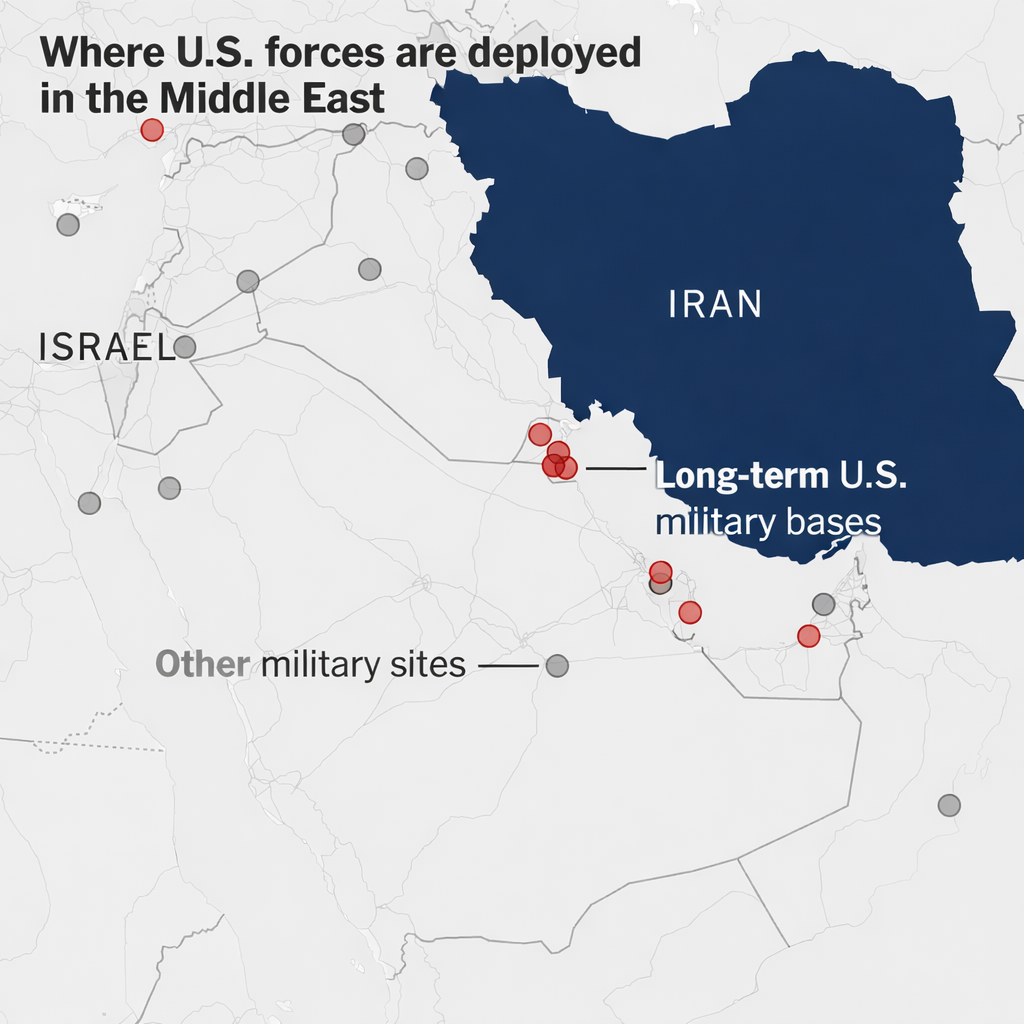
A map of U.S. air, naval, and support installations across the Middle East illustrates how a dense regional network of bases places American forces within range of multiple escalation pathways in an Iran-centered conflict. Source: NY Times
The escalation ladder also extends beyond traditional battlefield operations. A recent U.S. intelligence assessment warned that Iran and its proxies could increase cyber activity against the United States, including disruptive hacktivist-style attacks, and that retaliation risks could grow under certain political conditions. That assessment aligns with government cyber advisories describing Iranian-linked actors probing vulnerable networks and industrial systems across multiple critical infrastructure sectors.
A world-war pathway here wouldn’t necessarily begin with a cinematic cyber “blackout.” It’s more likely to begin with accumulated disruption that forces retaliation decisions under uncertainty. Attribution disputes, public panic, and political pressure can push governments to treat cyber interference as an armed attack even when legal and technical boundaries are ambiguous.
When leaders begin to see military strikes as threats to their country’s survival, their options start to shrink. What might have once led to a limited response can quickly feel like a fight for survival. In those moments, countries often turn to proxy forces to push back without confronting each other directly.
The risk of escalation grows when there are no easy ways for either side to step back without losing face. Some proxy conflicts can be managed through quiet negotiations or local deals. But when a proxy group becomes a key part of a country’s deterrence strategy, shutting it down becomes much harder. Doing so can start to look less like lowering tensions and more like accepting a strategic loss.
Then there’s the nuclear component. Reporting from the International Atomic Energy Agency, along with public warnings from European governments, has reflected ongoing concern about Iran’s enrichment activities and its transparency obligations. A joint statement from the United Kingdom to the IAEA Board of Governors has emphasized unresolved transparency questions and linked them to obligations under reinstated United Nations Security Council resolutions. Damage to nuclear facilities or disruptions to safeguards arrangements can become accelerants rather than stabilizers, because they raise the possibility that one side believes the other is racing the clock.
A final accelerant on the direct escalation ladder lies in the human factor of time. As conflicts drag on and casualties mount, leaders come under increasing pressure to deliver decisive outcomes. Public patience fades, and political incentives begin favoring actions that promise resolution rather than restraint. This dynamic isn’t partisan or unique to any one country. It’s a structural feature of prolonged wars. Over time, the pressure to end a conflict can push leaders toward decisive and often unpredictable gambles.
The Gulf-state tripwire
The Gulf monarchies have long tried to live in an uncomfortable space between dependence and autonomy. They rely on U.S. security support in practice, even when formal treaty structures vary, and they also manage economic and diplomatic relationships with rivals and major powers. In an Iran-centered war, that hedging becomes harder. There’s no meaningful way to be “uninvolved” when missiles and drones can reach your airspace or when your ports host commodity exports.
The first tripwire is the basing and military presence. Once U.S. sorties begin flying from Gulf facilities, regional air defenses are coordinated through shared operational centers, and intelligence integration becomes routine, Iran can plausibly argue that host states are part of the conflict.
The American posture in the region relies on a network of installations across Qatar, Bahrain, Kuwait, the United Arab Emirates, Iraq, and nearby states. Al Udeid Air Base in Qatar serves as the forward headquarters for U.S. Central Command, while Bahrain hosts the headquarters of the U.S. Navy’s Fifth Fleet. When fighting reaches these installations, the line between host territory and an active battlefield blurs quickly.
The second tripwire is energy infrastructure and the credibility of markets. Even though the United States depends less on Gulf imports than it once did, oil prices are set globally, and the Gulf still anchors a large share of export capacity and spare production.
The U.S. Energy Information Administration notes that while some pipeline alternatives exist, most oil moving through the Strait of Hormuz has no practical alternative route out of the region. The International Energy Agency similarly warns that disruptions in the strait can ripple worldwide through sharp price spikes and, if prolonged, physical shortages.
A world-war scenario becomes more plausible if markets and policymakers begin to see the Gulf’s energy system not as occasionally vulnerable but as routinely contested. At that point, defending energy flows can turn into a permanent feature of global economic management.
The third tripwire is domestic stability under economic strain. Gulf states rely on large expatriate workforces and on investor confidence to keep capital flowing. If exports slow, ports face disruptions, or air traffic becomes unreliable, economic management can quickly become a national security concern.
Recent discussions in Washington about how to contain energy-price spikes show how domestic economic pressure can shape wartime decisions even for governments far from the Gulf. Gulf governments face similar pressures, but with an added vulnerability. Financial markets and real estate can react quickly to shifts in confidence, sometimes moving on sentiment rather than on underlying economic conditions.
A Lebanon front that cannot stay local
The Lebanon theater carries a unique escalation risk because it brings together three volatile ingredients. There is an armed non-state actor with deep military capability, a neighboring country that views that actor as an existential threat, and a host state whose institutions have been under strain for years. When violence expands in this environment, it rarely remains contained. Logistics, politics, and humanitarian consequences tend to spill across borders almost immediately.
Events on the ground show how quickly tensions in this arena can move from simmering to sustained confrontation. Hezbollah has continued rebuilding its capabilities after earlier rounds of fighting, replenishing drone and rocket supplies with support from Iran. At the same time, human rights groups have documented how cross-border attacks can displace civilians and cause widespread harm, especially when the Lebanese state lacks the capacity to shield communities or control armed groups operating on its territory.
Conflicts that begin producing large-scale humanitarian fallout rarely stay local for long. They attract external attention, funding, logistics, and diplomatic pressure. Each of those responses adds another layer of political complexity, linking a local front to wider regional and global tensions.
The escalation trigger here isn’t just heavy fighting between Israel and Hezbollah. It’s the point at which the Lebanon conflict becomes an unavoidable regional war engine. One pathway runs through attacks that expand beyond border zones into dense urban areas and critical infrastructure. Another runs through the erosion of external buffers, especially international forces and monitoring mechanisms designed to reduce accidental escalation.
Analysts have emphasized that Iran’s broader strategy in a widening confrontation is likely to rely heavily on proxy activation. Once proxy forces begin operating across multiple areas, deterrence becomes more difficult, and the end of the conflict becomes more complex. Lebanon’s internal fragility intensifies this dynamic.
Even if foreign armies never formally deploy inside Lebanon, forms of outside involvement have already appeared in quieter ways. As the state weakens, the conflict can still escalate into an internationalized conflict. Ungoverned space expands, migration pressure grows, and outside powers begin competing for influence inside the vacuum. In strategic terms, this kind of instability tends to pull others in, not because governments want another war, but because they worry about what a collapsing state could become amid an expanding conflict.
Chokepoints and the economics of escalation
The most direct way for an Iran-related war to spill into the global system runs through commerce and energy. Modern conflicts don’t typically stay confined to the battlefield. They ripple through commodity markets and supply chains, and those economic shocks can influence strategic decisions almost as much as military outcomes.
Start with the Strait of Hormuz. The EIA’s analysis of flows in 2024 and early 2025 shows that the strait carries a large share of the world’s seaborne oil trade. Significant volumes of liquefied natural gas pass through the same corridor, and many of the destination markets are concentrated in Asia. The International Energy Agency frames the vulnerability in simple policy terms. Because bypass routes are limited, even a short disruption can trigger sharp price swings. If interruptions last longer, the concern shifts from volatility to the possibility of real shortages.
The Red Sea offers a recent example of how these dynamics can unfold. The EIA has documented how attacks beginning in late 2023 reshaped shipping patterns across the region. Tanker flows through the Bab el-Mandeb chokepoint declined as vessels rerouted around the Cape of Good Hope, adding weeks to voyages that previously moved through the Suez Canal corridor. The World Bank’s analysis of the Red Sea shipping crisis shows how those longer journeys translate into wider economic strain. Distances increase, travel times lengthen, and supply chains begin to absorb the cost and delay.
The commercial layer matters because it can push governments into roles they would rather avoid. When private shipping companies decide the risks are too high and stop sailing through a war zone, states are left with an uncomfortable choice. They can accept shortages and price spikes, or they can step in and assume risks the market no longer will. In early March, the United States announced support for maritime trade through an insurance and reinsurance program for Gulf shipping, a sign that commercial traffic may not return without government backing.
The experience in and around Yemen offers a clear example of how quickly maritime security problems can become global ones. Attacks by the Houthis on commercial vessels in the Red Sea prompted warnings from the U.S. Maritime Administration that ships from many countries were at risk and that crews faced direct danger. If similar disruptions begin affecting the Strait of Hormuz, the economic shock would grow dramatically.
When major powers move from rhetoric to force
The final step from regional war to world war is the involvement of major powers, which raises the probability of direct confrontation. Intent matters, but sequence matters too. Major powers can slide into escalatory positions through “defensive” steps that look offensive to rivals.
Russia’s incentives are comparatively clear. A prolonged Middle East war could absorb U.S. attention and munitions while complicating Western alliance management. Analysts have argued that Moscow has an interest in Iran’s survival as a partner and may assist in selective ways while avoiding confrontation, precisely because the relationship is designed for durable cooperation rather than a mutual defense guarantee.
The world-war risk comes from support that narrows the distance between “not involved” and “involved.” Recent reports point to intelligence sharing that could help Iran target U.S. military assets. Even if Moscow insists it’s not directing Iranian strikes, the effect is to raise the cost and risk faced by U.S. forces and to create pressure for retaliation. If intelligence support shifted from selective to systematic, or became tied to specific operational outcomes, the potential for a broader confrontation would rise sharply.
China’s position looks different, but it still carries its own escalation risks. In early March, Chinese officials emphasized de-escalation and described the Strait of Hormuz as a vital trade artery for the global economy.
Even so, the absence of direct military backing doesn’t eliminate risk altogether. A pathway involving China could emerge through measures intended to protect maritime trade. Naval presence missions, convoy escorts, or negotiated safe-passage arrangements would bring Chinese forces closer to an active war zone. Even operations framed as commercial protection could create friction with U.S. and allied navies operating in the same waters.
Major-power involvement also changes how the original belligerents think about time, risk, and compromise. If Iranian leaders begin to believe that outside powers will provide diplomatic cover or financial breathing room, the urgency to end the war quickly can fade. Time may start to feel like an asset rather than a constraint.
In Washington, the calculation can shift in the opposite direction. If the conflict starts to look like a test of credibility against rival powers, compromise may appear less like prudence and more like retreat, even if the immediate military goals have already been achieved.
At that point, wars often take on a momentum of their own. Decisions are no longer driven only by the grievances or objectives that started the conflict. Leaders begin weighing their reputations, alliance expectations, and the political cost of appearing weak to both rivals and partners.
If history offers any lesson, it’s that global crises rarely erupt all at once. They spread through the world’s pressure points (energy routes, trade networks, and great-power rivalries) until instability in one region begins to shake the entire system. In moments like these, those who have prepared for uncertainty tend to be better positioned than those reacting to it in real time.