
By Preserve Gold Research
The U.S. stock market, long the engine of investor wealth, faces a growing chorus of caution. Several prominent institutions are warning that the coming years could bring a “lost decade” for stocks. Rather than a sudden crash with sharp, short-lived pain, these cycles often trap markets in a long stretch of sideways movement. In such a scenario, corporate earnings rise while valuations slowly deflate until prices realign with fundamentals—it’s time that causes the real damage. Inflation quietly eats away at gains, leaving investors treading water for years. While it may sound unlikely, history reminds us that castles in the sky can’t float forever.
What’s Behind the Lost Decade Narrative?
A growing body of research now argues that U.S. equities may be entering a period where returns could flatten for years, not because of a single shock, but because several structural and market forces are converging at once. Valuations remain unusually high. Monetary conditions are tight. Leadership within the major indexes has narrowed even as core economic fundamentals show signs of strain. Taken together, experts say these pressures create a climate where past gains may be difficult to replicate, and where disappointment becomes the base case.
Stretched Valuations and Pulled-Forward Gains
U.S. equities began this decade priced at levels so lofty that history offers few examples of them holding for long. The cyclically adjusted price-to-earnings ratio for the S&P 500 recently hovered near 38, placing today’s market roughly in the 97th percentile of its past range. High starting valuations have repeatedly aligned with weaker forward returns, and many strategists caution that this pattern may reassert itself. Goldman Sachs’ Investment Strategy Group notes that the last decade’s surge likely pulled forward returns. A stretched valuation regime reduces room for upside and increases the odds that earnings growth must shoulder the adjustment. Like a stretched spring that’s been yanked tight, you can stretch it a bit more, but tension rises, and slack diminishes. Unless corporate earnings grow far faster than history or valuations somehow defy gravity, something will eventually have to give.
Higher Rates and the End of Easy Money
High interest rates and persistent inflation mark a decisive shift from the easy-money era that powered the 2010s. The Fed’s tightening cycle in 2022-2023 pushed borrowing costs sharply higher, and while rates have eased somewhat, few expect a return to the near-zero environment that once inflated valuations. Vanguard analysts argue that the neutral policy rate has moved higher due to productivity trends and the government’s large fiscal position. They call this new regime “the single most important financial development since the GFC”.
Higher bond yields now compete directly with equities, compressing the present value of future earnings. Vanguard’s 10-year U.S. equity forecast has fallen to roughly 4.2%-6.2% and, after inflation, real returns could hover near zero. With the equity risk premium near its lowest level since the late 1990s, the U.S. no longer offers the generous reward over bonds that cushioned investors for decades. When a 60/40 stock-bond portfolio has nearly the same outlook as an all-stock portfolio, experts say it may be time to consider other options.
Market Concentration and Systemic Fragility
The S&P 500’s dependence on a small cluster of mega-cap technology firms adds another layer of vulnerability. The “Magnificent 7” delivered impressive gains, but their dominance leaves the index acutely exposed. Experts say this top-heavy concentration behaves like a fault line. When a narrow group carries the bulk of the market’s capitalization, earnings power, dividends, and buybacks, the entire structure becomes sensitive to any stumble. It’s like a high-rise skyscraper resting on a few pillars, susceptible to collapse if any of them give way. Even a modest earnings miss or regulatory blow to one dominant firm could reverberate across the index. When markets become overly optimized for recent winners, efficiency gains are often offset by the increased risk of a sudden, destabilizing shock.
Passive Flows and the Risk of Reversal
Over the past decade, passive index investing has exploded in popularity. Trillions of dollars have flowed into index funds and ETFs that buy stocks indiscriminately based on their market capitalization. This trend, coupled with massive corporate stock buybacks, has created a tailwind for the largest stocks. In rising markets, passive flows act as automatic buying of the winners, further reinforcing the upward momentum.
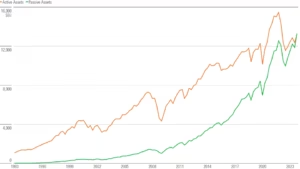
Passive fund inflows have surged over the past decade while active funds have steadily lost ground, creating a market increasingly driven by automatic buying and vulnerable to sharper reversals when sentiment turns. Source: Morningstar
During a downturn, that same mechanism often works in reverse. If the market starts trending flat or down and investors begin withdrawing funds, passive products must sell stocks regardless of fundamentals, potentially accelerating declines. Companies tend to cut buybacks when profits weaken, removing another key source of demand as prices fall. Like a falling row of dominoes, this cycle feeds on itself. Each withdrawal forces more selling, which in turn puts further pressure on prices, prompting more investors to exit. It becomes a self-fulfilling prophecy, where the expectation of poor performance can lead to actions that make it more likely. Analysts caution that this reflexive dynamic could be another ingredient in the “lost decade recipe”, as periodic panicky outflows meet a thin cushion of active buyers.
Slower Economic and Earnings Growth
Beneath the market structure issues, there are fundamental headwinds that analysts warn could dampen growth in corporate earnings, the ultimate driver of stock returns. Demographic aging, slower labor force expansion, and sluggish productivity gains have constrained the economy’s ability to grow. The OECD reports that productivity growth has broadly downshifted across advanced economies over the past two decades. If the overall economy can only grow at, say, ~2% annually (as many forecasts suggest for the U.S.), it’s hard for corporate profits to rise much faster than that on a sustained basis.
Goldman Sachs strategists note that if demographic and structural drags continue, earnings growth may struggle to meet investor expectations. This would leave lofty price-to-earnings multiples to do the “heavy lifting” of the adjustment, which means multiples coming down. Put simply, if companies can’t grow profits at the rate investors have become accustomed to, stock prices will eventually reflect that harsher reality.
There’s also inflation to contend with. Even if milder than 2022’s spike, persistent inflation could continue nibbling at real returns and potentially force central banks to keep policy tighter than in the pre-pandemic decade. Lower potential growth, paired with higher capital costs, creates an environment that historically has produced weak or inconsistent equity performance.
What Wall Street’s Biggest Institutions See Ahead for U.S. Markets
Multiple major financial institutions have issued muted or outright cautious forecasts that align with this darker backdrop. Although their methodologies differ, their conclusions converge on a similar warning: U.S. equities could offer far lower returns in the coming decade than investors have grown accustomed to.
Goldman Sachs: “Dead” or Lost Decade Ahead
Goldman Sachs expects the S&P 500 to deliver only ~6.5% nominal annual returns over the next 10 years, potentially the weakest outlook among major global markets. In downside scenarios, annual gains could fall toward ~3%, effectively flat after inflation. High valuations and extreme concentration drive much of their concern. Goldman has urged clients to “diversify beyond the U.S.,” arguing that today’s bull market, driven by a small handful of large-cap tech companies, leaves little room for error. Their team correctly anticipated U.S. underperformance in 2023 and now warns that the structural factors behind that trend persist.
Vanguard: Lowest Return Expectations Since the 1990s
Vanguard’s long-term outlook paints an equally sobering picture. Their models project nominal annualized returns of 4-6% for U.S. equities over the next few years, a clear break from the double-digit gains of the 2010s. U.S. valuations are “most stretched” relative to other regions, and higher policy rates diminish equities’ advantage over bonds. Joseph Davis, Vanguard’s chief economist, emphasized the theme of a new normal: higher rates mean investors can no longer count on the kind of easy double-digit stock gains that defined the 2010s. The firm also highlights that the equity risk premium is now the lowest it’s been since the 1999-2009 lost-decade lull, when stocks had no compound annual growth rate and negative growth after inflation.
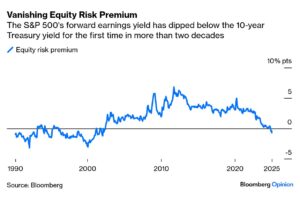
The equity risk premium has steadily eroded since the late 1990s, falling toward levels last seen before the 1999-2009 lost decade. As the reward for holding stocks over bonds contracts, the market may be entering a period where returns struggle to outrun inflation. Source: Bloomberg
JPMorgan: Roughly ~5% Returns
JPMorgan’s strategists have similarly issued guarded forecasts. They reportedly expect about 5% annual returns for U.S. equities in the coming years. This estimate implies that after adjusting for inflation, real returns could settle near the low single digits. Their concerns mirror those of Goldman and Vanguard: high valuations, narrow leadership, and the possibility that profit margins could revert from cyclical extremes.
Bank of America: A Defensive Stance and Rising Appeal of Alternatives
Bank of America’s Michael Hartnett has been among Wall Street’s more bearish voices. While BofA hasn’t explicitly published a 10-year percentage target like Goldman or Vanguard has, Hartnett’s research notes have hinted at a coming paradigm shift. In late 2023, he described the investment backdrop as “no longer ‘TINA’ (There Is No Alternative [to stocks]) but rather TARA – There Are Reasonable Alternatives.” With cash yields and bonds offering over 5% in the short run, BofA has advocated “holding more bonds and even gold” as a hedge, anticipating that stocks could struggle.
Hartnett warns that global liquidity excesses since 2009 created “booms, bubbles, and debasement,” suggesting the next chapter could involve paying back the piper. BofA’s team has also highlighted that U.S. equity inflows as a percentage of global flows have been dropping, a sign that international investors are already rotating away from U.S. stocks. The old playbook of relying on the Fed or on tech leadership may not yield the same rewards as before.
OECD: Structural Drags on Growth
Although the OECD (Organisation for Economic Co-operation and Development) doesn’t forecast stock returns, its economic outlooks provide context that supports these wary market projections. Its recent analyses show global growth decelerating and highlight how potential output growth in advanced economies has downshifted. This structural slowdown means the ceiling for trend growth is lower. The U.S. economy, in its 2025-2027 outlook, is expected to grow around only 1.8-2% annually in real terms (with much of that growth front-loaded and then easing). In that scenario, it’s hard to envision corporate earnings rising much beyond mid-single-digit growth consistently.
RBC Wealth Management: High Hurdles Ahead
RBC’s analysts echo the theme of tempered expectations. In RBC’s 2026 outlook, they remain neutral on U.S. equities but caution that elevated valuations could become a problem if earnings growth buckles. They draw a parallel to the 2000s “lost decade” by reminding investors that the S&P 500 went roughly nowhere from 2000 to 2009—a stretch that included two major bear markets and a full round-trip in prices. With valuations and interest rates still high, RBC advises focusing on quality and defensive positioning rather than momentum chasing. They acknowledge the market has cleared difficult hurdles before, but warn that today’s conditions make such leaps far more challenging.
Why Investors Can’t Count on the ‘Fed Put’ Anymore
For decades, investors embraced a simple creed: “Don’t fight the Fed.” Whenever stocks wobbled or growth faltered, investors assumed the Federal Reserve would ride in with rate cuts, liquidity, or new facilities. This quasi-guarantee of central bank support became nicknamed the “Fed put “, an implied safety net that seemed to cap the downside. From Alan Greenspan’s rapid easing after the 1987 crash to Ben Bernanke’s quantitative easing in 2008 to Jerome Powell’s actions in 2020, the pattern was clear. Now, analysts warn that era is fading. The Fed put, if not gone, appears deeply out of the money, and that shift could shape any future lost decade.
The Fed now faces conflicting mandates and constraints that it didn’t during the easy-money era. After a long stretch of undershooting its 2% target, it’s suddenly found itself wrestling with readings above 3-4%, and it’s still trying to drive them down. That fight limits its freedom to slash rates at the first hint of market stress. In early 2025, Chair Jerome Powell signaled a more detached stance. “There’s a lot of waiting and seeing going on…and that just seems like the right thing to do at a time of elevated uncertainty,” he said, indicating that the bar for rate cuts or fresh support is much higher now. Powell and his colleagues have been at pains to avoid premature policy loosening because they remember the lessons of the 1970s, when easing too early allowed inflation to flare back up.
Alan Blinder, former vice chair, put it bluntly: Powell’s “first job is to take out the view that the Fed is on the verge of slashing interest rates a lot in a hurry.” The central bank wants to break the market’s reflexive belief that weakness automatically triggers a relief rally. Recent episodes have reinforced that message. In 2023-2024, softer economic data and banking strains, including the collapse of Silicon Valley Bank, didn’t prompt rapid easing. The Fed held rates relatively high, a clear departure from the prior decade, when even modest global tremors led to pauses or reversals.
For investors, this means drawdowns could be deeper and recoveries slower than what the post-2008 playbook conditioned them to expect. The “Fed put” now looks like it will only be exercised if there’s an obvious systemic crisis. Short of that, experts say the Fed is likely to step back and let asset prices correct. In such a world, a lost decade doesn’t need a single violent crash. It could emerge through repeated declines and incomplete rebounds that leave indices treading water, especially if policymakers refuse to inject fresh liquidity each time sentiment sours.
There’s also the matter of the Fed’s balance sheet and toolset. Years of quantitative easing swelled its balance sheet to nearly $9 trillion at its peak, and quantitative tightening has only partially reversed that buildup. Policy rates near 5% give some room to cut, but not as much as when they sat near 2% or below. Expanding the balance sheet again could face political resistance and renewed inflation fears. As FTI Consulting noted, the Fed “will have to choose” and won’t be able to hold rates near zero while also keeping inflation under control. The institution is likely to prioritize price stability over rescuing every market stumble.
Fiscal policy complicates the picture further. Massive budget deficits are injecting stimulus into an economy where the Fed is trying to remove it. That tug of war could keep rates higher for longer and inject new bursts of inflation risk. Political battles over spending and the debt ceiling may add volatility that the Fed can’t offset. Monetary policy can react, but it can’t fix structural fiscal choices. That leaves investors with an unstable mix of higher-rate policy, large deficits, and a central bank wary of stepping in to help.
Put simply, monetary policy is shifting from a safety net to a constraint. Stocks will increasingly have to justify themselves through earnings and real growth rather than repeated interventions. If the Fed resists cutting until markets are already down 30-40%, the damage will already be done, and even late moves might not spark a strong recovery if inflation remains above target. That combination of higher inflation risk, tighter policy, and a reluctant Fed raises the odds that any equity slump might simply have to grind on. And this is exactly the kind of landscape in which a lost decade could take shape.
Foreign Investors Are Pivoting Away from U.S. Debt
A quieter but equally consequential shift is also taking place in the background. While the trend may not dominate headlines, foreign appetite for U.S. Treasuries is fading, which could push interest rates higher and drain liquidity. For years, heavy foreign buying kept U.S. borrowing costs low. That support is weakening as federal deficits surge. Foreigners once held nearly 50% of U.S. public debt. Today, they hold roughly 30%. In absolute terms, foreign accounts still own $8.5-9T of Treasuries, but U.S. debt has ballooned from about $6.4T in 2008 to over $38T in late 2025. Their holdings have not kept pace, forcing domestic buyers and the Fed to absorb more supply and the Treasury to offer higher yields.
Higher yields feed directly into equity markets. They act like gravity on valuations, pulling multiples lower as investors demand more compensation for holding risk. When the 10-year Treasury offers 5% risk-free, equities must deliver stronger growth to justify their prices. Elevated borrowing costs weaken corporate profits and make refinancing more punishing for indebted firms. Currency and geopolitical currents add further strain. Treasury holdings have become a geopolitical lever in trade and strategic disputes, and even incremental diversification can push yields higher.
China exemplifies the shift. Once the largest creditor to the U.S., Beijing has been steadily reducing its Treasury holdings for a decade as it diversifies away from the dollar and defends the yuan. China’s stash of U.S. Treasuries fell to around $700 billion in 2023–2025, the lowest since 2008. Meanwhile, other countries’ central banks (such as Japan’s and those of oil exporters) have had their own shifting needs and, in some cases, less excess cash to invest in U.S. bonds due to narrower trade surpluses.
Another factor is that foreign investors now find U.S. stocks more attractive than Treasuries. Over much of the last decade, U.S. equities consistently outperformed the rest of the world. Foreign institutions pursued higher returns by buying U.S. corporate stocks and reducing their portfolios’ share of U.S. government bonds. As of mid-2024, for the first time, foreign private investors held more in U.S. equities than in U.S. Treasuries. This “risk-on” behavior by foreign investors has been a boon to Wall Street, but it also means less support for U.S. bond prices, which has contributed to higher yields. Paradoxically, if the lost decade narrative convinces foreigners to pull back on U.S. stocks now, they’re not necessarily going to plow back into Treasuries. They might just invest more at home or elsewhere entirely, given geopolitical tensions and diversification goals.
Preparing for a Tougher Market Cycle
The specter of another lost decade for stocks is concerning for many Americans, particularly those approaching retirement or already dependent on their investments. It challenges the complacency of a generation who have mostly seen equities trend inexorably upward with quick recoveries from every dip. Now, a confluence of high starting valuations, a regime shift in interest rates, diminished policy crutches, and structural economic drags has created a landscape where mediocre could be the best we get.
While views differ on magnitude, the through-line across most institutions is clear. Expectations for U.S. equities have reset lower. Markets that were once buoyed by cheap money, rapid profit growth, and broad global demand now face valuation gravity, tighter financial conditions, and slower economic engines. This, analysts say, is the soil from which a lost decade could sprout in the U.S., as it did in Japan, where the Nikkei stock index took over 30 years to return to its 1989 peak.
When risks accumulate from multiple directions, sensible hedges matter. This is where diversifiers like gold may play a role. Precious metals don’t rely on earnings cycles and have historically maintained purchasing power as real returns on financial assets weakened. In an era when stocks can churn and bonds struggle to offset volatility, gold may serve as a steady counterweight to rising uncertainty.