
By Preserve Gold Research
The collisions in the South China Sea are not happening by accident. When a Chinese patrol vessel deliberately rammed a Philippine coast guard ship near Sabina Shoal in August 2024, the choreography was too practiced to be opportunistic. When Chinese maritime safety officers boarded a Vietnamese fishing boat near the Paracels the following month, beating the crew badly enough to require hospitalization, the incident followed a recognizable arc. These events are part of a deliberate pressure campaign. It’s systematic, granular, and carefully calibrated to stay below the threshold of formal war.
What makes this campaign significant extends well beyond regional maritime law. The South China Sea has become the primary arena through which Beijing tests American resolve, weakens alliance credibility, and constructs leverage ahead of a summit with Washington that will almost certainly pivot on Taiwan. The gray-zone tactics deployed in these waters, including harassment by coast guard vessels, militia swarms, floating barriers, and deliberate rammings, serve a purpose that runs deeper than fishing rights or reef ownership. They’re designed to reshape what other countries believe the United States is actually willing to defend.
A Pressure Campaign Below the War Threshold
The Asia Maritime Transparency Initiative has been tracking these deployments in detail. In 2025, China’s maritime militia averaged 241 ships per day in contested zones, an all-time high, up from 232 the year before. The China Coast Guard logged roughly 1,939 ship-days of patrol at key South China Sea locations in 2024, compared to 1,652 in 2023. Scarborough Shoal alone accounted for approximately 516 of those days, up from 376 the year prior.
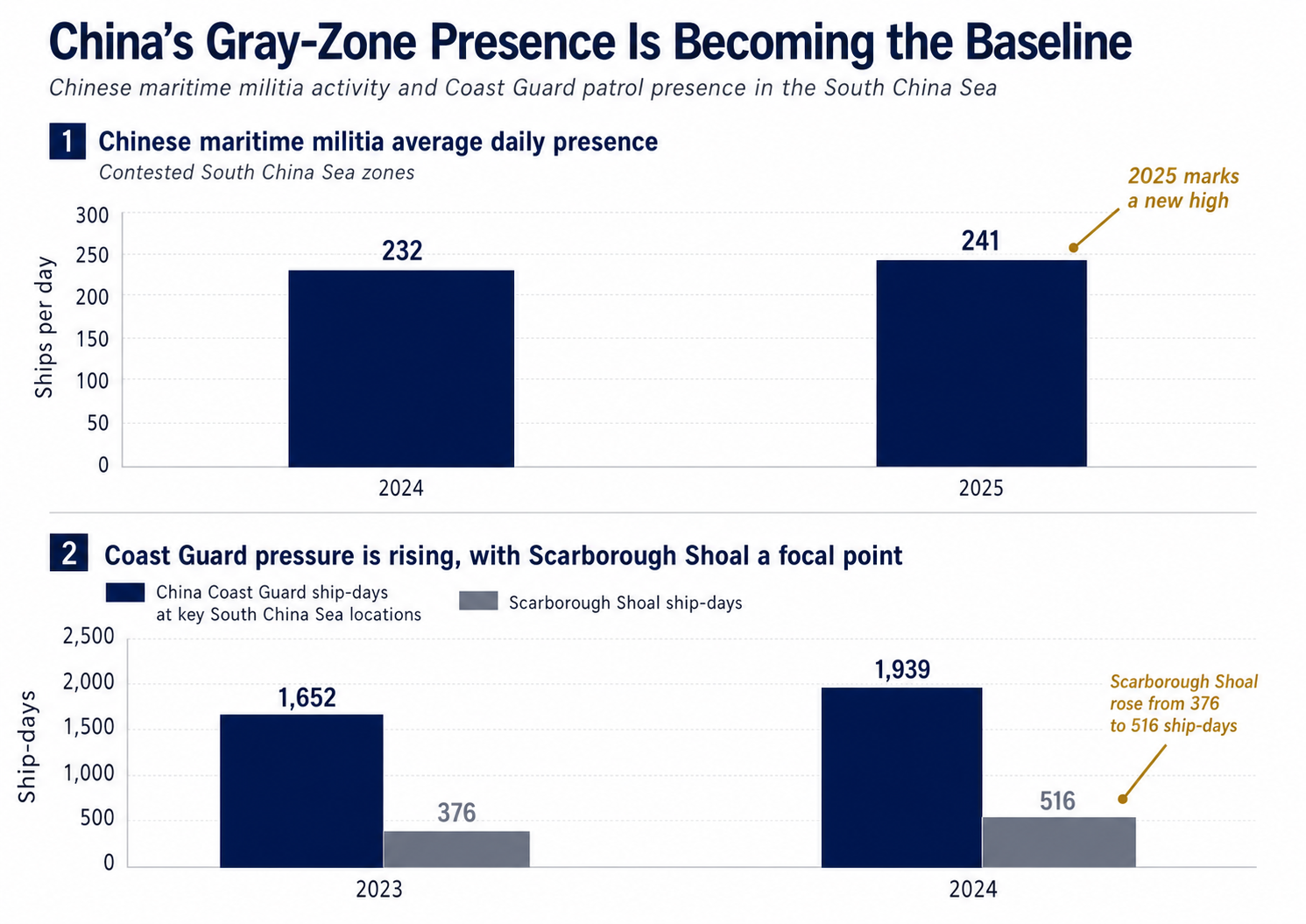
China’s maritime pressure is no longer episodic. Daily militia presence and Coast Guard patrol-days have risen into a steady operating pattern, turning contested waters into an arena of permanent coercion. Source: Asia Maritime Transparency Initiative/CSIS, Chinese maritime militia and China Coast Guard patrol tracking.
These aren’t patrols. They’re occupations conducted incrementally, each week indistinguishable from the last, accumulating into a new baseline that every subsequent negotiation is forced to treat as the starting point.
The incidents fit within a wider framework that a RAND Corporation analysis cataloged as comprising nearly 80 distinct gray-zone tactics deployed across all instruments of Chinese power against Taiwan, Japan, Vietnam, India, and the Philippines over the past decade. The common feature is deniability. Each action falls just short of the threshold that would trigger a formal alliance response. Yet the cumulative weight shifts the balance on the water, in diplomatic perception, and in the domestic politics of smaller claimant states.
Former U.S. diplomat Daniel Russel, reflecting on the dynamics after the April 2024 trilateral summit between Washington, Tokyo, and Manila, put it directly: Beijing’s goal is “to isolate the target of its pressure campaign,” to make the Philippines or Vietnam feel exposed, to complicate solidarity signals, and to make American protection feel contingent rather than certain.
Treaty Language Meets Maritime Ambiguity
The April 2024 summit was itself a response to that calculation. When President Biden met with the leaders of Japan and the Philippines and declared that U.S. defense commitments to both countries are “ironclad,” the statement was not diplomatic boilerplate. It was a deliberate effort to foreclose the isolation strategy.
The trilateral leaders expressed serious concern over China’s militarization of the South China Sea and announced plans for joint coast-guard exercises. More pointedly, Manila had pushed Washington to clarify publicly that the 1950 U.S.-Philippine Mutual Defense Treaty covers any attack on Philippine forces anywhere in the South China Sea, not just Philippine territory. Washington confirmed it. The distinction matters enormously, because most of the current friction happens on contested reefs and shoals well outside Philippine land borders.
Whether those declarations translate into genuine deterrence is a more complicated question. Credibility in alliance politics isn’t established through communiqués. It builds or erodes through follow-through in moments of deliberate ambiguity, and the South China Sea provides a constant supply of them.
What would actually happen if Chinese forces downed a Philippine aircraft, or seized a resupply vessel on a documented humanitarian mission? The political and military machinery that converts treaty language into actual intervention has never been tested at scale in this region. China is paying close attention to the gap between words and action.
Taiwan Moves Toward the Center
The pattern of pressure extends more directly to Taiwan. Beijing has been explicit, loudly and repeatedly, that Taiwan is its central preoccupation heading into any high-level exchange with Washington. In April 2026, China reportedly demanded that the United States drop references to Taiwan’s defense from an upcoming joint statement. The White House declined.
Around the same time, Taipei accused Beijing of pressuring African governments to block overflight clearances for Taiwan’s president, effectively grounding a planned state visit. These aren’t random provocations. They’re part of an argument Beijing is constructing in advance of any negotiation. Accommodation on Taiwan has a price, and China is raising that price continuously.
The military signals amplify this. In May 2024, following the inauguration of Taiwan’s President Lai, the PLA’s Eastern Theater Command launched “Joint Sword 2024A,” its largest Taiwan-area exercises in years, involving 15 navy ships, 16 coast guard ships, and over 30 aircraft in mock attack formations around the island. U.S. officials warned publicly that such actions “risk escalation and erode longstanding norms.”
By late 2025, after a record American arms sale to Taiwan, China had staged another round of large-scale war games under the banner of “Strait Thunder-2025,” this time including over 400 sorties. The exercises stress-test Taiwan’s defenses, wear down its readiness cycles, and demonstrate the speed at which blockade conditions could be established. They’re also aimed at Washington as reminders that any summit concession on Taiwan carries an implicit military meaning.
Shipping Lanes, Chips, and Global Exposure
The economic stakes embedded in all of this are not trivial. Roughly one-third of all global merchant shipping transits the South China Sea. Through the Taiwan Strait alone, approximately $2.45 trillion in goods moved in 2022, more than 20% of world seaborne trade. For China itself, 21.6% of its trade flowed through that corridor that year, creating a genuine constraint on how aggressively Beijing can disrupt the lanes it also depends on.
A sustained blockade or major conflict would force ships to reroute around the Philippines, adding 800 to 1,000 miles to each voyage. The disruption would be analogous in cost and scale to the Red Sea diversions that sent freight rates surging in late 2023 and into 2024. The knock-on effects would spread quickly. Insurance premiums would rise, delivery timelines would stretch, and commodity prices would face upward pressure, absorbing purchasing power across economies with no direct stake in the dispute.
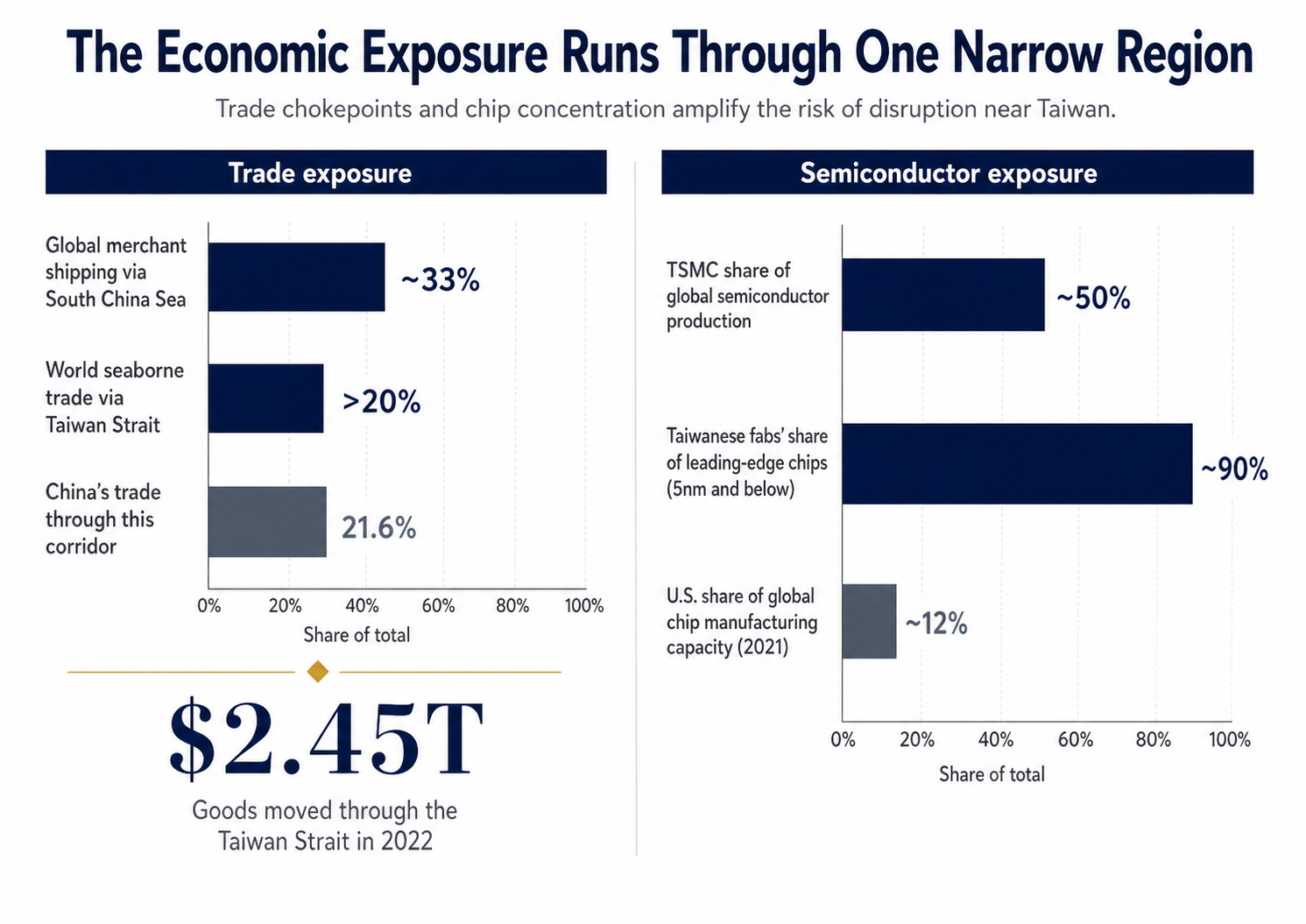
The strategic risk is magnified by economic concentration. A disruption near Taiwan would touch not only shipping lanes and insurance markets, but also the advanced chips that sit beneath modern computing, defense systems, and global manufacturing. Source: CSIS; Semiconductor Industry Association/BCG; Taiwan Semiconductor Manufacturing Company; UNCTAD trade and maritime transport data.
The semiconductor dimension compounds this exposure. Taiwan Semiconductor Manufacturing Company alone produces roughly 50% of the world’s semiconductors. This figure climbs to approximately 90% of the most advanced chips at five nanometers and below when all Taiwanese fabs are included.
Apple, Nvidia, Qualcomm, most defense microelectronics, and essentially every advanced computing application on earth depend on supply chains routed through a small island that Beijing regards as unfinished sovereign territory. The Center for Strategic and International Studies has bluntly described the exposure: disruptions to Taiwan’s chip ecosystem alone could cost the world trillions of dollars.
Even a confined conflict that caused carriers to avoid Taiwanese ports would cut off a disproportionate share of the components that run contemporary economies. The United States had approximately 12% of global chip manufacturing capacity in 2021, significant in revenue terms but nowhere near adequate to withstand a supply interruption of that magnitude.
China’s Port Reach Adds Another Layer
China has also expanded its global maritime infrastructure footprint, thereby compounding these risks. Under the Belt and Road Initiative, Chinese companies have built or taken stakes in 117 ports worldwide, including major facilities across Southeast Asia, South Asia, Africa, and Southern Europe. Chinese firms now control roughly 27% of global container port capacity, giving Beijing leverage over the logistics networks that international commerce relies on in ways that extend well beyond any single choke point.
If a confrontation in the South China Sea prompted coordinated pressure through affiliated port networks, including delays, insurance complications, or restricted access, the economic effects could ripple far beyond the immediate geography of conflict. China itself sends roughly 95% of its energy and raw material imports by sea, mostly via Malacca and the South China Sea, which constrains how far Beijing can push disruption without inflicting serious costs on its own economy. That constraint is real, but it narrows as military and political pressure intensifies.
The United States has been working to reduce these exposures across multiple layers simultaneously. The CHIPS and Science Act reflects a recognition that dependence on a single geographic node for advanced semiconductor production represents a structural risk, not just a trade inconvenience.
Diplomatic and military coordination with the Philippines, Japan, and Australia has deepened noticeably since 2022. January 2026 saw the eleventh joint U.S.-Philippine naval patrol of Scarborough Shoal. A bipartisan Senate bill proposed $2.5 billion to strengthen the Philippine armed forces. The annual Balikatan and Malabar exercises now involve a wider coalition of Pacific partners, while the AUKUS framework has tied Australian submarine capacity into the region’s deterrence architecture. The objective running through these efforts is the same. The United States and its partners are trying to make the cost of coercion visible and the solidarity of regional partners credible.
Regional Alignment Has Limits
Whether this coalition holds under sustained pressure is uncertain. Vietnam has historically been cautious about provoking Beijing, but the September 2024 boarding incident prompted Hanoi to publicly protest in a register it rarely uses. Indonesia and Malaysia have lodged separate complaints over incursions near their exclusive economic zones. Singapore, which typically avoids direct confrontation with Beijing, has raised concerns through ASEAN channels.
These responses suggest that Chinese assertiveness is producing exactly the kind of regional alignment it was presumably designed to prevent. But alignment built on shared grievance is not the same as alliance built on integrated capacity. The military balance between China’s expanding maritime presence and its neighbors’ ability to resist it remains heavily lopsided. Coast guard modernization programs and joint patrol schedules can’t fully substitute for the kind of hard deterrence that requires actual military consequence.
The upcoming May summit in Beijing introduces a different and in some ways more dangerous set of complications. When Washington and Beijing meet at the leadership level, the South China Sea becomes a bargaining chip, something either side can offer to trade for concessions elsewhere.
Beijing may offer visible de-escalation near Scarborough Shoal or Second Thomas Shoal as a gesture meant to ease diplomatic tension around Taiwan, while continuing attrition at lower visibility. Washington faces the opposite temptation. It could accept a quiet arrangement in the South China Sea in exchange for Chinese cooperation on trade, technology controls, or pharmaceutical precursors, without fully accounting for what that bargain would signal to Manila, Hanoi, and Tokyo. The history of these arrangements offers little reassurance. Each apparent accommodation tends to move the baseline of Chinese pressure higher once the diplomatic moment has passed.
If either side backs off, they will aim to present it as just a temporary compromise. The most dangerous outcome would be a situation in which China makes a visible concession (e.g., allowing more fishery patrols) while continuing its other pressure, lulling the U.S. into complacency, only to strike harder later. For now, the escalation ladder still has room to climb higher on both sides.
Summit Risk Without Clear Red Lines
The risk of miscalculation at the summit between President Trump and President Xi isn’t that the two sides will agree to the wrong terms. It’s that neither side has clearly bounded its own red lines, and each may leave the conversation believing the other accepted constraints that were never explicitly agreed to.
China’s leaders have never formally renounced the use of force over Taiwan. U.S. officials have indicated that an attack on treaty-allied forces in the South China Sea would constitute a red line, but exactly what that commitment covers in contested, ambiguous scenarios has remained deliberately elastic. Sustained gray-zone pressure is specifically designed to exploit that elasticity, to find the exact pressure point at which deterrence frays without triggering a response Beijing can’t absorb. The ladder of escalation, from water cannons to collisions to seizures to exchange of fire, still has room to climb.
The financial dimension of all this is worth considering because it rarely receives adequate attention in security analysis. The combination of trade route fragility, semiconductor concentration, energy logistics, and the monetary policy responses that would follow any major escalation creates a set of interlocking exposures that conventional portfolio assumptions don’t adequately price.
Geopolitical shocks in the Taiwan Strait have historically caused significant disruption to equity markets, insurance pricing, and corporate investment planning, even when events stopped well short of actual conflict. Sustained escalation would compress exactly the kind of systemic uncertainty that erodes the purchasing power of nominal assets and strains the assumptions embedded in long-duration financial instruments.
Institutions and governments with concentrated exposure to any single policy-dependent outcome face a deeper form of fragility. That outcome could be a maintained trade arrangement, a diplomatic understanding, or a functioning shipping corridor. The risk often remains hidden until the assumptions that support it are actively challenged.
Portfolio Assumptions Under Geopolitical Stress
That is why some investors and institutions are taking a harder look at what diversification actually means now. For decades, portfolios were built around a fairly stable world. Trade routes worked. Counterparties could be trusted. Monetary policy, while imperfect, moved within a familiar range. But that world is starting to look less certain.
When shipping lanes, diplomatic commitments, and regional security arrangements are all under pressure at the same time, the old assumptions become harder to defend. A portfolio built for calm trade corridors may not be built for a world where those corridors are being actively contested.
That helps explain the renewed interest in assets that sit outside the control of any single government. It also explains the appeal of assets with no counterparty risk. The reason is not coincidental. It parallels the maritime pressures described here, where value increasingly depends on whether political arrangements continue to hold. The point isn’t that conflict is inevitable. It’s that the margin for managed stability is getting thinner. Portfolios built as if that margin were unlimited deserve a closer look.
There is no easy resolution in sight. China’s deployment tempo has increased for three straight years. PLA exercises around Taiwan have grown larger and more frequent. Beijing’s demands heading into the summit remain difficult to reconcile with the security commitments Washington has already made to its treaty partners. Each year, the diplomatic room for compromise gets narrower as the military and maritime pressure builds.
What looks like stability in the South China Sea is not really stability, it’s a managed contest. For now, the restraints are holding. But one miscalculation, one collision handled badly, or one diplomatic misread could change that quickly. The pressure shows no sign of abating, and the institutions built to contain it are being tested in ways they weren’t designed for.