
By Preserve Gold Research
Investors have just priced in lending to the United States over the next three decades. At the August 13 auction, 30-year Treasury bonds sold at a yield of 5.216%, the highest auction yield since 2001. Two-year Treasury notes sold that same week at 4.15%. That gap shows how much more compensation investors now require to lend the government money for 30 years rather than 2.
The premium reflects a fiscal problem that compounds inside the federal budget. Interest costs are rising faster than the economy that ultimately has to support them, and investors are demanding more compensation for taking on long-term risk. The Treasury can’t walk away from an auction because borrowing costs are too high. It has to sell debt at whatever yield attracts enough buyers. On August 13, those buyers made clear that financing the United States for three decades now comes at a higher price.
The Real Yield Is Doing Most of the Talking
A 30-year yield is not about a single number. It bundles together what investors expect short-term rates to average over three decades, plus additional compensation for the risk that those expectations turn out wrong. Economists call that second piece the term premium, and it helps explain why inflation alone doesn’t account for today’s unusually high long-term yields.
Start with what inflation is actually doing. The Bureau of Labor Statistics reported that consumer prices rose 3.4% over the twelve months through July, while prices excluding food and energy rose 2.5%. Both readings improved slightly from June. But inflation is still running above the Federal Reserve’s preferred pace.
Even after stripping inflation out, however, borrowing costs remain unusually high. Inflation-protected 30-year Treasuries, which pay a fixed return above whatever inflation turns out to be, yielded 2.97% on August 13, according to Federal Reserve H.15 data. A real return near 3% on the safest asset in the world isn’t a small number. It means a large share of what the government pays to borrow for thirty years has nothing to do with future inflation at all.
Federal Reserve economists Daniel Covitz and Eric Engstrom looked at this predicament in a February research note. They found no evidence that expectations of higher long-run inflation explained the rise in far-forward Treasury rates. What they did find was a link to what they called “increased concerns about future federal deficits.” The rise in the nine-to-10-year forward rate over the prior five years, they noted, was the largest since the late 1970s and early 1980s.
Supply plays a role too. Research by Federal Reserve economists Canlin Li and Min Wei found that the amount and duration of Treasury debt private investors must absorb can push term premiums higher. That effect is separate from any change in perceived default risk. New York Fed researchers use a similar framework to split yields into rate expectations and this premium. Put in plain terms, when the Treasury sells more long-dated debt than the market wants to hold at the old price, the price has to move.
That doesn’t mean investors have stopped trusting the US to pay its bills. Buyers still showed up on August 13, and indirect bidders, often used as a rough gauge of foreign demand, took a solid share of the auction. The message was subtler, and potentially more consequential. Investors were still willing to lend but demanded higher returns.
Mortgage Rates Already Show What This Auction Costs
The repricing doesn’t stay isolated to bonds. The Bank for International Settlements has described the sovereign yield curve as the foundation beneath almost every other borrowing rate in an economy. Risk premiums get layered on top of that foundation, which is another way of saying that when it moves, everything built on it moves too.
Housing shows that transmission clearly. Freddie Mac’s weekly survey put the average 30-year fixed mortgage rate at 6.67% on August 13. That’s down slightly from the week before, but still above the 6.58% recorded a year earlier.
It’s a small weekly move sitting inside a much bigger one. Mortgage rates don’t track the 30-year Treasury rate one-for-one, since mortgage-backed securities carry their own prepayment and credit risks. But both instruments compete for the same pool of long-duration capital, so a repriced Treasury market doesn’t stay a Treasury-only story for long.
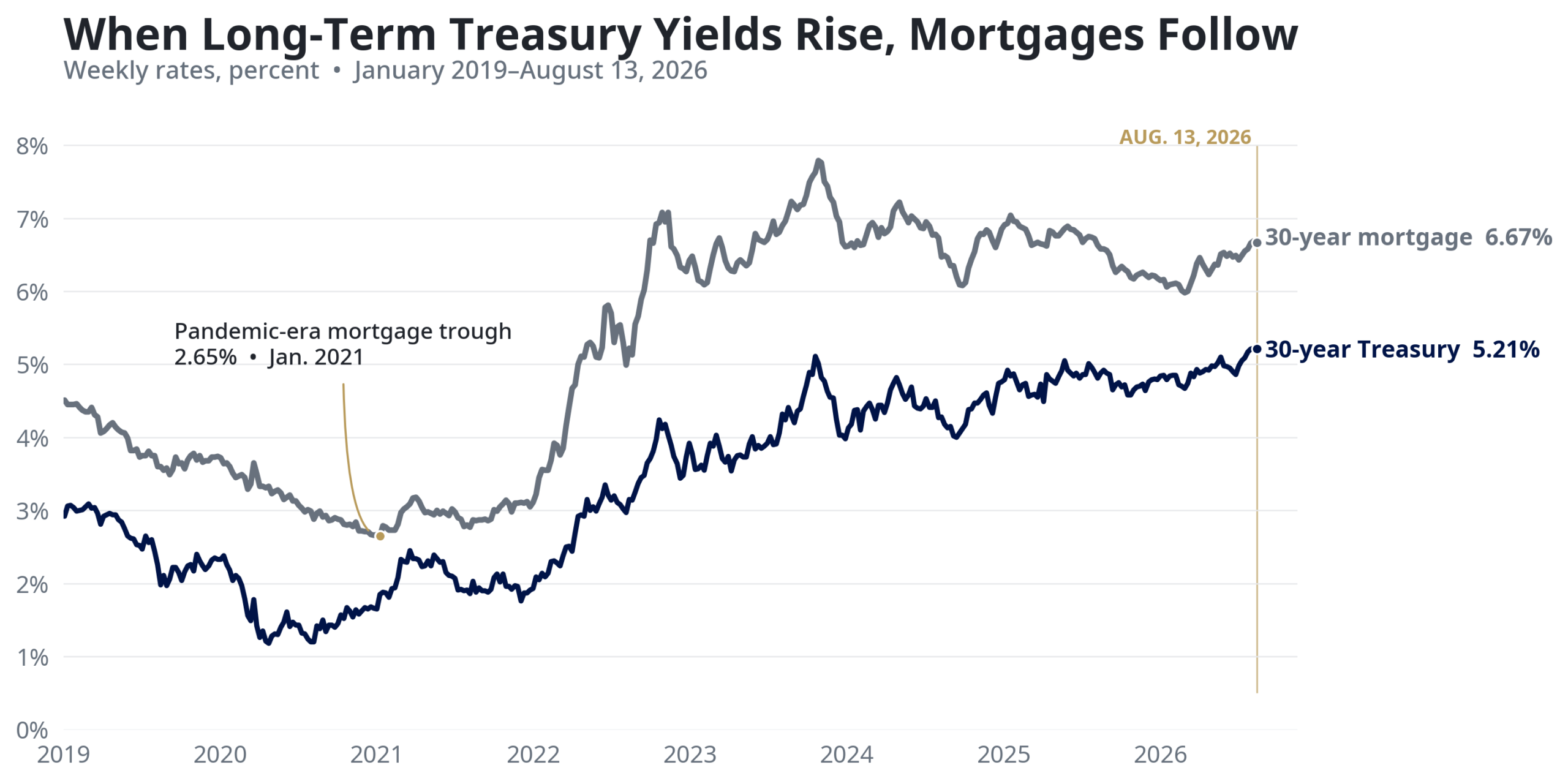
Mortgage rates do not move one-for-one with Treasury yields, but both depend on the price investors demand for long-duration capital. The sharp repricing of government debt since the low-rate era has been accompanied by a similarly large increase in the cost of financing a home. Source: Freddie Mac, Primary Mortgage Market Survey; Board of Governors of the Federal Reserve System, H.15 Selected Interest Rates.
Running the numbers on an ordinary loan helps put the effect into perspective. A $400,000, 30-year fixed mortgage at 6.67% costs about $2,573 a month in principal and interest alone. At 5.5%, the same loan costs about $2,271 a month. That’s a difference of roughly $300 per month, or more than $3,600 per year, for the same amount borrowed. For a family already stretching to cover a down payment, insurance, property taxes, and everyday expenses, that difference can determine whether a house is affordable at all.
A family shopping for a starter home this month faces this rate dilemma, whether or not they’ve ever read a Treasury auction result. So is a small manufacturer financing a new production line, or a mid-sized company rolling over a bond that comes due this year. Corporate borrowers now have to compete for capital against government debt paying more than 5% with essentially no default risk attached. Federal Reserve research on rate pass-through found that Treasury yield movements flow substantially into corporate borrowing costs and, from there, into household lending markets.
That changes what gets built. A factory expansion, a data center, an apartment complex – all of them once penciled out under cheaper financing and some no longer clear the bar. Stock investors face a version of the same pressure, since a safe 5%-plus government yield raises the return any riskier investment has to beat to look worthwhile. Strong earnings and economic growth can help offset the added cost. But cheap money isn’t doing nearly as much of the work anymore.
Interest Costs Are Closing In on the Defense Budget
Behind every Treasury auction is a federal budget that keeps generating more debt to sell. The Congressional Budget Office’s July review put the federal deficit at $1.8 trillion for the first ten months of fiscal 2026. That’s $169 billion wider than the same stretch a year earlier. That revision compounds every quarter this pace continues. CBO raised its estimate for the full fiscal year to $2.1 trillion, up from the $1.9 trillion it had projected back in February.
Net interest is a big reason why. CBO recorded $963 billion in net interest outlays over those same ten months, up 14% from a year earlier. Put that next to what the Pentagon spends: the Department of Defense reported $763 billion in outlays over the same stretch, according to the same CBO tables. The comparison isn’t a claim that debt service and defense spending serve the same purpose. It shows how much of the federal ledger interest payments now occupy.
The mechanics work with a lag, and that lag is part of what makes the danger easy to miss. The Treasury doesn’t refinance its entire debt stock every year. Old bonds carrying low coupons mature gradually and get replaced with new debt priced at whatever the market demands that week. That means a prolonged period of higher rates can continue pushing federal interest costs upward for years, even if annual deficits eventually stabilize.
CBO’s February baseline shows how that arithmetic could play out. It projected that public debt would rise from 101% of GDP in 2026 to 120% by 2036. The annual deficit is also expected to widen, from 5.8% of GDP in 2026 to 6.7% by 2036. Both are well above historical norms. Over the previous 50 years, the federal deficit averaged 3.8% of GDP, according to CBO.
Interest costs were the biggest driver of that deterioration. CBO projected net interest would climb from $1.0 trillion in 2026 to $2.1 trillion in 2036, money the government could otherwise spend or avoid borrowing. As a share of the economy, that’s a rise from 3.3% of GDP to 4.6%, the fastest-growing major category in the entire federal budget.
In a statement on the economic outlook for the next decade, CBO Director Phillip Swagel warned that budget projections “continue to indicate that the fiscal trajectory is not sustainable.” While projections are subject to change, the underlying issue won’t. The bigger the debt gets, the more every extra percentage point of yield costs.
Treasury’s Choice: Borrow Short or Lock In Decades
The Treasury still says it can handle what’s coming. Its August refunding statement described current auction sizes as leaving the department “well positioned” for projected borrowing needs, with bills and cash-management tools available to absorb surprises.
The financing pipeline behind that confidence is enormous. Treasury’s borrowing estimate put privately held net marketable borrowing at $739 billion for the July-through-September quarter, assuming a $950 billion cash cushion. That’s a lot of new debt to place in a short window. It also projected another $628 billion for the following quarter, and the first figure alone came in $68 billion above the Treasury’s estimate from May.
The pressure becomes more apparent beyond the next few months. Minutes from the Treasury Borrowing Advisory Committee’s August meeting showed the median primary dealer forecasting a $1.45 trillion funding shortfall across fiscal 2027 and 2028. That’s what happens if current auction sizes and bill issuance stay where they are. Dealers generally expect this year’s sizes to hold, but they anticipate nominal coupon auctions will likely need to grow sometime in 2027. For now, the committee recommended leaving sizes unchanged.
That leaves the Treasury with an uncomfortable tradeoff. Selling more short-term bills spreads out less duration risk today, and bills draw strong demand from money-market funds and banks. But it also means refinancing sooner, at whatever rate prevails when that bill comes due. Selling more long bonds locks in financing for decades and removes that rollover exposure, at the cost of whatever term premium investors demand to hold it.
No maturity mix makes the deficit itself disappear. Pension funds and insurers with long-dated obligations may welcome 30-year paper. Asset managers may find a 5%-plus nominal yield newly attractive after years of near-zero alternatives. Other buyers will step back if something else offers a better return for the risk involved. The yield balances all of that out. A fully subscribed auction can still leave taxpayers carrying a more expensive debt load than the previous one.
Why Rate Cuts Won’t Necessarily Lower This Yield
It’s tempting to assume the 30-year yield will fall whenever the Fed lowers short-term rates. The record argues otherwise. In July, the Federal Open Market Committee held its target range at 3.50% to 3.75% in a 9-3 vote. Three regional presidents, Beth Hammack, Neel Kashkari, and Lorie Logan, dissented in favor of a rate increase. Two weeks later, the 30-year Treasury sat at 5.21%. The Fed controls the overnight rate far more directly than it controls what investors demand to lend the government money for three decades.
Covitz and Engstrom’s research is useful here again. They observed that long-term Treasury yields had stayed elevated through an earlier stretch of substantial Fed rate cuts. They tied that divergence to deficit concerns rather than to any less confidence in the Fed’s ability to control inflation. Barclays strategists reached a similar conclusion after the August sale. Markets are becoming increasingly reliant on “price-sensitive investors,” they cautioned. The same amount of Treasury supply, in the team’s words, “may require a larger yield concession to clear” going forward.
Several paths remain open from here. If inflation continues to cool and fiscal projections improve together, long yields could ease on both fronts at once. A recession could also push yields down, as investors seek safety and expect looser policy, though that would arrive paired with weaker tax revenue and higher automatic spending. The harder scenario is one in which inflation remains sticky enough to limit Fed easing, while deficits remain large enough to keep issuance elevated. Investors would then have reason to demand both higher expected short rates and a larger premium.
There is another route, in theory. The Fed could buy enough long-dated Treasury securities to directly push yields lower. But doing so to reduce the government’s financing costs would raise serious questions about central bank independence and inflation control. Nothing in the current data suggests policymakers are moving in that direction.
The Conditions That Could Actually Ease This Pressure
None of this is fixed. The bond market isn’t sentencing the country to 5%-plus long yields forever, and a few developments could shift the balance. Further disinflation would help. The same July CPI report that put headline inflation at 3.4% also showed it cooling from June’s pace. Continued progress would give the Fed more room to lower short-term rates without reigniting price pressure.
An improvement in the fiscal outlook could work on the other side of the yield. That doesn’t require eliminating the deficit overnight, nor does it put the responsibility for today’s debt on any single administration’s shoulders. Tax policy, spending decisions, demographics and decades of interest-rate choices all fed into where the debt sits today. For an investor lending to the government for 30 years, however, the more important question is where the debt is headed from here.
Faster productivity growth could also help, although the effect is less straightforward. Stronger productivity expands the economy and the tax base available to support the debt. But faster growth can also keep real interest rates higher, so growth alone doesn’t guarantee cheaper government financing. What matters is whether the economy can grow faster than the interest burden compounds. Even during a strong decade, that isn’t assured.
The Treasury’s debt managers are also working out the mechanics of financing such a large market. The August TBAC minutes described ongoing work on market transparency, dealer capacity and issuance composition. Those changes can make it easier for investors and intermediaries to absorb a growing supply of Treasuries. But better market plumbing doesn’t reduce how much debt must be sold when large deficits continue year after year.
What Diversification Means When the Anchor Rate Moves
While warning signs have been growing, this doesn’t mean that the US is about to default. Treasury securities are the deepest, most liquid government debt market, and the government continues to issue enormous quantities of them without difficulty. What changed is the price. Investors aren’t willing to finance thirty years of U.S. obligations on the unusually favorable terms that prevailed for much of the period after the financial crisis.
For households, that makes financial planning across different interest-rate environments more important. Cash needs shouldn’t depend on selling a long-duration bond at the wrong moment, and retirees leaning on fixed income know that risk better than most. Someone who locked in a mortgage before rates climbed has something worth appreciating. And anyone reaching for yield in riskier assets should recognize that a government bond paying over 5% has changed the competition those assets face.
It also strengthens the case for spreading risk across multiple asset classes. Treasuries and TIPS still have their advantages, including deep liquidity and the government’s credit backing. But precious metals like gold belong in a different category entirely, since they aren’t tied to a government’s promise to make a future payment or to the fiscal condition supporting that promise.
That’s part of why the IMF’s June note on central-bank reserves treats gold as a diversifier. It urges reserve managers to size their holdings through the same risk frameworks they would apply to any other asset. Taking the signal from the bond market seriously doesn’t require replacing all of your government bonds with bullion. It means recognizing that a market repricing 30 years of federal borrowing is also changing some of the assumptions behind long-term financial plans built during an era of unusually cheap money.
Federal deficits have been climbing for years. Interest rates have also moved back toward levels that would have looked far more familiar before the post-financial-crisis period of exceptionally low borrowing costs. And in early August, those trends met at a 30-year Treasury auction yield of 5.216%, the highest since 2001.
The assumption that the federal government can always borrow for decades at low rates no longer looks safe. Every additional percentage point of yield increases the cost of financing new debt and refinancing old obligations as they mature. With the debt stock already so large, that pressure doesn’t remain confined to Treasury auctions. It gradually becomes another claim on the federal budget, and one that becomes harder to ignore each time more debt is issued at today’s rates.