By Preserve Gold Research
Chinese rare-earth suppliers spent the end of the summer teaching American manufacturers how quickly a supply chain can fail even when a product is available, and the buyer is ready to pay. A signed contract and a valid export license aren’t the same thing as a delivery.
In September, analysts reported that a handful of Chinese suppliers had refused to ship rare earths to U.S. customers since early August. The trigger was a Chinese sanction on a U.S. group that monitors corporate supply chains. The material existed, and American buyers could pay for it. Shipments stopped anyway, because the sellers feared trouble at home for selling to the wrong customer.
The shift now under way in Washington treats that problem as structural. Federal agencies and corporate buyers have begun securing access to key raw materials in advance, much like a firm carries insurance. They no longer assume a market will supply them on the day. The premise is that the cheapest supply chain in a calm year can become ruinously expensive when a single link closes.
U.S. companies had waited more than six months for the licenses that they needed. Shortages and high prices were still hitting the defense, semiconductor, aerospace, medical devices, and energy sectors. Reva Goujon, a strategist at the Rhodium Group, put it bluntly to the news agency. China, she said, had been “very effective in using rare earth export controls” to shrink the U.S. government’s room to maneuver.
Call the extra cost of guarding against that the resilience premium. It’s the money a government, a company or a household spends now to cut the odds that the next disruption turns into a catastrophe. It buys backup suppliers, larger inventories, domestic plants and stockpiles.
America’s Critical Minerals Problem Isn’t Just About Price
The modern economy runs on a reassuring idea. Scarce things stay for sale at some price. Most of the time it holds. Markets match millions of buyers and sellers without anyone deciding centrally how much copper a transformer plant should get. When something runs short, a higher price draws more supply, producers expand production, and substitutes start to look worth the switch.
Critical minerals are where this pattern reaches its limit, and Congress effectively wrote the limit into law. The U.S. Geological Survey works from a three-part test. A mineral counts as critical when it’s essential to the economy or national security. Its supply chain has to be open to disruption, and losing it would have to carry serious consequences for making things.
The final 2025 list names 60 minerals, close to double the 35 the government listed in 2018. Copper joined this round, alongside graphite, gallium, antimony and the rare earths. Of everything it studied, the USGS said a rare-earth disruption would do the most damage to the economy.
This doesn’t mean that the US is about to run out of 60 elements; it’s not. The problem is concentration at particular points along a long chain. Mining is only the first step. Ore has to be concentrated, separated, refined, converted into chemicals, alloyed, shaped into parts, qualified for use, and delivered on schedule. A country can sit on deposits and still have nothing usable to show for it.
Markets do close these gaps, but it tends to be slow. A futures quote can’t summon a processing plant. Metallurgical skill takes years to build. A new part has to be qualified before it can ship. A mine needs surveys, capital, and permits before it yields anything. The shock lands on its own schedule, and the fix runs on a slower one.
Markets can eventually close these gaps, but usually not quickly. A higher price may attract investment, but it can’t produce a processing plant overnight. Metallurgical expertise takes years to develop. New parts have to be tested and qualified before they can enter production. Mines need surveys, financing, and permits before they produce anything. Supply disruptions can arrive almost immediately. Rebuilding the capacity to replace what was lost often takes years.
China Controls the Step That Turns Ore Into Magnets
Rare earths show how narrow the bottleneck can be. The International Energy Agency estimated that China mined about 60% of the world’s magnet rare earths in 2024. It ran roughly 91% of the separation and refining that turns raw ore into usable material. Those magnets go into cars, wind turbines, factory motors, data centers and weapons.
The bottleneck sits in the processing rather than the ground, and processing is the harder thing to copy.
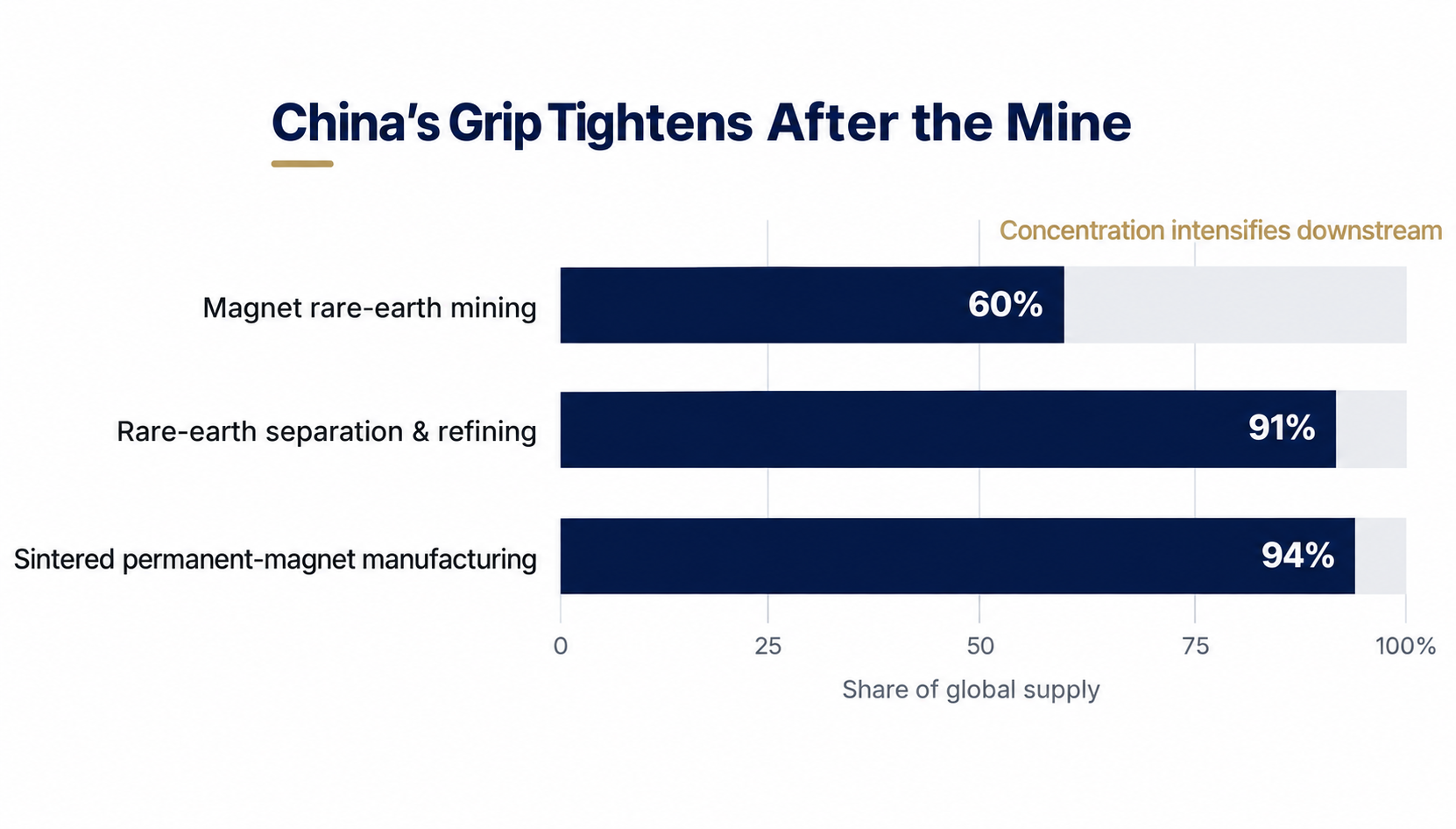
China’s dominance increases as rare earths move downstream, from 60% of magnet rare-earth mining to 91% of refining and 94% of sintered permanent-magnet production in 2024. The vulnerability lies increasingly in the capacity to turn raw material into a finished component. Source: International Energy Agency, Rare Earth Elements; 2024 global magnet rare-earth supply-chain data. The IEA reports the 60%, 91%, and 94% shares directly.
It matters more when access to supply becomes part of foreign policy. China’s commerce ministry imposed export controls on a set of medium- and heavy-rare-earth items in April 2025, citing national security and its nonproliferation commitments. Officials there have stressed that the rules are a licensing regime, not a blanket ban, and that civilian users can be approved.
The September shipments show why that still leaves buyers exposed. Once a routine sale gets tangled up with sanctions lists and compliance checks, the supplier itself may pull back, license or not. A company can hold cash, a purchase order and an urgent production schedule and still have nothing on the loading dock. When the April controls landed, some carmakers in the United States and Europe couldn’t get the magnets they needed. A few cut output or paused lines while they waited.
That isn’t the kind of shortage a higher bid necessarily solves. A normal shortage is a price problem. This one is a permission problem, and permission can be withheld by someone with no commercial reason to sell to you at all. Firms that once shopped purely on price now pay for a second source, or a few months of stock. The cheapest supplier may still be the cheapest on paper, but the price doesn’t capture the risk that the material never arrives.
The Hidden Cost of America’s Just-in-Time Supply Chains
American industry didn’t stumble into concentrated supply chains. For years it had good reasons to build them.
Inventory costs money. It fills warehouses and needs insurance. It can also become obsolete and lock up cash that could be earning a return elsewhere. Spare factory capacity costs money too, and a plant that runs at half capacity looks wasteful next to a rival running flat out. Globalization has reinforced the point. If a specialized supplier overseas could make a part more cheaply, manufacturers don’t usually see a reason to build it at home.
The model that won rewarded lean stocks and production packing, where scale pushed unit costs down. In steady years it was remarkably productive. The weakness shows up when an input worth a fraction of a percent of the finished product can prevent the product from being finished at all.
The Bank for International Settlements warned that disruptions in critical inputs, “even when their economic values are low, can create a chokepoint” across an entire supply chain. It pointed to this year’s helium shortage, citing the Strait of Hormuz closing as proof.
The problem is clearer at the factory level. A specialized material is a fraction of a percent of the cost of a $50,000 machine. Trimming 20% off that input once looked like smart purchasing. But if relying on a single supplier creates even a small chance that the machine can’t be finished, the savings start to look less impressive. The company priced the cost of the material, but not the cost of losing access to it.
The July GAO assessment shows how slowly those alternatives can develop. For many critical materials, substitutes remain limited, or the domestic facilities needed to produce them don’t yet exist. The United States will rely on mature lithium-ion battery chemistries for years, while recycling is constrained by the limited amount of scrap available to process.
The Energy Department Starts Buying Down the Risk
The clearest evidence of the shift isn’t in speeches. It’s in where the money is going. In August alone, the Energy Department announced or selected more than $760 million across three critical-mineral efforts. The programs are built differently, and the funding still has to go through the award process.
On August 18, it selected nine projects worth $162 million to extract scandium, copper, antimony, rare earths, and other materials from industrial waste streams. The goal, said Audrey Robertson, a DOE assistant secretary, was to “de-risk commercial scale production technologies.”
De-risking means the government is trying to close a gap private investors won’t cross on their own. A pilot processing plant can be strategically valuable yet still appear unappealing next to an established foreign producer with greater scale and lower costs. If investors expect prices to fall before the plant reaches full output, the rational move is to pass. But allowing domestic capacity to disappear whenever imports are cheaper creates a different risk. The savings last only as long as the imports do.
Two days later, the department selected seven projects worth $500 million to expand domestic processing, battery manufacturing, and recycling. Earlier that month, it had floated the idea of raising it to $100 million to train workers, on the estimate that mining alone will need about 6,000 more engineers this decade.
The August announcements are part of a broader effort. In February, the Export-Import Bank announced Project Vault, a strategic reserve of critical minerals for commercial industry. It’s backed by roughly $12 billion in financing, including an EXIM loan and private capital, with materials held in secure U.S. facilities. Manufacturers’ purchase commitments decide what gets stored. A loan of that size isn’t the same as spending $12 billion, and the broader policy direction predates the current administration.
Ironically, what’s being restored is slack, something the industry spent decades trying to remove. A second supplier looks inefficient until the first one fails. Measured against today’s price, redundancy can look wasteful. Measured against the cost of losing supply altogether, it starts to look more like insurance.
The Critical Minerals Americans Depend on Every Day
“Critical minerals” sounds like a defense-policy term. In practice, many of them are closer to home – in wiring, in cars, phones and hospital scanners.
The USGS says electrical uses account for about three-quarters of the copper the country consumes, with building construction the single largest market. That makes copper hard to separate from almost every physical thing the country is trying to build, from power plants to transmission lines to data centers. When a utility pays more for transformers and switchgear, some of that cost is reflected in the monthly power bill.
The same GAO work, drawing on USGS data, put U.S. reliance on net copper imports at 57% of the country’s 2025 copper use. Chile was the top source of refined imports. Copper isn’t as scarce as an obscure specialty metal. Its weaknesses are the scale of demand, the years it takes to open a new mine, and how difficult it is to replace copper in high-performance electrical work.
Graphite is a sharper case. The same report found the United States had depended on imports for all of its natural graphite since at least 2021. China supplied 46% of those imports and 80% of world mine production in 2025. Graphite is the main anode material in lithium-ion batteries, the kind that run phones, electric vehicles, drones and grid storage. The country barely refines any itself.
Rare earths add another layer. The USGS reported that the country imported 80% of the rare earths it used in 2024, including neodymium and dysprosium for magnets and gadolinium for medical imaging.
The dependence extends well beyond a handful of materials. As of December 2025, USGS data showed that the United States was fully dependent on imports for 12 critical minerals and more than 50% dependent on imports for another 34. Needless to say, it’s not a niche concern. Industries that run on these materials generated $4.09 trillion of value in 2025, over an eighth of the economy.
What Supply Insurance Adds to the Bill
Resilience isn’t free, and pretending it might be would miss the point.
A domestic plant built partly for security can cost more than imports from a long-running foreign supplier. Bigger inventories tie up cash. A second supplier usually charges more than the cheapest one. Stockpiles need financing, storage, testing and rotation. Grants come from public funds, and government loans put taxpayers at some credit risk. Those costs eventually reach households through product prices, federal spending, infrastructure bills, or weaker corporate margins.
There’s no reason to assume every domestic supply chain will be cheaper. Requiring a resilient one to beat the lowest global price in every situation would defeat much of the purpose of building it.
The real question is whether the added cost reduces enough risk to justify the expense. For a utility waiting on a transformer, or a carmaker short of magnets, the number that matters isn’t the spot price of the missing part. It’s the idle crews, the delayed output and the sales that never happen. That gap, between a small input cost and a large failure cost, is why a cheap material can justify an expensive effort to secure it.
Insurance works the same way. Most years a homeowner gets nothing back from a fire premium, and paying it still makes sense, because it covers a rare event with a very high cost. Imagine two supply setups. One costs $100 a year and rarely fails. The other costs $105, with backup stock and a second source. For nine ordinary years, the cheaper one wins. In the tenth it fails, for $200, while the resilient version loses a fraction of that. The extra $5 was the better deal all along. The hard part is judging that tenth-year probability. For decades, a political cutoff in a commercial supply chain looked remote. Pandemic shutdowns, wars, sanctions, and export controls have made it harder to defend.
There’s also risk on the other side. “Strategic” can become a label used to prop up weak companies. Subsidies pull in lobbyists, planners back the wrong technology, and stockpiles fill with the wrong material. The discipline is to aim the money at concentrated failure points where the losses would be large, the substitutes poor, and recovery slow.
What Central Banks Understand About Gold and Financial Resilience
A strategic reserve changes the order of events. Normally a shortage is settled by price, which rises until enough buyers step back. A reserve puts physical material under known control before the shortage starts, so the first move isn’t a scramble. Oil reserves and military stockpiles have worked this way for decades. What’s new is that a broader set of ordinary industrial inputs is being treated as too important to leave to whatever the market can deliver on any given day.
Central banks have wrestled with a similar question for generations: What should a country hold today so it still has options during a crisis?
Most reserve assets are financial claims. Foreign-currency deposits sit inside banking systems, and bonds are somebody’s promise to pay. Their advantage is liquidity, since major government bonds and reserve currencies trade in deep markets almost any time. Yet central banks also continue to accrue gold.
The European Central Bank laid out the reasoning in a 2025 review. Gold, the bank noted, “is not a liability of any counterparty and thus carries no default risk,” and its supply is limited and grows slowly. A bar in direct custody isn’t another institution’s obligation. That takes one kind of counterparty exposure off the table, though storage, security and access bring risks of their own.
Central banks bought about 850 tonnes of gold in 2025, the ECB reported this year. That was down from more than 1,000 tonnes a year between 2022 and 2024, but still well above the previous decade’s pace. Many hold a mix of assets because different assets solve different problems. Treasuries pay interest and offer deep markets and dollar liquidity. Gold serves a different purpose. It’s a scarce physical asset with no issuer behind it.
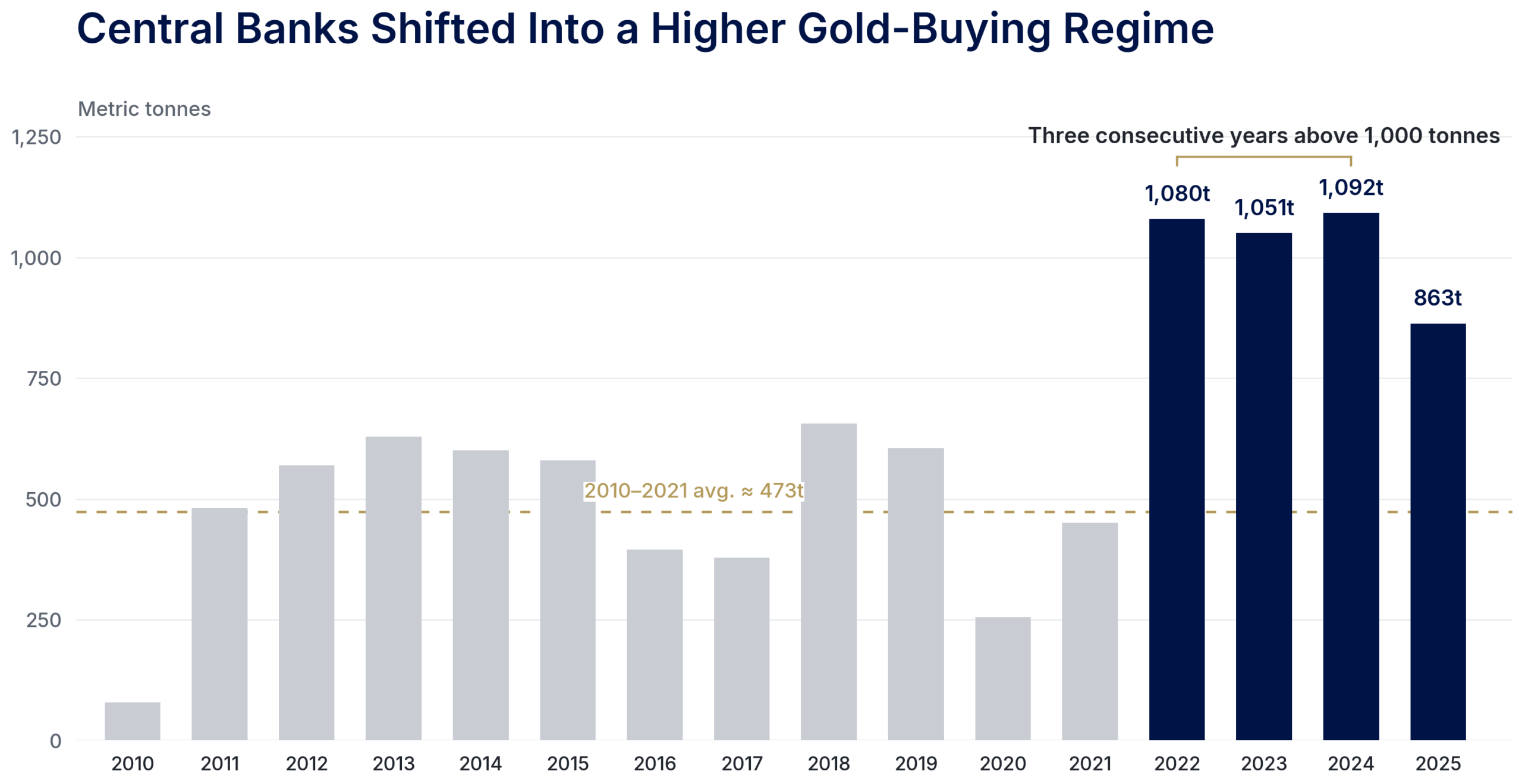
Central-bank gold buying moved into a markedly higher range after 2021. Purchases eased in 2025 after three consecutive years above 1,000 tonnes, but remained well above the pre-2022 average, suggesting that official demand for gold as a reserve asset has remained elevated. Source: European Central Bank, The International Role of the Euro, June 2026; IMF; Metals Focus, Refinitiv GFMS, and World Gold Council.
The same tradeoff appears at the household level. An emergency fund gives up some potential return in exchange for cash when something goes wrong. Diversification gives up the chance that one strong investment carries the entire portfolio. In both cases, some upside is sacrificed for the ability to absorb a bad stretch without being forced into a sale at the worst possible time.
That’s the thread tying a rare-earth cargo that never ships to a central bank’s vault. For years, economic planning assumed that a critical material or asset could be bought when it was needed. The September disruptions exposed the limits of that assumption. The material can exist, the buyer can have the money, and access can still disappear.
Washington’s response has been to secure more options before the next disruption arrives. In calm years, some of that redundancy will look expensive or unnecessary. But the risk that a supplier or government can suddenly restrict access was never zero. The country is only beginning to price that risk more realistically.