By Preserve Gold Research
The Federal Reserve raised interest rates in mid-September. Then, almost in the same breath, it described the U.S. economy as healthy. Officials said consumer spending has been resilient and business investment strong. That combination doesn’t happen often. Central banks usually raise rates to cool an economy down, not while describing one that sounds like it’s holding up well.
The move took the federal funds rate to a range of 3.75% to 4.00%, the Fed said, with officials adding only that “inflation remains elevated.” For many Americans, that’s underselling the current situation. BLS data put consumer prices up 3.4% through August, with gasoline up 27.4%.
The producer-price report was worse. Prices businesses charge each other for goods and services rose 5.4% over the same period, with diesel fuel alone jumping 24.1% in a single month.
Unlike periods when inflation was driven mainly by excess demand, today’s pressure is being intensified by an oil shock. Higher energy prices are raising the cost of living for households and the cost of doing business for companies. The Fed can’t produce more oil, but it can try to prevent those price increases from spreading more broadly through the economy. That means raising borrowing costs even as long-term interest rates are already climbing.
The United States isn’t in a stagflation economy yet. BEA data put real GDP growth at 1.5% annually in the second quarter, down from 2.1% in the first. But the risks are becoming harder to ignore. Persistent inflation is colliding with slower growth, rising energy costs and tighter financial conditions, leading some analysts to draw comparisons with the stagflationary pressures of the 1970s.
Mortgages and Grocery Bills Feel the Squeeze First
Average hourly earnings for private-sector workers rose 3.1% through August, a relatively strong nominal gain. But consumer prices rose faster, at 3.4%, and that’s the clearest sign of stagflation risk. Workers are getting raises but still losing purchasing power.
Real average hourly earnings fell 0.1% between July and August and were 0.3% lower than a year earlier. Real weekly earnings crept up only because people worked more hours, not because pay outpaced prices.
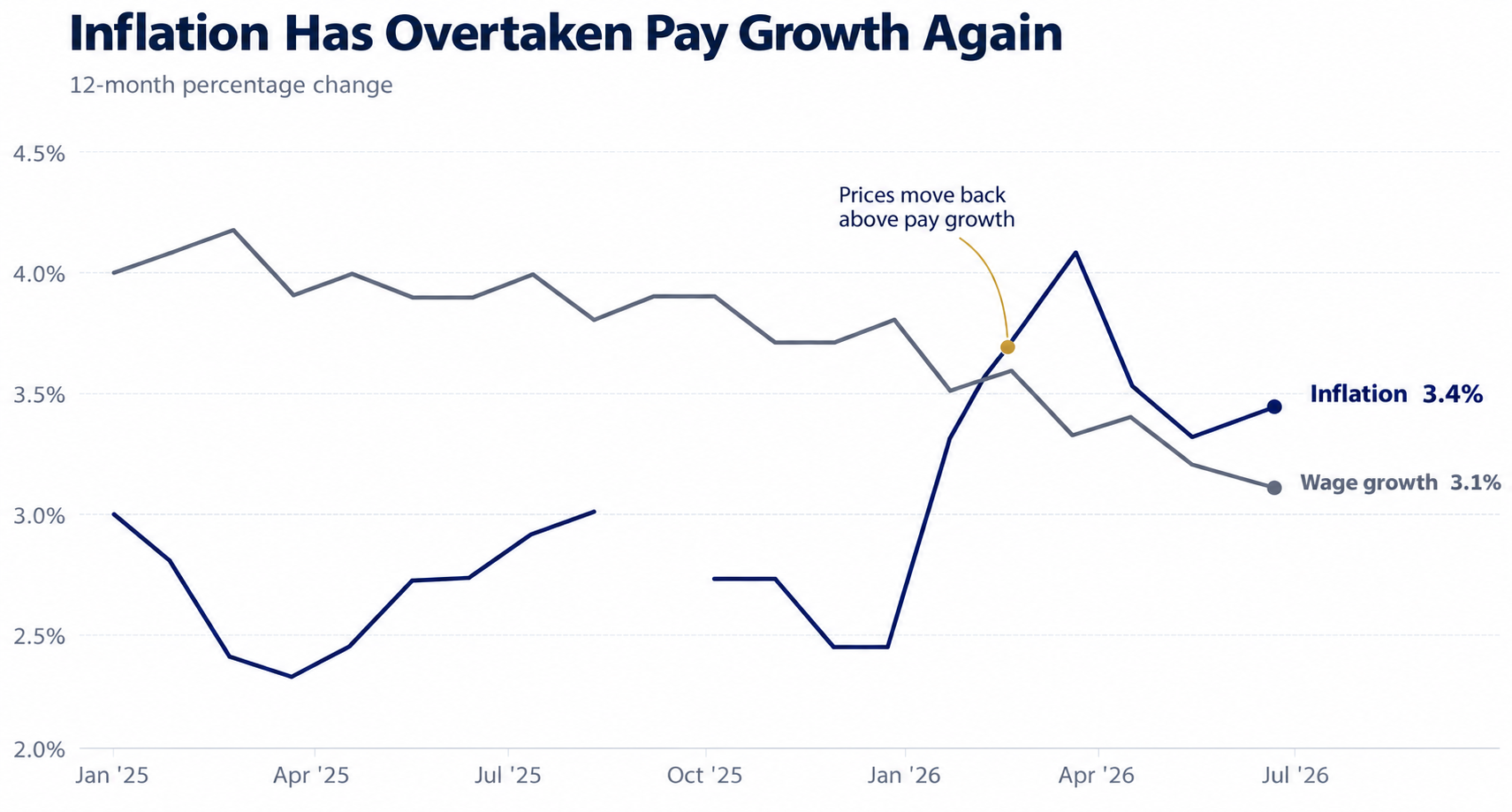
After a period in which pay gains provided some protection from inflation, consumer prices have moved back ahead of wage growth. By August, prices were rising 3.4% from a year earlier versus 3.1% growth in average hourly earnings, leaving hourly purchasing power slightly lower. Source: U.S. Bureau of Labor Statistics, Consumer Price Index and Current Employment Statistics.
Housing tells a similar story. Freddie Mac put the average 30-year fixed mortgage at 7.03% on September 24, up from 6.30% a year earlier. A homeowner who already locked in a low rate may not notice the change. But a prospective home buyer who finds that a home they were considering is no longer within reach because of the larger interest payment will.
Businesses face the same problem. A large company with long-maturity, fixed-rate debt can remain insulated for years. A small business renewing a credit line next quarter doesn’t have that luxury. When the old financing expires, the new rate takes its place. Projects, equipment purchases, and expansions that made sense a year ago may no longer clear the same financial hurdle.
Savings offer less cushion than they used to. The personal saving rate stood at just 3.0% in July, and real consumer spending was essentially flat that month even as nominal spending rose. Add higher gasoline prices, more expensive housing, and a thinner savings cushion, and the strain on household budgets becomes easy to see.
The effects of the shift are also unevenly distributed. A household that doesn’t have much debt earns more on its savings when rates rise. A household that has a variable-rate loan gets squeezed from the other direction. Tightening doesn’t reach everyone at once. It moves through the economy in stages, and for some households the most painful effects show up well after the first rate increase.
Rising Energy Prices Are Spreading Through the U.S. Economy
Energy shocks are first felt at the gas pump but their more consequential effects show up later, once higher fuel costs trickle through the economy.
Diesel is one of the clearest cases. Trucks move food and building materials. Farms depend on diesel equipment, and construction crews use diesel-powered machinery. When the PPI report shows diesel prices jumping 24.1% in a single month, that increase doesn’t stay with the trucking company. Over time, it shows up in grocery prices and construction bids. It shows up in factory costs as businesses decide how much of the increase they can absorb and how much they need to pass on.
The Energy Information Administration’s latest outlook estimated crude-production shut-ins of 6.7 million barrels a day in August, while its market review projected that supply constraints could persist into 2027. Much of the disruption stems from the continuing conflict in the Middle East, which forecasters have repeatedly identified as a major source of this year’s energy pressure.
The World Bank also warned that escalating hostilities and further disruption to commodity markets remain major downside risks to global growth.
How much of this turns into lasting inflation depends largely on how long it lasts. A brief energy spike can push headline inflation higher and then fade from the annual comparison. A prolonged shock is more difficult. Higher fuel costs begin working their way into contracts, wage negotiations, and the prices businesses quote customers. Once that happens, sticky inflation can set in.
In a September speech, Fed Governor Christopher Waller said that he didn’t “see elevated energy prices and tariffs now as a significant source of ongoing inflation pressure.” But he also acknowledged energy costs had climbed sharply through the year and flagged a renewed pass-through into expectations as a real upside risk.
The New York Fed’s August survey suggests consumers are already paying attention. Median one-year inflation expectations stood at 3.6%, while expected gasoline price increases rose to 4.6%. Longer-term expectations haven’t risen sharply, but households are clearly noticing renewed pressure from energy.
Why the Fed Can’t Solve an Oil Shock With Higher Interest Rates
Central banks can raise the price of money. But they can’t repair a damaged pipeline or reopen a blocked shipping lane.
That’s what makes supply-driven inflation so difficult to fight. Higher interest rates don’t put more oil on the market. Instead, they work through second-round effects: cooling demand, tightening credit, and trying to keep businesses and households from assuming today’s prices are the new normal. The cost of that strategy is slower growth, paid by an economy that didn’t cause the original shock.
The Fed’s September projections put the median federal funds rate at 4.1% through the end of both 2026 and 2027, higher than officials expected in June. That suggests policymakers now expect restrictive monetary policy to last longer. The reason isn’t an overheating labor market. It’s that officials aren’t confident the inflation problem is temporary.
The effects extend well beyond the Fed’s policy rate. The two-year Treasury yield, which is closely tied to expectations for monetary policy, closed at 4.81% on September 25. Longer-term yields have risen as well, pushing up borrowing costs for businesses and households even without another Fed move.
Stock prices feel it too, through a different channel. As risk-free yields rise, investors can earn more from government debt without taking on corporate earnings risk. That raises the return other assets need to offer. High-growth companies can be especially sensitive because more of their value depends on profits expected many years into the future, which become less valuable when discount rates rise.
“Up until now, it’s just been a commodities and rates story,” said Chris Jeffery, head of macro strategy at Legal & General Investment Management. “It’s not been an equity and credit story.”
Commodity and bond markets can react to an energy shock almost immediately. The damage to equities and credit tends to arrive later, after higher financing costs and slowing demand begin to weigh on corporate profits. The transmission is slower, but it reaches much more of the economy once it takes hold.
The Fed has been left without any comfortable choices. Tighten too little and higher inflation risks becoming embedded in wages, prices, and expectations. Tighten too much and an energy-driven loss of purchasing power can turn into a broader economic slowdown. That’s what makes stagflation so difficult for central banks. Fighting one side of the problem can worsen the other.
Federal Deficits Are Making Higher Interest Rates Harder to Escape
The Congressional Budget Office’s baseline projected a federal deficit of $1.9 trillion, or 5.8% of GDP, for fiscal 2026. That figure didn’t account for any additional borrowing an energy shock or weaker economy might require. Debt held by the public was projected to reach 101% of GDP this year and climb toward 120% by 2036. Much of that increase comes from a rising interest bill rather than new spending programs.
CBO also described how heavy federal borrowing can affect the rest of the economy. When the government competes for money in capital markets, it can push interest rates higher and crowd out private investment. A manufacturer financing a new plant and the Treasury financing the federal deficit ultimately depend on the same pool of savings. The difference is that the Treasury can keep borrowing even when the price of that capital rises.
Deficits aren’t the only reason Treasury yields have climbed. Inflation expectations, Fed policy, geopolitical risk, and changing investor risk premiums all matter. But large and persistent deficits make the rate environment less forgiving. The government still has to sell huge amounts of debt while investors are demanding more compensation for inflation and the risk of locking up money for longer periods.
That makes every Treasury auction another test of how much yield investors require to keep absorbing the supply.
If oil retreats quickly, inflation expectations stay anchored and Treasury yields ease back, and much of today’s tightening could unwind before doing serious damage. But if energy stays expensive while the government keeps borrowing heavily and the Fed stays restrictive, households and companies face tighter financial conditions. The pressure comes from more than one direction.
Could the 1970s Stagflation Crisis Happen Again?
Although the scope is proportionally smaller, the comparison to the 1970s gets stagflation’s mechanism right. A World Bank analysis of the 2022 commodity shock pointed to three ingredients shared with the 1970s. Supply disruption fed inflation, a preceding stretch of loose monetary policy set the stage, and growth weakened once policymakers tightened in response. Those same ingredients are visible again now.
Ayhan Kose, then director of the World Bank’s Prospects Group, identified the one advantage today’s central banks have over those of the 70s. Credible policy frameworks, he argued, can “anchor inflation expectations and reduce the amount of policy tightening required.” If workers and businesses trust the Fed will eventually get inflation back near 2%, they have less reason to bake permanently higher prices into wages and contracts. That’s what made the feedback loop during the 1970s so hard to unwind.
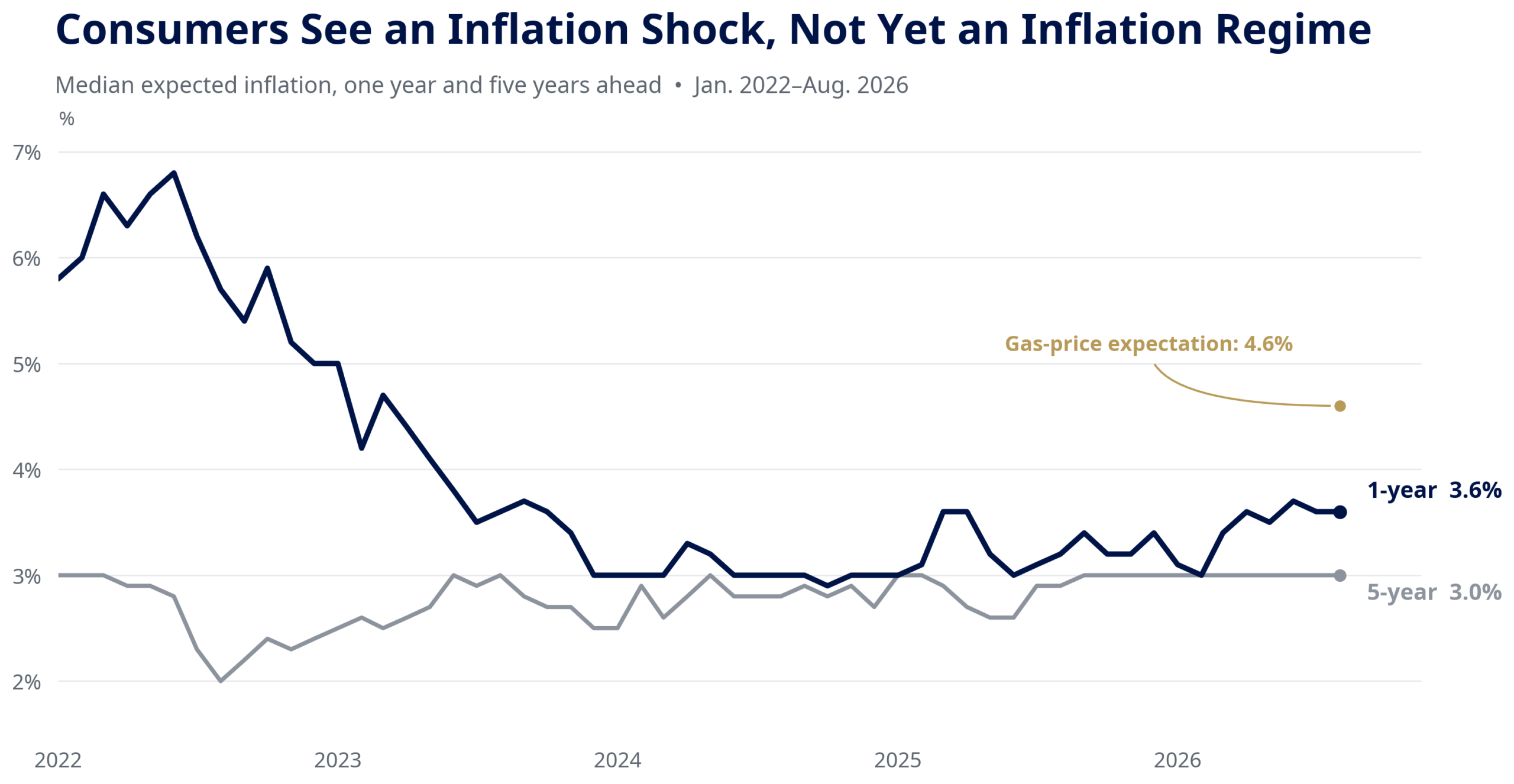
Consumers are clearly noticing the renewed inflation pressure, but they have not yet extrapolated it far into the future. One-year inflation expectations stood at 3.6% in August while five-year expectations remained at 3.0% – an important distinction for a Fed trying to keep an energy shock from becoming entrenched. Source: Federal Reserve Bank of New York, Survey of Consumer Expectations.
The Fed’s own forecasts depend heavily on those expectations remaining anchored. Despite projecting 3.7% inflation for 2026, officials still expect inflation easing back toward target over the following two years. Those are forecasts, not guarantees. But they describe an institution trying to avoid both permanent inflation and an unnecessary recession, a harder needle to thread than either extreme alone.
The other difference is underlying strength. The Fed pointed to robust capital investment and strong productivity growth in its September statement. The World Bank’s current outlook also flags broader AI adoption as a genuine upside to productivity. Even so, the outlook cut its global growth forecast to 2.5% for 2026, citing the Middle East conflict and energy prices.
The United States isn’t facing this shock alone, either. The European Central Bank’s own September projections expect euro-area inflation to peak late this year for the same reason. Officials penciled in 3.0% inflation for 2026 against growth of just 0.9%. An energy shock hitting several advanced economies at once can weaken foreign demand and push more than one central bank to stay restrictive simultaneously. That tightens financial conditions abroad even where a country’s own domestic demand still looks healthy.
Higher productivity could provide some cushion. An economy that produces more output per hour can absorb stronger wage growth with less inflationary pressure than one that has stagnant productivity. But that doesn’t make the near-term energy shock go away.
How Stagflation Changes the Stock-and-Bond Relationship
A portfolio problem is hiding inside all of this, and it gets less attention than the headline inflation numbers. In an ordinary downturn, weakening growth pushes interest rates down. Bond prices rise, in turn, and that gain offsets at least part of an equity decline. It’s why many investors prefer to pair government bonds with stocks.
Stagflation can weaken that protection. If inflation remains elevated while growth slows, central banks have less room to cut rates. Bond prices can remain under pressure while weaker earnings weigh on stocks.
Research from the London Bullion Market Association asserts this is why the traditional 60/40 stock-bond mix works less well in some environments than others. When inflation keeps a central bank from easing, sovereign bonds may not diversify away equity stress the way investors assume. That doesn’t mean bonds have lost their role. It means the source of the downturn changes what protection actually looks like.
This is where precious metals like gold become more relevant. World Gold Council research points to its liquidity and its tendency to behave differently from stocks and bonds during periods of stress. When inflation and geopolitical risk weaken the usual relationship between stocks and government bonds, gold can provide diversification that doesn’t depend on falling interest rates.
Four Signals Will Decide What Comes Next
Four things will decide whether this becomes genuine stagflation or fades into a rough quarter.
The first is how far inflation spreads. Energy-driven price spikes can reverse quickly once supply catches up. It’s a different story if core services, wages and business selling prices start climbing too. That would suggest the shock has become embedded rather than just passing through.
The second is the labor market. Payrolls grew by 162,000 in August and unemployment held at 4.1%, numbers that don’t yet fit a stagnation story. A sustained slowdown in hiring alongside inflation that stays above target would change that diagnosis fast.
The third is whether inflation expectations stay anchored. The New York Fed’s survey still shows long-run expectations well below anything resembling the 1970s. If that starts to shift, the Fed gains a reason to keep tightening even as growth cools, which is precisely the awkward position a supply shock creates.
The fourth is the bond market itself. If long yields stay above 5% even as growth slows, that’s a signal worth taking seriously. It would mean inflation or fiscal concerns, not just the Fed’s overnight rate, are keeping the cost of capital high. Government bonds would then be providing less of a cushion for a portfolio precisely when equities need one most.
The 1970s don’t have to repeat for the consequences to bite. A milder version still erodes real income and narrows the room policymakers have to respond. The country hasn’t had to navigate that combination in decades.