By Preserve Gold Research
Foreign investors put $232.2 billion into new U.S. investments in 2025. But nearly all of it went toward buying businesses that were already here. According to Bureau of Economic Analysis data, $218.4 billion, or about 94%, was spent acquiring existing U.S. companies.
That number sits awkwardly beside the White House scoreboard, which is far larger. A National Manufacturing Day proclamation issued in late September said the administration had secured “more than $11.2 trillion in United States and foreign investments.” It described the result as “the greatest reshoring of American manufacturing in our Nation’s history.”
The president cited an even larger number, indicating that more than $20 trillion had been invested in the U.S. “from outside countries and companies.” That’s nearly twice the administration’s own tally.
If $11.2 trillion were invested into new factories, power plants, ports and chip plants, the American public couldn’t miss it. Construction spending would surge, and payrolls would climb. Equipment orders would stack up. So far, most of those signals remain far more subdued than the headline numbers suggest.
Part of the problem is what the headline total actually includes. It combines company acquisitions, aircraft purchases, financing arrangements, trade commitments, and multiyear investment pledges. But only a portion of that money will translate into new productive capacity. The administration hasn’t published a breakdown showing how much, or when those projects are expected to materialize.
For communities that are planning around these announcements, this matters. A town expecting a new plant is counting on construction jobs, equipment purchases, and eventually permanent workers. Buying a company that’s already operating there may bring new ownership and fresh capital, but it doesn’t create the same economic footprint.
Trade Deals and Takeovers Inflate the Headline
A dollar spent building a chip plant in Arizona and a dollar spent buying an existing American company can both be labeled investment. But their effects on the economy are significantly different. One pays for construction, equipment, and new capacity. The other mainly changes ownership of assets that already exist.
The White House’s investment page assigns $500 billion to India and describes the entry as mutual trade expansion. A February 2025 joint statement behind it set a goal called “Mission 500,” aiming “to more than double total bilateral trade to $500 billion by 2030.” Trade counts exports, imports, and services moving in both directions. None of that is capital sunk into American plants.
Qatar’s $1.2 trillion works differently. The White House called the May 2025 agreement an “economic exchange worth at least $1.2 trillion.” Its largest single item was a $96 billion Qatar Airways order for Boeing jets with GE Aerospace engines. A foreign airline buying American-made planes props up existing factories and counts as an export sale. Qatari capital isn’t building $96 billion of new plant capacity.
The UAE’s $1.4 trillion carries its own qualifier. The White House described a “10-year, $1.4 trillion investment framework” that the country had previously committed to. The new deals were presented as a way to accelerate it.
Behind the Gap Between Pledges and Capital
The channel matters as much as the headline amount. A $100 billion aircraft order supports exports and aerospace production. An acquisition of the same size changes ownership of an existing asset. A $100 billion chip-plant program directly adds construction and industrial capacity. A trade target may not involve new capital investment at all.
Measured against what actually arrived, the gap is wide. Bureau of Economic Analysis figures show the UAE increased its U.S. investments by $3.5 billion in 2025, set against that $1.4 trillion pledge. The other two big Gulf figures show a similar gap.
Part of the gap is timing, since the pledges run for years and the annual figures cover one. Spread over the 10 years, a $1.4 trillion commitment works out to roughly $140 billion a year by simple division. The UAE’s 2025 increase was a small fraction of that pace.
Foreign investment did pick up in early 2026. Even at that stronger pace, however, “it would take until 2041 to achieve $6 trillion,” noted Derek Scissors, an economist at the American Enterprise Institute.
That doesn’t make the agreements meaningless. Export orders keep factories busy, foreign financing can cheapen infrastructure, and long-term energy purchases can justify new capacity. Stacked together and labeled an investment boom, though, they produce a number far larger than the fresh capital now flowing into American plants.
Greenfield Spending Remains a Small Share
The Bureau of Economic Analysis runs an annual survey of foreign direct investment that sorts what political announcements tend to blend. The term covers money foreign companies spend to buy or build American businesses. Acquisitions, brand-new businesses and expansions each get their own line.
The 2025 total rose 49.5% from a revised 2024 level, BEA said. But the mix inside that increase matters more than the headline.
Manufacturing drew $121.8 billion, or 52.5% of the total. That sounds like reshoring in full swing. Yet the industry totals include takeovers. A foreign buyer that snaps up an existing chemical maker or steel producer registers as a manufacturing investment without a single new plant. Meanwhile, the cash from an acquisition lands with the sellers. They may reinvest it in a new American factory, a stock portfolio, or another country entirely.
Federal Reserve economist Cody Kallen showed how far one deal can distort the picture. Kallen found that the 2025 rise in foreign metals investment was explained entirely by Nippon Steel’s $14.2 billion purchase of U.S. Steel. Without that deal, investment in the sector would have fallen about 60%.
A new owner can still modernize facilities, hire workers, and invest additional capital. But the acquisition itself doesn’t create a new factory. The plant, workforce, and physical footprint already exist.
The more revealing measure is greenfield investment, meaning new businesses built from scratch or expansions of existing foreign-owned operations. That spending totaled $13.8 billion in 2025, a little under 6% of first-year investment, according to BEA. Transportation and warehousing accounted for the largest share.
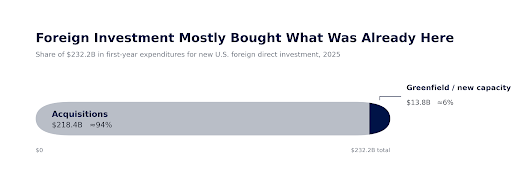
Nearly all of the foreign direct investment recorded in 2025 went toward acquiring businesses that already existed. Spending on new businesses and expansions accounted for only about 6% of the total. Source: U.S. Bureau of Economic Analysis, New Foreign Direct Investment in the United States, 2025.
Some of the sectors most often tied to the reshoring pitch look thin by comparison. Computers and electronic products drew just $2.0 billion, BEA said, and chemicals $1.8 billion. A single leading-edge chip plant can cost many times that. The year’s greenfield money has spread across many modest projects and very few large ones.
Other analysts read the year the same way. UBS economist Arend Kapteyn, who worked through the same figures, put the year’s total roughly $30 billion below its 10-year average. Pledges ran well ahead of the money.
Kallen’s broader analysis points in the same direction. The number of new foreign investments, counting both new builds and acquisitions, declined modestly in 2025, and announced greenfield projects slipped from 2024.
Foreign capital tied to the artificial-intelligence boom followed a similar pattern. Kallen calculated that announced foreign acquisitions of U.S. high-technology companies reached $213 billion in 2025. Whether those transactions are completed, he wrote, will be “an important determinant of total FDI into the U.S. in 2026.”
A completed deal lifts the investment total but says little about how much new productive capacity will follow.
Jobs tell the same story. BEA said acquired companies already employed 211,700 people. Total planned employment, which counts those workers, came to 232,400. That leaves about 20,700 jobs for every new plant and expansion combined.
Factory Construction Is Shrinking as Equipment Output Grows
If an onshoring wave were already being deployed at scale, factory construction is where it would show first. The latest numbers point the other way.
Census Bureau data put manufacturing construction at an annual pace of $170.7 billion in August, down 19.2% from a year earlier.
The slide isn’t a one-month blip. Spending through the first eight months of 2026 ran 21.8% below the same stretch of 2025. The figures aren’t adjusted for price changes, so the drop in actual building is probably a little steeper.
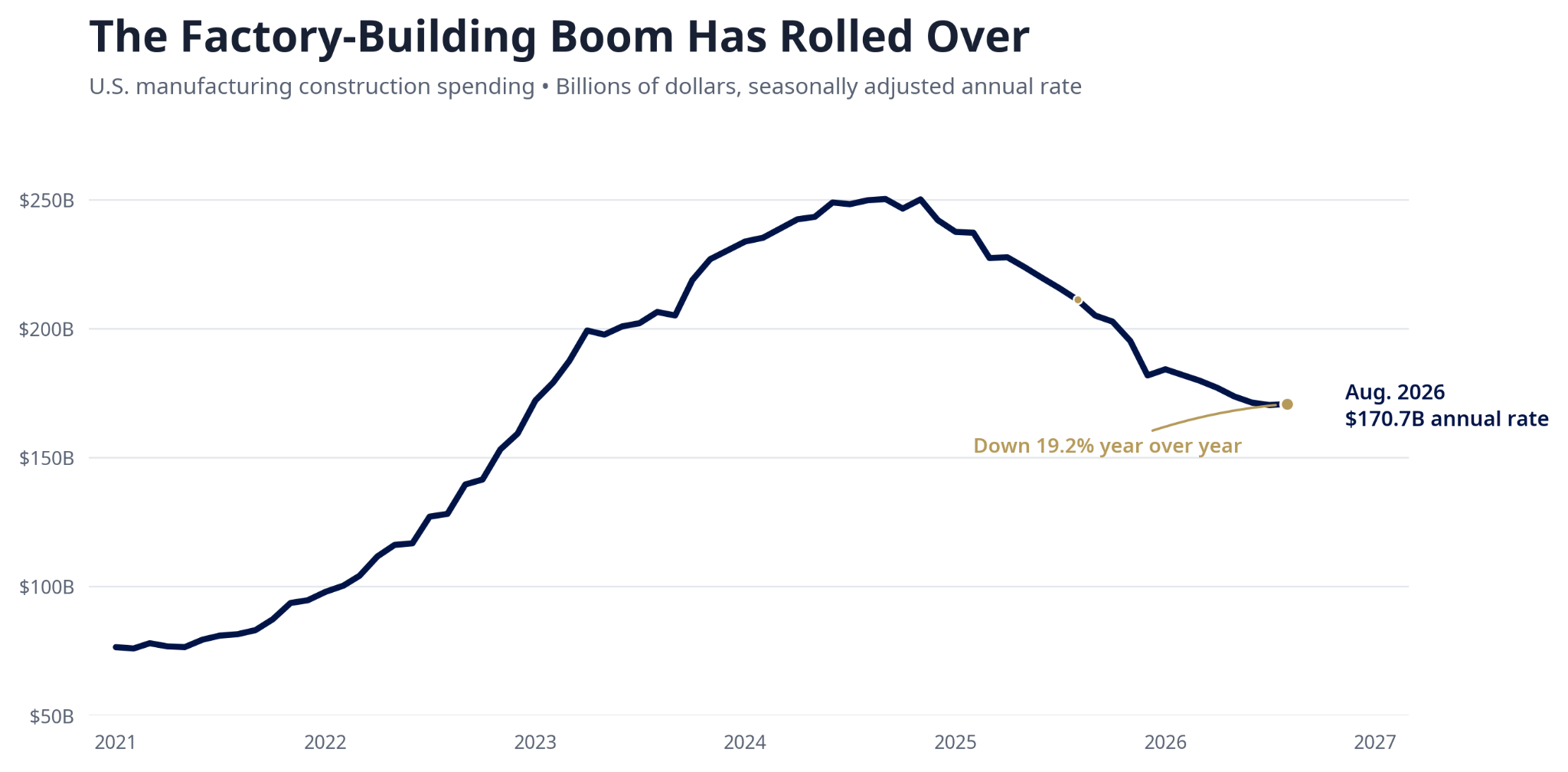
Manufacturing construction surged during the earlier chip, battery and EV investment cycle, but the trend has reversed. By August 2026, spending was running 19.2% below its year-earlier pace—even as trillion-dollar investment commitments continued to accumulate. Source: U.S. Census Bureau via FRED, Total Construction Spending: Manufacturing in the United States.
A contractor bidding on the next factory shell sees that before any statistician does. So does a machine shop waiting on orders from a plant that hasn’t broken ground. Construction usually comes first, machinery installation next and hiring last, so weakness at the first stage tends to reach the others with a lag. America is still working through the factory-building cycle that followed earlier chip, battery and electric-vehicle announcements, so the direction of travel says more than the level.
Parts of the economy look stronger. Business equipment output rose 7.1% from a year earlier in August, according to Federal Reserve data, and the Census figures show power-related construction up 8.5%. However, machinery and new computing capacity can lift what the country can produce without a single new factory building going up.
Much of the building that is happening is concentrated in digital infrastructure. BEA’s estimate of second-quarter growth revised investment higher, with nonresidential structures, “led by commercial and health care, mainly data centers,” among the leading contributors. That’s real capital investment, but it points more toward server halls than assembly lines.
Manufacturers also have room to produce more with the capacity they already have. Factory utilization stood at 75.7% in August, below its long-run average, while output was just 0.9% higher than a year earlier. Companies usually have a stronger reason to expand when existing plants are running close to their limits. Many aren’t there.
Hiring shows the same restraint on a smaller scale. Bureau of Labor Statistics data described manufacturing employment as “little changed” in September, up 9,000 on the month and 72,000 since a low in December 2025. Modern plants employ fewer people for each dollar invested, so payrolls alone can understate a real buildout.
The longer view is less encouraging. BLS data for 2025 showed output falling in 66 of 85 manufacturing and mining industries, even as labor productivity rose in 39 of 80 manufacturing industries. That points to a lot of restructuring and efficiency gains, and not much of a broad production surge.
Who Pays When a Promised Plant Arrives Late
When a promised investment doesn’t materialize, the people who announced it usually don’t bear the cost. A county may widen roads or grant tax breaks for a plant, then wait years for a second production line. A supplier that hired workers or bought equipment in anticipation of new orders has to carry those costs in the meantime.
Planning errors spread further than that. A utility that sizes new power capacity around announced factories may find the load arrives smaller or later than promised. A city that builds its budget around promised jobs can face the same problem. In both cases, officials are trying to distinguish firm commitments from longer-term ambitions, a distinction the headline investment totals rarely make clear.
Federal Reserve economist Kallen described policy pulling in two directions. Tariffs can push foreign producers to build behind the tariff wall. They also raise what factories pay for imported parts and materials. For manufacturers that depend on those inputs, a policy intended to bring production home can also make domestic production more expensive.
Uncertainty adds a second drag, because “firms may delay investments amid ambiguity over the duration and severity of tariffs,” Kallen wrote.
How policymakers interpret the investment totals matters because it can shape what comes after. Those who take it as proof that tariffs and incentives are working could judge the policy mix by the headline and skip the factory data. Those who dismiss it as hype may discount real projects.
Investors face a version of the same problem. A pledge is a claim on someone else’s future behavior, and long projects carry risks from interest rates, commodity prices, permits, power supply, and politics. A $20 billion intention spread over a decade has a very different certainty than $2 billion already spent on equipment and payroll.
The distance between a promise and a plant can stay wide for a long time. Assets that don’t depend on anyone’s delivery schedule, gold among them, play a different role in a portfolio than a stake in the announced boom.
Slow Projects Are Normal, but Pledges Still Need Dates
There is a legitimate timing defense. Greenfield projects started by foreign companies in 2025 have planned spending of $66.1 billion, with roughly four-fifths still to come. BEA counts only first-year spending, so a plant that takes three years to build may appear as only a small fraction of its eventual cost in the year it is announced.
That’s normal for large industrial projects. An announcement comes near the beginning of a long process that includes site selection, engineering and financing, followed by permitting, utility agreements, construction, equipment installation and months of testing. For major factories and energy projects, that process can stretch across several years. The timeline varies too much by industry to fit any single standard.
There’s also a real economic case behind the investment push. The US has deep capital markets and a large consumer base, and tariffs change the math of building near American customers. Many of the sectors highlighted on the White House’s investment page, including technology, aerospace, energy and manufacturing, are areas where additional domestic capacity could matter.
But time cuts both ways. The longer the horizon, the harder it is to treat the full value of a commitment as money already invested. Interest rates and commodity prices change. Permits stall and demand shifts. Projects can shrink without being formally canceled.
Analysts normally separate announcements, financing, final approval, construction, money spent, and commercial production into distinct stages. The White House totals generally don’t, so a pledge at the first stage sits beside a plant already running. A memorandum with a foreign government, for instance, can sit for years before any company signs a contract to build anything.
The global picture carries the same warning. UN Trade and Development said worldwide foreign investment rose 6% to $1.6 trillion in 2025. It described the recovery as narrow, fragile and uneven, with a small number of megaprojects in artificial-intelligence infrastructure accounting for much of the gain.
The Boom Will Have to Show Up in Concrete and Payrolls
Over the next few years, several measures should show whether the announced boom is actually materializing into industrial expansion.
BEA’s greenfield spending needs to rise sharply, both in dollars and as a slice of all new foreign investment. The planned spending tied to 2025 projects is an early benchmark. Future BEA releases should show those plans turning into actual outlays, not delays and cuts.
Factory construction should stabilize and then climb. Capacity use should move toward its long-run average while output rises alongside it. Hiring should broaden beyond a handful of subsectors to include engineering, the construction trades, machinery, and supplier payrolls. A gain of 72,000 jobs since December is welcome, but it looks modest next to the scale of the claims.
A real manufacturing revival should also reach beyond the projects that make headlines. A new chip plant needs chemical suppliers, equipment servicing, reliable power and water supply. Those second-round investments often matter as much as the announcement that set them off, and the available data don’t yet show them arriving at anything close to a historic scale.
Skepticism about the headline totals doesn’t require skepticism about the broader strategy. The country agreements could still generate far more investment than current statistics show, and many projects announced in 2025 and 2026 can’t reasonably be expected to be operating yet.
But the burden of proof grows with time. By 2027 and 2028, trillions of dollars in credible industrial commitments should begin to look more like excavation sites and expanding payrolls and less like promises and press releases.
So far, only a pipeline exists. Real projects are a part of it. But so do acquisitions, export orders, and trade ambitions that make the headline total much larger than the new capital entering U.S. productive capacity.
Two sets of books now exist. Pledges announced at podiums fill one, and concrete poured and workers hired fill the other. Nothing published connects them, which leaves a total of $11.2 trillion with no visible support beneath it.