
By Preserve Gold Research
Washington’s annual interest bill has surpassed $1 trillion, and the full cost of today’s higher borrowing rates has yet to reach the federal budget. In fiscal 2026, the government spent more on interest than on national defense, with a growing share of federal revenue going toward debt from previous years.
Much of that debt still carries interest rates from when borrowing was considerably cheaper. At the end of September, the average rate on outstanding federal debt was about 3.5%, according to Treasury figures. By October 16, the yield on a 10-year Treasury note was just over 5%. As older securities mature, Washington must replace them at the rates investors are willing to accept. If those rates remain elevated, the interest bill will keep growing.
The pressure is compounded by a federal deficit of roughly $2 trillion. The government must borrow to cover spending that exceeds its revenue, adding to the debt on which it already pays interest. Higher borrowing costs then make future deficits more expensive to finance, leaving less room in the budget for other priorities.
Interest Takes More of Every Tax Dollar
The federal government spent approximately $1.052 trillion on net interest in fiscal 2026, which ended September 30, according to the Treasury’s Monthly Treasury Statement. That comes to roughly $2.9 billion a day.
Interest exceeded the approximately $965 billion spent on national defense and nearly matched Medicare’s $1.073 trillion in net outlays. Only Social Security and Medicare accounted for more spending among the government’s major budget categories. The comparison puts the federal debt burden into perspective. Servicing past borrowing now costs more than national defense and nearly as much as one of the country’s largest healthcare programs.
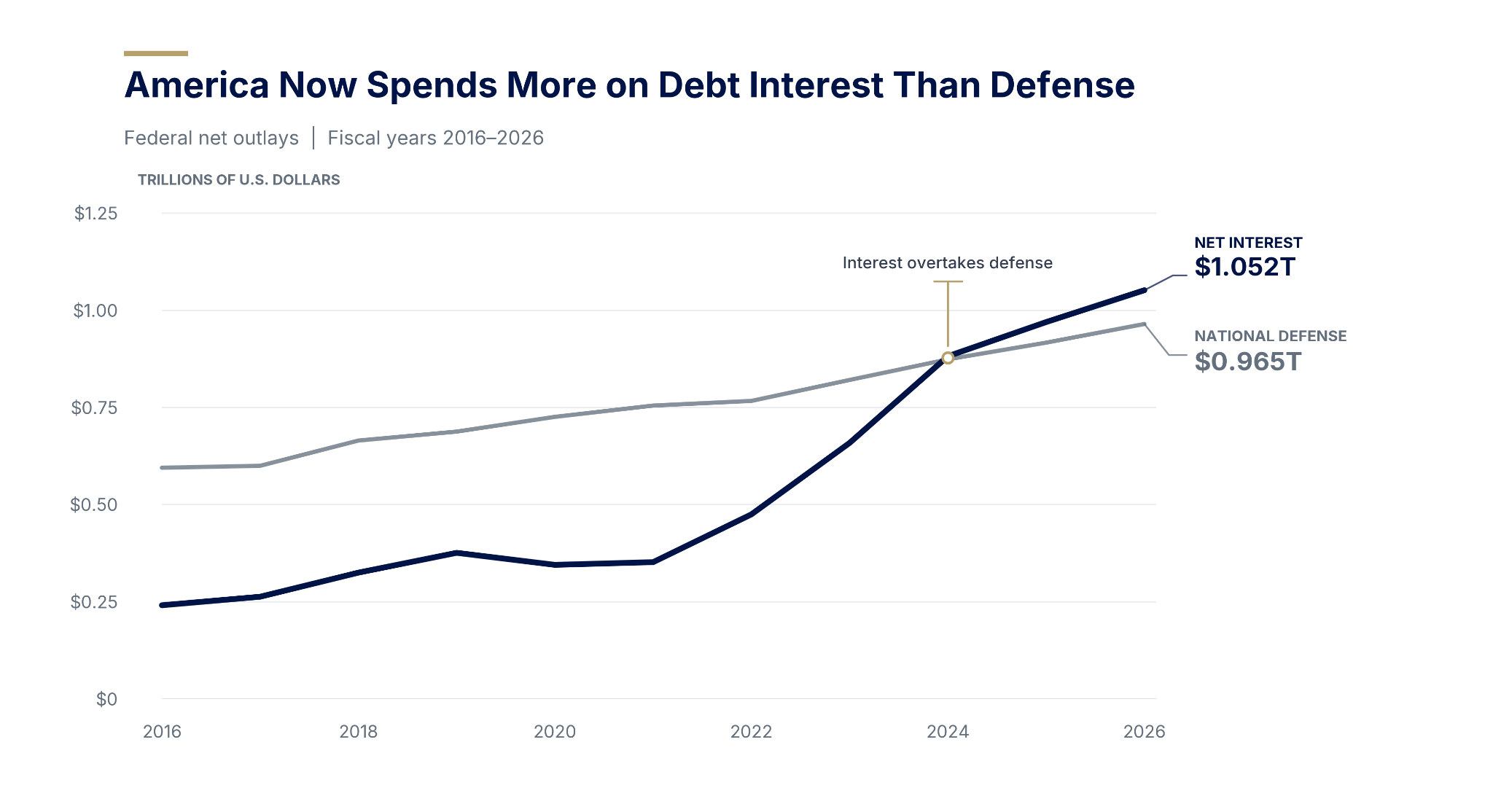
Federal interest payments have risen far faster than defense spending over the past decade. Interest first overtook defense in fiscal 2024, and by fiscal 2026 the government was spending roughly $87 billion more servicing its debt than on national defense. Source: U.S. Department of the Treasury, Monthly Treasury Statement, Table 9, fiscal years 2016–2026.
Interest payments won’t buy another hospital visit. They won’t repair a bridge or strengthen national defense either. They go to Treasury holders, including mutual funds, banks, the Federal Reserve, and foreign investors. Some Americans receive part of that income through their savings and retirement accounts. But the Treasury still has to find the money to pay it.
That obligation is growing faster than federal revenues. Net interest increased approximately 8% from fiscal 2025, while federal receipts grew about 3%. A larger debt burden and the cost of refinancing existing obligations continue to put pressure on the budget.
Net interest absorbed about 19.5 cents of every dollar the government collected. Without that expense, the deficit would have been roughly $941 billion. Lawmakers can debate next year’s spending, but they can’t vote away interest owed on debt already issued. The commitments made in earlier years keep showing up in the current budget.
Older Debt Is Coming Due at Higher Rates
The government’s debt doesn’t all come due at once. A note sold when rates were low keeps its original rate until maturity. When repayment comes due, the Treasury typically borrows again. The replacement debt carries whatever rate the market then demands.
That helps explain why today’s interest bill doesn’t reflect today’s borrowing costs. The increase works through the budget over time, as securities mature. Falling rates could ease that process. But if rates stay elevated, more of the debt will gradually carry higher payments.
Treasury’s debt data showed $40 trillion in total public debt outstanding on September 30. About $32.4 trillion was held by the public, meaning investors outside the government’s own accounts. That’s the portion most relevant to financial markets, where the Treasury has to keep finding buyers as debt matures and deficits require new borrowing.
On October 16, the two-year Treasury note yielded 4.74%, while the 30-year bond yielded 5.43%. Both were well above the average rate on existing federal debt, showing how much more expensive new borrowing had become compared with debt issued when rates were lower.
CBO looked at this exposure in two higher-rate scenarios. If interest rates ran half a percentage point above its baseline, cumulative deficits through 2036 would increase by $1.9 trillion. Roughly $300 billion of that would come from interest on the additional borrowing required to meet the higher payments.
In the scenario with rates 1.5 percentage points higher, deficits increased by $6 trillion. Debt held by the public reached 133.1% of the economy by 2036. The government would borrow more to service its debt, then pay interest on that additional debt.
These scenarios assumed average 10-year yields of about 4.8% and 5.8%, compared with 4.3% in CBO’s baseline. The October 16 yield fell between them. A single day’s rate doesn’t establish what the government will pay over a decade, and the scenarios are sensitivity tests, not forecasts. They do show how much the budget depends on borrowing costs that Washington cannot set for itself.
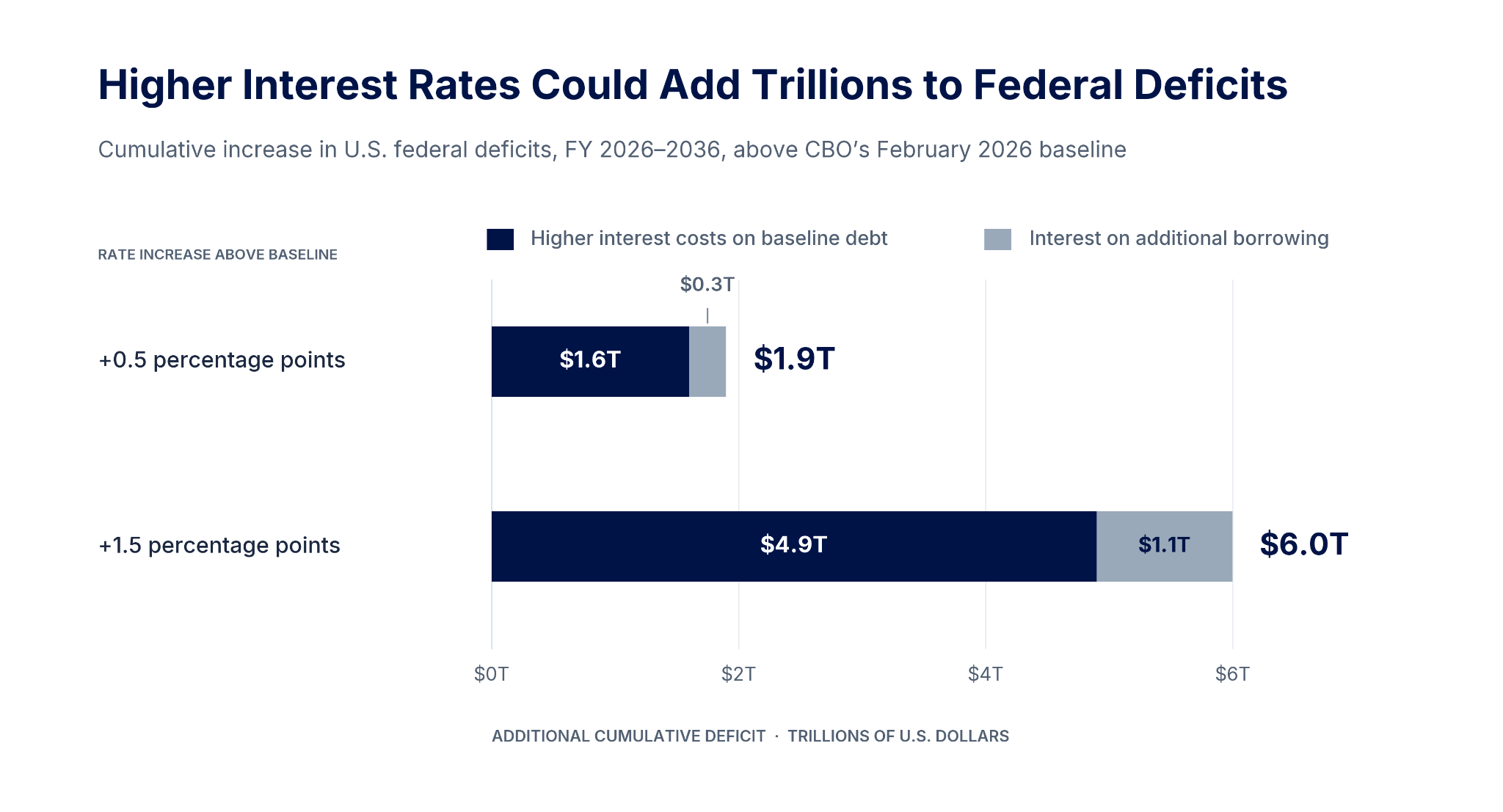
Higher borrowing costs create a second expense beyond the initial interest increase: the cost of financing the larger deficits they produce. CBO estimates that rates 1.5 percentage points above its baseline would add $6 trillion to cumulative deficits through 2036, including $1.1 trillion from servicing the additional debt. These scenarios illustrate fiscal sensitivity, not a forecast. Source: Congressional Budget Office, Projections of Deficits and Debt Under Two Scenarios With Higher Interest Rates, October 8, 2026.
CBO completed its economic forecast in early December 2025, before this year’s rise in yields. By mid-October, the 10-year rate was nearly 0.8 percentage points above the level the agency had expected for late 2027. That gap is one reason to watch the assumptions behind the budget as closely as the spending totals.
The Same Rates Reach Households and Businesses
Higher federal borrowing costs don’t stay confined to Washington. They also affect households applying for mortgages and businesses seeking loans. Treasury yields help determine borrowing rates across the economy, so when those yields rise, the effects extend well beyond the federal budget.
The average 30-year fixed mortgage rate reached around 7.5% in mid-October. Redfin reported that pending home sales fell 4% in September, which was the largest monthly decline in three years. Mortgage rates generally track the 10-year Treasury yield, although lenders also factor in other costs and risks when setting rates.
A manufacturer financing equipment and a city borrowing for a water project face a similar problem. Higher financing costs can make a worthwhile project harder to afford.
Government borrowing also competes with other demands for money. Companies are raising hundreds of billions of dollars to build artificial intelligence infrastructure. With both Washington and businesses seeking financing, investors have more choices about where to put their savings and what return to require.
Treasury Still Has Buyers, at a Price
Investors continue to buy U.S. government debt in large amounts. The concern isn’t whether the Treasury can attract buyers today, but how much additional interest it may have to offer as borrowing needs grow.
At its August meeting, the Treasury Borrowing Advisory Committee reviewed dealer forecasts showing a $1.45 trillion funding shortfall across fiscal 2027 and 2028 if auction sizes remained unchanged. That figure represented the gap between projected borrowing needs and what existing auction sizes would raise.
The committee said current auction sizes appeared sufficient through fiscal 2026. Dealers generally expected the Treasury to increase sales of longer-term notes and bonds sometime in 2027. Those larger auctions could meet the government’s financing needs, provided investors are willing to buy the additional debt at the yields offered.
The growing supply of Treasury debt is already influencing what investors expect in return. JoAnne Bianco, senior investment strategist at BondBloxx Investment Management, told CNBC in September that investors were increasingly concerned about inflation, U.S. fiscal deficits and Treasury supply. “All of those things make them think there needs to be more term premium,” she said. That premium is the extra return investors demand for holding long-term bonds rather than repeatedly buying short-term securities.
Healthy demand still shows up. Foreign investors made $300.7 billion in net purchases of long-term U.S. securities in August, according to the Treasury’s capital-flow report. Those purchases included securities beyond Treasuries, so the figure doesn’t represent foreign government-bond buying alone.
BlackRock also said in mid-October that it would hold more Treasuries than its benchmark for the first time in about six years. The firm cited higher yields as an opportunity to secure income. Pension funds and insurers with payments to make years from now have similar reasons to consider long-term government bonds yielding around 5%.
The Treasury has some flexibility in how it meets that demand. It can issue more short-term bills, adjusting borrowing as financing needs change. But relying more heavily on short-term debt also means refinancing more frequently, leaving borrowing costs exposed to shifts in interest rates. The International Monetary Fund warned about the growing share of short-maturity debt in April.
The Treasury has also taken steps to improve trading conditions. In August, it announced plans to at least double the maximum size of its buybacks of older 10- to 30-year securities, helping push yields lower that day. But buying back older bonds doesn’t address the deficits creating the need for more borrowing.
Krishna Guha of Evercore ISI emphasized that distinction in a client note, saying “the operation changes almost nothing in terms of the fundamentals, in particular the unchanged need to finance the tidal wave of hyperscaler debt in addition to very large government deficits.” On September 29, the 30-year Treasury yield briefly exceeded 5.6%, reaching its highest level since 2002.
Heavy borrowing by bond investors adds another risk. The Bank for International Settlements has warned about high public debt and the growing influence of investors outside the banking system. The Federal Reserve also reported that hedge-fund leverage had reached record highs.
If lenders withdraw financing, funds that purchased Treasuries with borrowed money may be forced to sell quickly. Those sales can drive bond prices lower and yields higher, even when other investors would prefer to hold their positions.
The Fed Has Limits, Too
It’s tempting to look to the Federal Reserve for relief. Lower interest rates would help with some of the government’s borrowing costs. But the Fed also has to consider what easier credit would do to inflation.
On September 16, the Fed raised its target range for short-term interest rates by a quarter percentage point, to 3.75%-4.00%. In its statement, the central bank acknowledged that inflation remained elevated and pledged its commitment to restoring price stability.
Consumer prices were 3.7% higher in September than a year earlier, according to Bureau of Labor Statistics figures. The PCE price index, the inflation measure the Fed targets, rose 3.4% over the year through August, BEA data showed. Households have been facing higher living costs while loans have remained expensive.
As of September 29, markets put the chance of another increase at the next Fed meeting above 70%. The report linked those expectations to energy prices elevated by the war with Iran. Those expectations can change, but further increases would raise the cost of replacing short-term Treasury bills.
BlackRock noted that investors were pricing in roughly 1.6 percentage points of additional Fed rate increases over the following year, a level of tightening the firm considered excessive. The difference in expectations highlights the uncertainty surrounding future interest rates and the risks of building a federal budget around a single forecast. Even a smaller rate increase would raise the cost of refinancing Treasury bills as they mature.
The Fed controls an overnight rate, not the yield on every government bond. Longer-term rates also reflect investors’ expectations for inflation and growth, along with the return they require for holding debt over many years. Inflation worries or the volume of Treasury sales can keep long-term yields high even if the Fed cuts its own rate.
Political pressure to make federal debt cheaper could backfire if investors believed the Fed was paying less attention to inflation. They might demand higher yields to compensate. The September rate increase, despite rising federal interest costs, shows the central bank was still willing to tighten policy.
The BIS has warned that repeatedly stepping in to stabilize bond markets can reduce the pressure on governments to rein in borrowing. Central-bank intervention may help restore trading during a market disruption, but it can also lead investors to expect another rescue when trouble returns. Meanwhile, the budget problems driving the borrowing remain unresolved.
Inflation itself offers no easy escape, either. Unexpected price increases reduce the purchasing power of fixed debt payments, but lenders can respond by charging more on new loans. Inflation-protected Treasuries adjust with prices. And families pay through the reduced buying power of their income and savings. Any benefit to the government’s existing debt comes at a cost elsewhere.
Repairing the Budget Will Take More Than Growth
CBO Director Phillip Swagel warned that the country’s current fiscal course is unsustainable. In the agency’s baseline outlook, net interest reaches $2.1 trillion by 2036, nearly one-fifth of federal spending.
The projected deficit grows from 5.8% of the economy in 2026 to 6.7% in 2036, even as the deficit excluding interest shrinks. Interest accounts for much of the deterioration. Over the rest of the decade, CBO attributes the growth in interest costs about equally to a larger debt and a higher average rate on it.
Calling the current path unsustainable doesn’t mean a crisis is necessarily around the corner. But it does mean that federal debt can’t keep growing faster than the economy indefinitely without changes to taxes, spending, economic growth, or borrowing costs. The United States has advantages that many countries don’t. It has a large tax base, borrows in its own currency, and operates within deep financial markets. Those strengths give Washington more room to maneuver, but they don’t make its obligations disappear.
Treasury Secretary Scott Bessent has argued that the country must grow its way out of debt. Faster growth would help by increasing incomes and tax receipts. Yet the scale required is far beyond CBO’s outlook. Growth alone would have to average 7.2% annually for a decade to balance the budget. CBO projects real growth of 1.8% a year from 2027.
Bessent has also called for bringing the deficit below 4% of the economy by the end of the current presidential term. Getting there would require more than counting on faster growth. Higher taxes would affect household budgets and business investment. Spending cuts would affect people who rely on federal benefits, companies with government contracts, and communities that depend on public projects. None of those choices comes without consequences.
The timing matters, too. Gradual changes give families and businesses time to adjust. Sudden tax increases or spending cuts leave far less room to prepare. Interest payments are especially difficult to address in the short term because they come from debt the government has already accumulated. Washington can’t decide to stop paying them.
The IMF’s review projected general government gross debt above 140% of the economy by 2031. Its measure includes more than the CBO’s federal debt held by the public, so the figures aren’t directly comparable. Still, the IMF urged governments to begin making budget adjustments sooner rather than later, citing the financial risks associated with rising debt.
In October, IMF fiscal chief Rodrigo Valdés advised governments with elevated fiscal risks to act before markets forced more painful changes. A government that acts before financing becomes difficult has more control over the timing of changes.
If investors suddenly demand much higher yields, borrowing becomes more expensive. Asset prices can fall, and credit can become harder to obtain. Policymakers may then find themselves raising taxes or cutting spending during an economic slowdown, when households and businesses are least able to absorb the impact.
Waiting also leaves Washington with less flexibility when the next emergency arrives. A recession can reduce tax revenue just as more Americans need assistance. A military conflict or natural disaster can create billions in unexpected expenses. CBO has warned that a growing debt burden could limit the government’s ability to respond to those challenges. The more revenue that goes toward servicing past borrowing, the less flexibility policymakers have when new demands arise.
What Savers Have at Stake
Investors can demand more interest well before they lose confidence enough to stop buying. On $32 trillion of publicly held debt, an increase of just one-tenth of a percentage point would eventually add roughly $32 billion a year, if applied across that amount as it refinanced. The calculation illustrates the scale; the actual cost depends on which securities mature and the rates that replace them.
There are also signs of gradual changes in the dollar’s global position. Its share of disclosed foreign-exchange reserves slipped from about 57.2% in the first quarter to 56.7% in the second, according to IMF data.
Foreign investors also help finance a substantial share of the national debt. At the end of September 2025, they held roughly 30% of publicly held federal debt, according to CBO’s outlook. Their purchases provide Washington with financing, but the interest paid to foreign holders also reduces national income. In effect, the government receives money it can spend today in exchange for ongoing payments.
CBO has warned that continued debt growth could eventually lead investors to question the value of federal debt and demand sharply higher interest rates. Persistent inflation could also weaken confidence in the dollar’s role as the world’s leading reserve currency. Neither outcome is inevitable. The fact that investors continue to buy Treasuries in large amounts remains an important part of the picture.
For American savers, the effects of rising rates are more immediate. Higher yields can provide better returns on newly purchased bonds, but they also reduce the market value of bonds people already own. Inflation creates a different problem. A household may continue receiving the same income from its savings, only to find that the money buys less each year.
These risks help explain why some investors keep a portion of their wealth in gold. Unlike a bond, gold doesn’t depend on an issuer’s promise to repay principal or interest. Its price can rise or fall, and it generates no income. But for investors concerned about government debt and the dollar’s long-term purchasing power, that independence can be part of its appeal.
For Americans who have spent decades building their savings, the concern is ultimately about how much those savings will be worth when they need them. Washington’s growing interest bill matters because its effects extend beyond the federal budget. It influences borrowing costs, limits the government’s ability to respond to future challenges, and adds uncertainty about what today’s dollars will buy in the years ahead.