
By Preserve Gold Research
This summer, tens of thousands of people mounted phones at eye level and filmed themselves doing chores. They cooked dinner, folded laundry, and stocked store shelves, and they got paid for the footage. The buyer wanted to teach robots how human hands move.
Figure, a U.S. maker of humanoid robots, said in August that people in more than 100 countries had uploaded over 16 million videos to its Index data program. About 44,000 people a week were sending in clips, and the company said it had paid them $15 million so far. The data needed for a general-purpose robot “doesn’t exist on the internet,” Figure wrote, so it has to come from people doing real chores.
Many of the people holding those cameras do the kind of work that laid-off office staff have long been told to move into.
Artificial intelligence is starting to loosen the tie between what the economy produces and what workers take home. Some of it shows up as layoffs, and more companies now name AI as the reason. Much of it never shows up at all. Employers hire fewer young people, let a department shrink as people retire or quit, and ask the remaining workforce to produce more.
The next stage could reach physical jobs, which have long been the backup plan for workers pushed out of other fields. If robots get good enough to fill them, more of the economy’s income will flow to whoever owns the machines. Paychecks would carry less of the load.
Those same paychecks fund payroll taxes, mortgage payments, and most consumer spending.
The Job Market Was Weaker Than Initial Reports Showed
The U.S. job market was softer in 2025 than the early reports suggested. The government’s yearly benchmark cut the March 2025 payroll count by 898,000 jobs, or 0.6%, BLS benchmark data show. Over the previous decade, the typical yearly revision has run about 0.2%.
The revision erased jobs that had existed only in the estimates. Employers had been adding workers more slowly than the monthly reports showed.
That softness carried into this year. Employers added just 29,000 jobs in September, and unemployment stood at 4.2%, according to the September jobs report. For a college senior sending out applications this fall, numbers like that mean fewer callbacks and longer waits between interviews.
AI is spreading fast through the companies doing that hiring. A Census Bureau working paper found that about 18% of firms used AI in at least one part of their business between November 2025 and January 2026. Weighted by number of employees, the share jumped to 32%, because big companies adopt new tools faster.
One in four workers worldwide holds a job with some exposure to generative AI, according to the International Labor Organization’s 2025 update.
When asked directly, employers played it down. Only 2% of firms told the Census Bureau they had cut jobs because of AI. Company announcements over the past year tell a different story.
Companies Are Now Naming AI as the Reason for Job Cuts
Challenger, Gray & Christmas, an outplacement firm, began tracking AI as a separate reason for layoffs in 2023. Employers cited it for about 55,000 announced job cuts in 2025, more than 12 times the count two years earlier.
This year, the count has more than doubled. Through October, employers named AI in 121,401 announced job cuts, about 20% of all cuts, according to Challenger’s October report.
AI was the leading reason employers gave for five straight months, from March through July, Challenger data show. Those totals count only the cuts companies chose to label.
At Amazon, Chief Executive Andy Jassy told employees in June 2025 that the company would “need fewer people doing some of the jobs that are being done today.” He wrote in a memo to staff that over the next few years, the company expected AI to “reduce our total corporate workforce.”
The cuts followed. Amazon eliminated about 14,000 corporate jobs in October 2025 and roughly 16,000 more in January. The company described the January round as a push to remove layers and bureaucracy. Its chief executive had already told staff where the efficiency would come from.
Other companies have been blunter. Oracle disclosed in a June regulatory filing that its workforce had shrunk by 21,000 people over 12 months, about 13%. “The adoption and deployment of AI technologies across our operations have resulted, and may continue to result, in reductions to our workforce,” the filing said.
Salesforce cut its customer-support staff from about 9,000 to 5,000, with Chief Executive Marc Benioff saying AI agents now handle the work. In February, the company said it no longer needed “to actively backfill support engineer roles.”
That phrase describes the hidden half of AI job loss. A job that isn’t refilled doesn’t appear in a layoff count. Snap made a similar move in April. It cut about 1,000 employees and closed more than 300 open positions, citing “rapid advancements in artificial intelligence.”
Block, the payments company run by Jack Dorsey, cut its staff nearly in half in February, from more than 10,000 to under 6,000. Dorsey predicted that within a year “the majority of companies will reach the same conclusion and make similar structural changes.”
Atlassian’s chief executive, Mike Cannon-Brookes, was direct when his company cut 1,600 jobs. It “would be disingenuous to pretend AI doesn’t change the mix of skills we need or the number of roles required in certain areas,” he said. “It does.”
The pattern has spread beyond tech. Dow, the chemical maker, is eliminating about 4,500 jobs as it leans harder on AI and automation. For a claims processor at an insurer or a payroll clerk at a manufacturer, those announcements read like a forecast.
Young Workers in AI-Exposed Jobs Have Fallen 19% Behind
The hiring side is harder to see. Researchers at Stanford’s Digital Economy Lab have been tracking it in payroll records from ADP, the payroll processing company. The lab reported in August that young workers in the jobs most exposed to AI had fallen behind. By June 2026, employment for workers ages 22 to 25 in those fields sat about 19% below the path of young workers in less-exposed jobs.
Older workers in the same jobs showed no similar gap.
Most of the gap came from slower hiring. Young staff kept their jobs at about normal rates, while fewer new workers were hired to replace them.
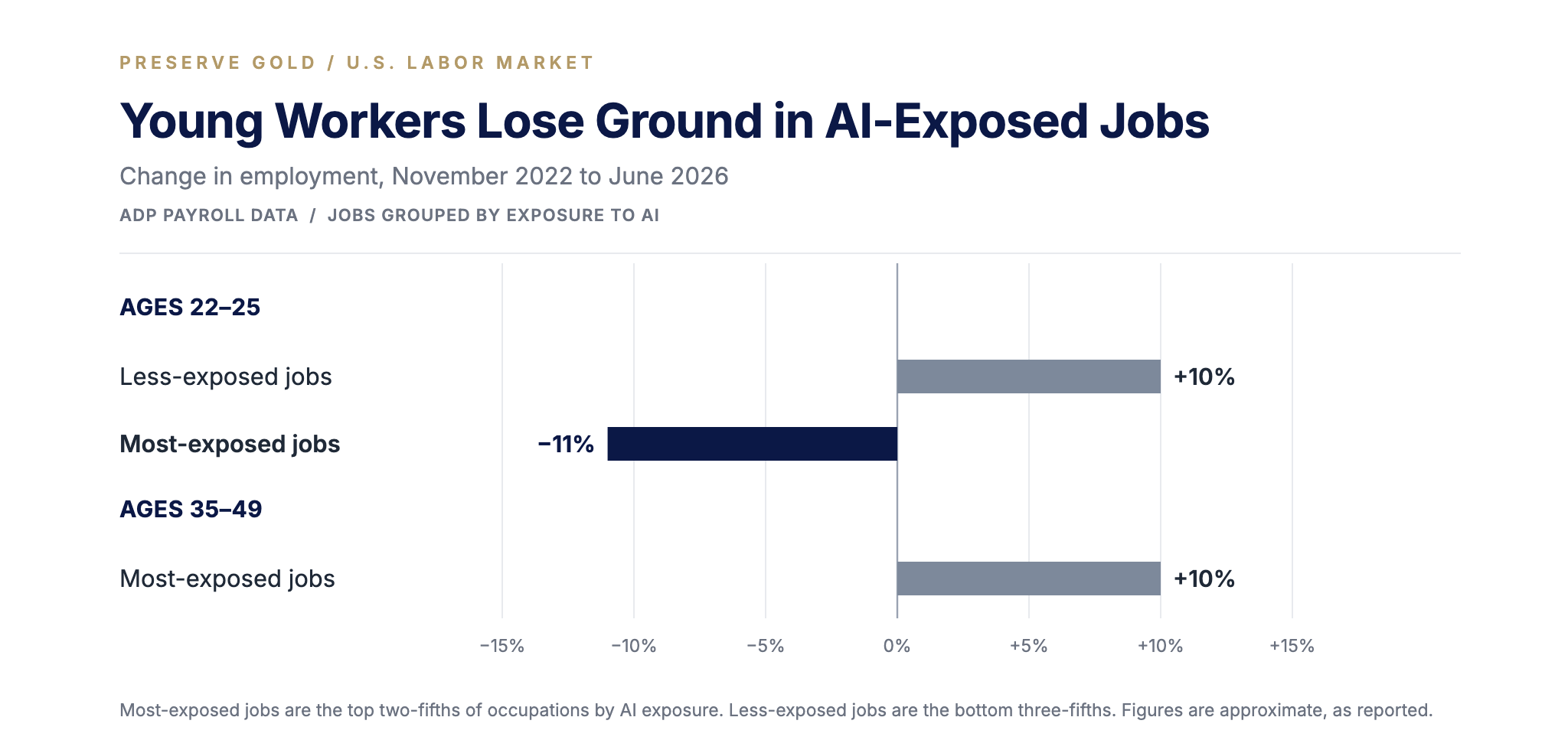
Employment of workers ages 22 to 25 fell about 11% in the jobs most exposed to AI and rose about 10% in less-exposed jobs. Workers ages 35 to 49 in the most-exposed jobs gained ground. The researchers measure that spread as a 19% gap. Source: Stanford Digital Economy Lab, Canaries in the Coal Mine? Six Facts About the Recent Employment Effects of Artificial Intelligence, August 2026 revision; ADP payroll data.
Young professionals usually learn their trade by doing routine, by-the-book work first. Junior analysts build the spreadsheets, first-year lawyers review documents, and new programmers fix simple bugs. Generative AI handles those tasks well. Experienced workers rely more on judgment built up over years of messy situations, and the Stanford data show their jobs holding up better.
AI can reshape a profession without touching the senior accountant at a regional firm. A firm that once hired five graduates each fall might hire three without a layoff notice ever getting filed.
That creates a slower problem down the road. Today’s junior staff are supposed to become tomorrow’s experts. If the bottom rung thins out, companies may find a decade from now that they’re short on seasoned people, too.
AI Hands New Hires the Skills Experience Used to Teach
Some of the clearest evidence comes from call centers. Economists Erik Brynjolfsson, Danielle Li and Lindsey Raymond tracked 5,172 customer-support agents after their employer rolled out an AI assistant. Issues resolved per hour rose 15% on average, according to their study in the Quarterly Journal of Economics. The least experienced agents improved the most. As the researchers read it, the tool picked up the habits of the best agents and passed them along to everyone else.
That helps new hires at first. But when software squeezes six months of on-the-job learning into two, the extra pay that used to come with those six months can shrink as well.
Fewer people may be needed, too. If one agent with AI can handle far more calls, a manager needs fewer agents for the same workload. When productivity outruns demand, the same work takes fewer human hours, and jobs disappear even as the business runs better. Salesforce’s support desk is a working example.
Nearly 40% of jobs worldwide are exposed to AI-driven change, International Monetary Fund chief Kristalina Georgieva wrote. In advanced economies like the U.S., she put the share at roughly 60%.
BLS projections show the economy adding 5.9 million jobs from 2025 to 2035, led by health care, computing and science. Office and administrative support is expected to lose 752,100 jobs, the steepest decline of any major group. The agency listed automation tools, including AI-powered ones, as one reason demand for several of those jobs is likely to fall.
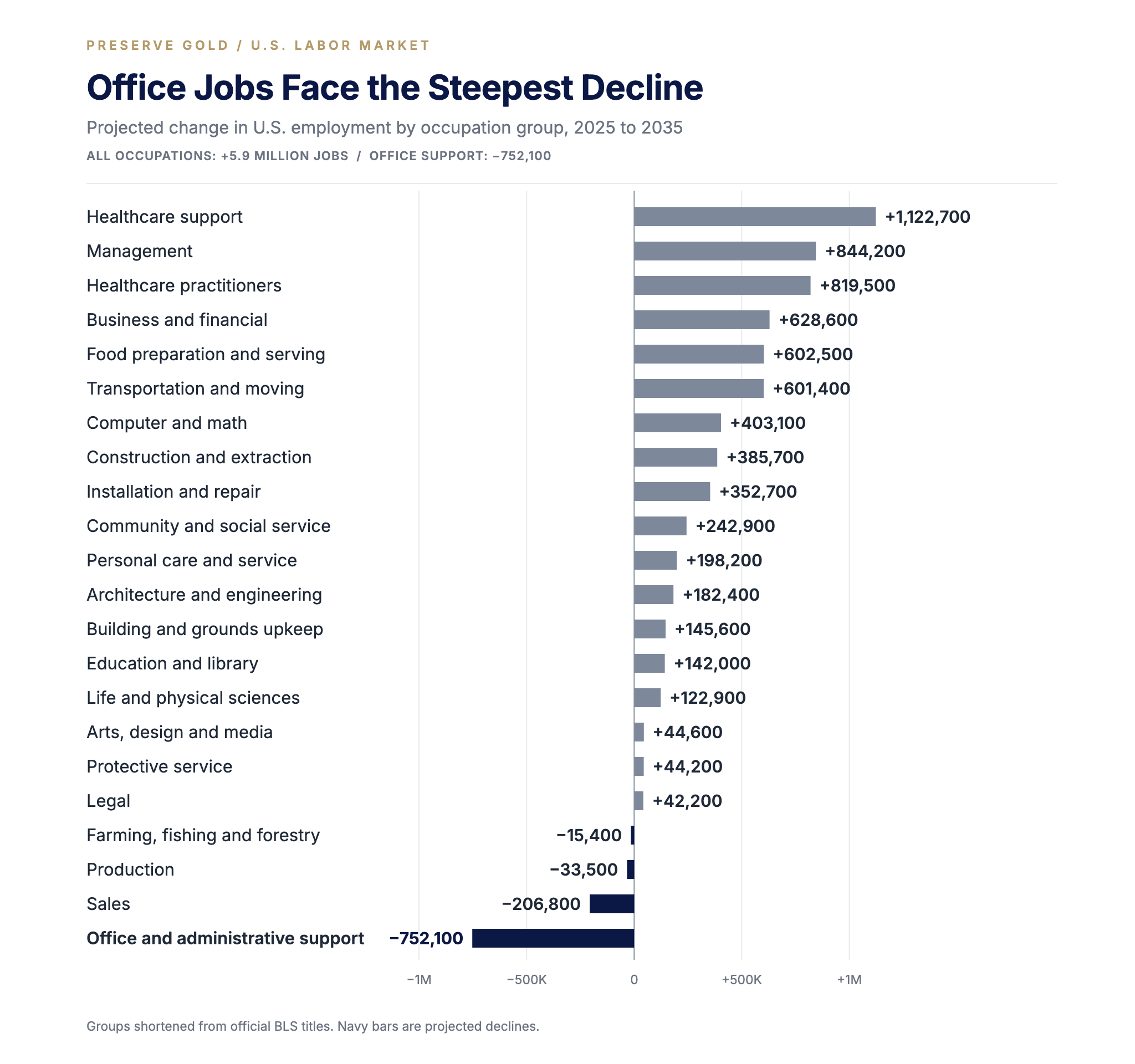
The government expects the economy to add 5.9 million jobs over the next decade, led by health care. Office and administrative support is projected to lose 752,100 jobs, the most of any group, partly because automation tools, including AI, are expected to reduce demand for several office roles. Source: U.S. Bureau of Labor Statistics, Employment Projections, Table 1.1, Employment by Major Occupational Group, 2025 and Projected 2035.
Those office jobs have long been a first step up for workers without a four-year degree. Picture the billing clerk at a hospital, or the dispatcher at a trucking company. When someone loses that kind of job, there has usually been somewhere else to go, most often a warehouse or a construction site.
Robots Are Learning the Jobs Workers Were Told to Retrain For
That fallback is where the camera footage comes in.
Office automation could train on the text, code, and images already online. Physical work is harder to capture. Almost nothing online shows how a person grips an oddly shaped box, or how that box shifts as someone carries it up a flight of stairs.
Data vendors now collect it straight from people. Objectways, which supplies training data to AI and robotics companies, describes head-mounted phones set at eye level as the most reliable recording setup. The result is “egocentric” video, shot from the worker’s point of view, which captures small hand movements no instruction manual spells out.
Turning that footage into robots that can work on their own will take time, but the direction is clear. Figure said Index lays the groundwork for customers to order robots as a service, and the chores its contributors film include housework and stocking retail shelves.
For generations, the standard answer to automation has been retraining. A bookkeeper becomes a technician, or a clerk moves into health care.
That advice weakens if machines keep following workers into new territory. A copywriter who retrains in marketing analytics now competes with AI analytics tools. A warehouse worker who learns to repair robots may watch the robots learn to diagnose themselves. Someone can spend two years mastering a new skill and find the machine learned it faster.
The Bank for International Settlements, the central bank for central banks, flagged this risk in its 2026 annual report. AI “competes directly with human cognitive abilities,” the BIS wrote, which sets it apart from earlier breakthroughs that reshaped whole economies. That could leave workers less room to climb into tasks machines can’t do.
A BIS working paper that simulated 711 U.S. job categories put it more sharply. It found that weaker AI helps workers by handling side tasks. Stronger AI reaches the core tasks of lower-wage jobs, “threatening substitution and increased inequality.”
Every Displaced Worker Is Also a Lost Customer
Most American families get their spending money from work. Employers pay wages, workers spend them, and that spending becomes the sales that pay the next round of wages. The payroll taxes taken out of each check fund Social Security and Medicare.
If machines become the main input to production, that cycle weakens. The BIS sketched one version and called it a “demand bottleneck.” As income shifts from workers toward AI investment and the people who own capital, the customer base shrinks. Productivity rises at first. Then long-run growth slips below its old trend, because household spending no longer justifies more investment. “Every displaced worker is also a lost consumer,” the report observed.
Say AI lets a regional insurer handle the same claims with 60 employees instead of 100. The insurer can cut premiums, raise profits or expand, and shareholders come out ahead. The 40 people who left don’t, unless they find comparable work.
Now suppose every insurer, bank, and law firm makes the same move, and new jobs don’t show up fast enough. Those companies end up selling to customers with thinner paychecks. A family puts off buying a home. A borrower falls behind on a car loan. A diner near a half-empty office park cuts its hours.
Something has to connect highly automated production back to household income, and nothing guarantees that happens on its own.
MIT economist Daron Acemoglu expects modest productivity gains from AI. He estimated the boost to total factor productivity at no more than 0.66% over 10 years, and likely below 0.53%. That measure tracks how efficiently the economy turns workers and equipment into output. Even with gains that small, he found AI could widen the gap between what capital earns and what labor earns.
A $1 Trillion AI Spending Boom Is Holding Up Growth
For now, a spending boom is covering up much of this. The five largest cloud companies are on track to spend more than $1 trillion on AI-related projects across 2025 and 2026, according to the BIS. The bank warned that the spending is increasingly running ahead of earnings and the cash these companies generate. That raises the risk of a sharp pullback if the returns disappoint.
Some of the companies doing the spending are also cutting staff to pay for it. Oracle’s job cuts came as it steered savings toward AI data centers, TechCrunch reported.
An electrician wiring a new data center is doing well from AI right now, even as a paralegal across town sees fewer openings. Headline GDP says less and less about how a typical household is doing.
That leaves the Federal Reserve reading inflation through a job market that hides some of its own weakness. With investment spending running hot, it’s steering with a faulty dashboard.
Investors face an awkward problem. A family’s paycheck could depend on how fast the employer automates. Its retirement account could lean heavily on the handful of tech companies doing the automating. A sharp pullback in AI spending would hit the portfolio, and a smooth AI success could squeeze the paycheck.
Some assets don’t depend on any single employer, tech company, or job-market outcome. Tangible stores of value like gold fall into that group, and they cover a risk that neither the paycheck nor the index fund does.
Who Owns the Machines May Matter More Than a Monthly Check
Most labor policy assumes adults will keep earning most of their income by selling their time. Unemployment insurance, training programs, and retirement benefits all rest on that assumption. Long-lasting job losses from technology would undercut all three.
Universal basic income, a guaranteed check whether or not someone works, is the obvious proposal. The best recent evidence complicates it. In a large U.S. experiment studied by economist Eva Vivalt and colleagues, low-income participants received $1,000 a month for three years.
Recipients spent more and gained some control over their time. The payments also reduced workforce participation by 4.2 percentage points, according to the NBER study’s latest revision. The researchers found no improvement in the quality of the jobs people held.
Paying for it is the harder problem. If AI capital eventually earns most of the income, taxing workers to support workers stops adding up. Anton Korinek of the University of Virginia and Lee Lockwood walked through that scenario in a Brookings primer on public finance. Their options included taxes on robots, computing power, and AI usage, along with sovereign wealth funds and “windfall clauses,” pledges by AI companies to share extraordinary profits.
A more direct fix would spread ownership itself. Rather than tax a slice of the income from machines a few people own, families or public funds could own part of the capital directly. In practice, that could mean broader retirement ownership, employee stock plans, citizen funds, or dividends tied to AI profits. Each comes with hard questions about who runs it, what incentives it creates, and how much political control it invites.
Ownership matters at every point of this shift. When an employer has a believable machine alternative, a worker has less bargaining power in a pay negotiation. When shareholders own the machine, the productivity gains flow mostly through profits and stock prices. For family finances, who owns the AI models, chips, and data centers may matter as much as how many jobs they replace.
The early evidence points one way. The Stanford, BLS, and BIS research all find the risk concentrated in entry-level, clerical, and lower-wage work, and company filings now confirm what the employer surveys missed. If machines become cheaper than people across most office work and much physical work, the economy could grow enormously wealthy. It would still count on paychecks to spread that wealth, even as it needs fewer people to earn them.
Mortgages, payroll taxes, and consumer spending all depend on wages carrying most household income. The first cracks have shown up at the entry level—the point where that load is supposed to pass to the next generation.