
By Preserve Gold Research
Voters delivered their verdict on Washington on November 3, handing Democrats control of both the House and the Senate. But the country’s financial problems remain much the same. On November 5, the national debt stood at about $40.6 trillion, Treasury data show. That figure includes money owed to outside investors and to the government’s own trust funds.
At the end of January 2025, the same figure was about $36.2 trillion.
The government also closed its 2026 fiscal year in September with a deficit of roughly $2.0 trillion, about $218 billion more than the year before. The Congressional Budget Office reached that estimate in its September budget review. Revenue grew. But spending grew faster, pushed up by interest on the debt and by Medicare and Medicaid.
The deeper problem is that much of the federal budget is already committed before lawmakers begin debating how to spend the next dollar. Programs such as Social Security and Medicare operate under laws and benefit formulas established years ago. Interest payments reflect money Washington has already borrowed. Any plan large enough to meaningfully reduce the deficit would require decisions that affect millions of Americans, many of whom would feel the consequences immediately.
Changing which party controls Congress doesn’t change those obligations.
Interest still has to be paid on time. Social Security checks still go out every month, and Medicare claims still get paid. Defense contracts, veterans’ benefits, federal salaries and thousands of tax credits stay written into law.
When the new Democratic majority takes office in January, it will inherit those commitments along with a growing national debt and a bond market that has made long-term borrowing increasingly expensive. Winning control of Congress may change which policies lawmakers pursue, but it doesn’t make the underlying financial choices any easier.
U.S. Debt Interest Payments Top $1 Trillion as Borrowing Costs Rise
Interest is the one federal bill Congress does not debate. It comes due automatically, and missing a payment would set off a financial crisis. Lawmakers can cut other spending, but they still have to pay interest on money the government has already borrowed.
Those payments have grown fast. Net interest, what the government pays on its debt minus the interest it earns, would top $1 trillion in fiscal 2026, CBO projected. By 2036, the agency expects the annual bill to roughly double, to $2.1 trillion.
Every dollar of that bill is a dollar that can’t go to a highway or a research grant. CBO projected that interest would reach 4.6% of GDP by 2036, the highest share of the economy on record since at least 1940.
Market rates have moved against the budget this year. The 10-year Treasury yield rose from about 4.2% on January 2 to nearly 4.9% on November 6, Treasury yield data show.
Higher market rates raise federal interest costs as existing debt comes due. Treasury bills, notes, and bonds mature at different times, so the increase is spread over years. Debt issued at low rates in 2020 and 2021 is now being refinanced at today’s higher rates.
Long-term borrowing costs are even higher. The 30-year and 20-year bonds both yielded about 5.3% on November 6.
The cost is already showing up. Treasury Department outlays rose $122 billion, or 8%, over fiscal 2026 because higher debt pushed up gross interest costs. The Treasury’s borrowing advisory committee also heard that current borrowing patterns would leave a modest funding shortfall in fiscal 2027, one official said, which short-term bills could likely cover.
Using more Treasury bills means refinancing more often. Bills mature within a year, so the government has to replace them at current market rates sooner than it would longer-term debt. Changes in Federal Reserve interest rates can therefore affect federal borrowing costs more quickly.
Those yields don’t only affect Washington. Rates on 30-year mortgages tend to track the 10-year Treasury yield. The same benchmarks shape what borrowers pay on car loans, corporate bonds, and small-business credit lines. A family refinancing a house, or a contractor rolling over an equipment loan, pays part of the government’s borrowing cost in a monthly payment. No austerity bill ever has to pass for that to happen.
Why DOGE’s $215 Billion in Savings Couldn’t Fix America’s Deficit
The Department of Government Efficiency (DOGE) put a widely held belief to the test: that Washington could significantly reduce its deficit by cutting waste, eliminating fraud, and trimming unnecessary government contracts.
“We simply cannot sustain, as a country, $2 trillion deficits,” Elon Musk said at a February 2025 Cabinet meeting. Musk was the public face of the effort. Its early ambitions ran far larger than anything it delivered.
Musk’s concern about the deficit was justified. Finding enough savings to make a meaningful difference proved far more difficult. The White House now credits government-efficiency efforts with an estimated $215 billion in savings, only a fraction of a single year’s deficit.
And even that figure may be generous. The Government Accountability Office checked part of DOGE’s public “Wall of Receipts,” its online list of claimed savings. Of 264 leases listed as terminated, 108 were already being phased out before DOGE existed, an August GAO report found.
DOGE also claimed $1.7 billion in savings on a Defense Health Agency contract that was never canceled or reduced. GAO said the site doesn’t adequately disclose the limits of its own data.
A government spending $7.4 trillion a year, by CBO’s count, has duplicate programs, improper payments, and buildings it doesn’t need. Any serious plan should go after them. Trimming waste and closing a deficit built into law are different jobs.
Most cost-cutting efforts focus on discretionary spending, the part Congress sets each year through appropriations bills. Outside defense, it makes up “only 15 percent of total federal outlays,” IMF staff wrote in their 2026 review of the U.S. economy. Efficiencies there alone, they concluded, are “insufficient.”
Even if an efficiency effort saved $200 billion a year, about 90% of this year’s deficit would remain. The government would still have to borrow to cover that difference.
Canceling a government contract might save money down the road, but it doesn’t pay down the debt we’ve already accrued. Meanwhile, the biggest expenses in the federal budget keep rising year after year, and they’re far beyond what cutting waste or eliminating a few contracts can fix.
Social Security Could Face a 22% Benefit Cut After 2032
Congress doesn’t start each year with a clean slate. Most federal spending flows from laws passed decades ago that keep paying out until lawmakers change them. Social Security benefits follow formulas written into law. Medicare and Medicaid costs follow enrollment, medical prices, and how often patients see a doctor.
Those programs grow as the population ages, and their trustees have put dates on the strain. The retirement trust fund can pay full scheduled benefits only until late 2032, according to the trustees’ 2026 summary. After that, incoming payroll taxes would cover about 78% of promised checks.
“Legislative action will be needed to prevent OASI reserve depletion,” the trustees wrote in the report’s conclusion. OASI is the old-age and survivors fund that pays retirement benefits. Counting the disability fund alongside it, combined reserves last into 2034, after which about 83% of benefits would be payable, the Social Security Administration said.
For someone who turns 59 this year and plans to claim at 66, 2032 arrives right as retirement begins. Under current law, a $2,000 monthly check would shrink to about $1,560 once the reserves are gone.
Medicare’s hospital fund is close behind. The 2026 Medicare trustees report projects that the fund will run dry by mid-2033. At that point, incoming revenue would cover 89% of scheduled benefits.
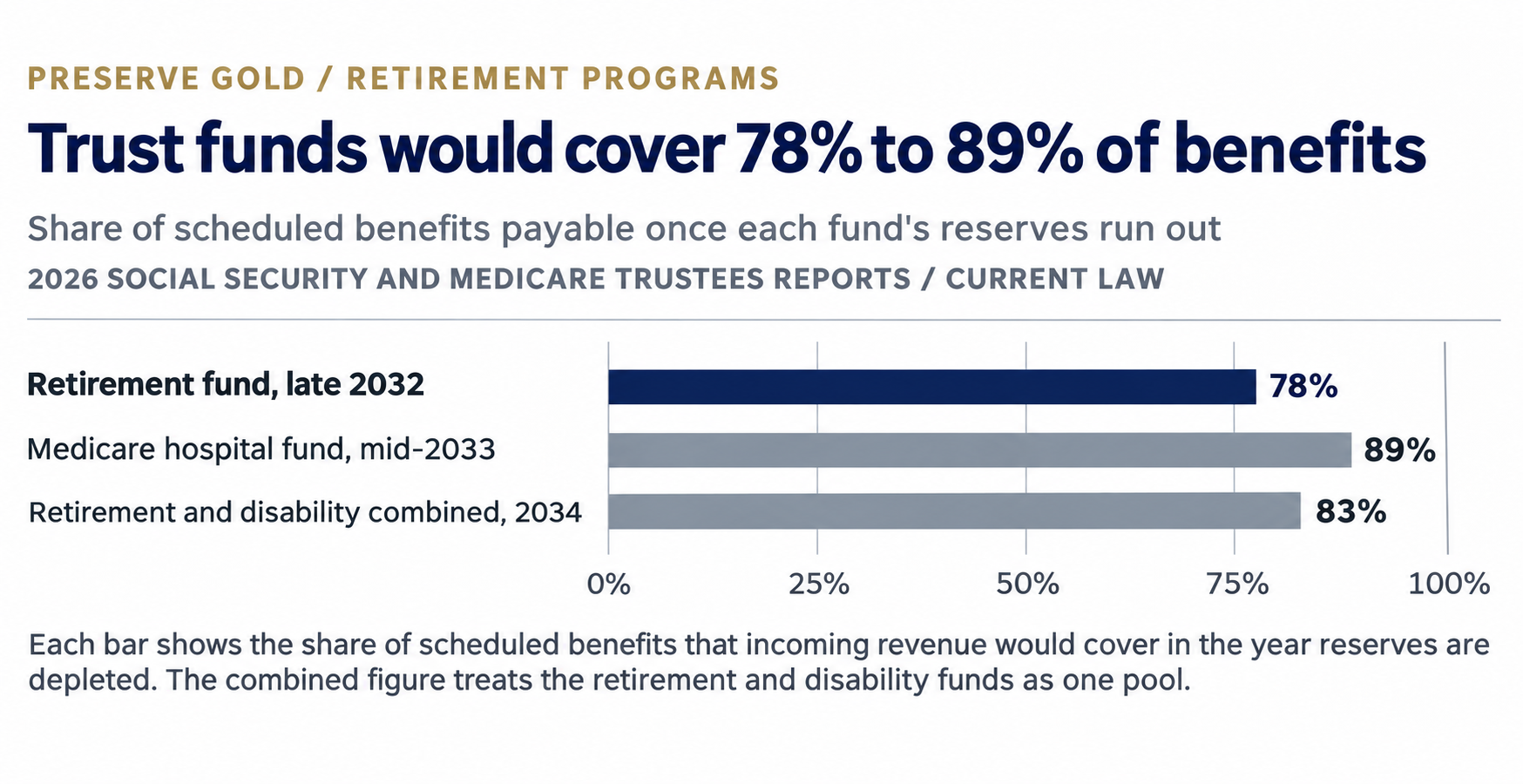
Once reserves run out, incoming revenue would still cover most promised benefits, from 78% for the retirement fund to 89% for Medicare’s hospital fund. Source: Social Security and Medicare Trustees, 2026 Trustees Reports, June 2026.
The drawdown matters to bond investors well before the reserves run out. The trust funds hold special Treasury securities, and cashing them in to pay benefits forces the Treasury to borrow that money from outside investors instead. The debt the government owes its own trust funds stood at about $7.8 trillion on November 5, Treasury’s daily debt figures show. As the Social Security and Medicare portions are spent down, more of that debt moves onto the open market.
The dates are awkward politically, because every repair requires choices elected officials have spent decades avoiding. Congress could raise payroll taxes, lift the cap on wages subject to the tax, slow benefit growth, raise the retirement age, or blend several of those.
CBO’s list of budget options shows how big those choices get. A new 1% to 2% payroll tax on all earnings could raise roughly $1.3 trillion to $2.5 trillion over a decade, according to the agency’s options report.
A 5% value-added tax, a sales-style tax collected at each stage of production, could bring in about $2.2 trillion to $3.4 trillion. Either would land on paychecks or store receipts in every state.
Why Neither Political Party Wants to Make the Cuts Needed to Reduce the Debt
Waste doesn’t have a lobby. Social Security beneficiaries do. So do Medicare patients, defense communities, states that lean on federal Medicaid money, homeowners who use tax breaks, and workers who pay payroll taxes.
The benefits of reducing the deficit are harder to see. They may take years to materialize through lower interest costs, more stable economic growth, and greater flexibility to respond to the next recession. Those benefits are spread across the entire economy. The costs of spending cuts or tax increases, however, often happen right away and fall on people who know exactly which decisions affected them.
Both parties have governed inside that trap. Federal debt has risen under Republican and Democratic administrations alike, interrupted only by the brief run of surpluses around 2000. Some of the increase came from deliberate choices. Recessions, wars, the 2008 financial crisis, and the pandemic drove much of the rest.
Borrowing also makes the cost easier to overlook. Americans don’t get a bill showing their share of the federal deficit. Instead, the Treasury sells bonds into the deepest debt market in the world, where central banks, pension funds, and lenders hold them as reserves and collateral. Strong demand for Treasuries lets Washington borrow on a scale few other countries could sustain. It also makes the consequences easier to ignore, since the full costs aren’t immediately visible to taxpayers.
Recent policy decisions show how difficult it is to make lasting progress. The Congressional Budget Office (CBO) estimated that the 2025 tax-and-spending law would add $4.7 trillion to federal deficits from 2026 through 2035, including its effects on economic growth and interest costs. Higher tariffs were expected to offset some of that increase, with CBO’s February outlook projecting $3.0 trillion in deficit reduction over the same period.
But that expected relief has already begun to shrink. According to CBO’s September review, customs receipts fell 11% in fiscal 2026 as the government began refunding duties collected under an emergency-powers law. Those refunds followed a Supreme Court ruling in February that overturned the tariffs.
The new Democratic majorities may shift priorities on taxes, health programs, and discretionary spending. However, any large fiscal deal still runs into the presidential veto, Senate rules, and the same short list of policies big enough to matter. Workable plans fill shelves at CBO and on Capitol Hill. Finding a majority willing to vote for one has been the hard part.
Bipartisan commissions are the usual workaround. They let both parties share the blame for an unpopular package, so neither can use it against the other at the next election. The 1983 Social Security rescue grew out of one. The 2010 Simpson-Bowles plan couldn’t win enough votes from the commission’s own members, and it never became law.
The IMF Says America’s Debt Fix Could Require More Than $1 Trillion a Year
Faster growth is everyone’s favorite fix. A bigger economy raises tax receipts without higher tax rates and makes a fixed debt smaller relative to national income. The U.S. shrank its World War II debt burden partly that way, through strong growth, some inflation, and low interest rates.
But growth alone is unlikely to close today’s budget gap. CBO’s February outlook projected federal spending at roughly 23% of GDP in 2026, compared with revenue of about 17.5%. That’s a substantial difference, and even a stronger job market wouldn’t generate enough additional tax revenue to close it.
IMF staff reached a similar conclusion in February. The Fund called for “a clear, frontloaded fiscal consolidation plan,” meaning deficit reduction that starts early, to put debt on a downward path relative to the economy. It said the bulk of the adjustment should come from higher federal revenue and from rebalancing Social Security and Medicare.
The Fund sized the job at around 4% of GDP relative to current projections. In an economy the size of today’s, that’s well over $1 trillion a year. Spending cuts alone would have to go far past foreign aid, consultants, and federal payrolls. Tax increases would have to reach well beyond billionaires and into the broad middle of the tax base.
That’s why most serious plans mix both. It’s also why the mix matters. A badly built tax can discourage hiring and investment. Careless cuts can gut the roads, basic science, and job training that support the growth the debt depends on.
Inflation can reduce the burden of government debt. Rising prices increase the dollar value of economic output while the amount owed on existing fixed-rate debt stays the same. Savers lose purchasing power because their deposits and bonds buy less each year. Creditors usually respond by demanding higher yields on new debt.
Economists call the other historical tool financial repression. Governments steer banks, pension funds, and insurers into holding public debt at rates below inflation, sometimes through regulation and sometimes through interest-rate caps. Washington and London both leaned on versions of it after World War II. It cuts the state’s borrowing costs by moving part of the bill onto savers with few alternatives.
Both routes shrink what a dollar of government debt is worth after inflation. Investors who see that risk tend to look for assets with no issuer behind them and no promise that can be broken, assets like gold. Its value doesn’t rest on a Treasury coupon, a deposit guarantee or a central bank’s restraint. That independence is why it has long served as a store of value outside any government’s balance sheet.
America Is Approaching Its Debt Ceiling. What Happens Next?
Waiting carries a cost of its own. The government is “on an unsustainable fiscal path,” GAO said in its fiscal health report. The agency projects that debt held by the public, the money owed to outside investors, will reach 123% of GDP in 2036. “The longer actions are delayed, the more dramatic they will need to be,” the report warned.
The math compounds with every passing year. When spending exceeds revenue even before interest, the government borrows the difference. More debt brings more interest. More interest widens the next deficit, and the cycle feeds itself.
CBO’s long-range numbers show where that loop leads under current law. Debt held by the public would reach 175% of GDP by 2056 in the agency’s long-term projections. Net interest would climb to nearly 7% of GDP, more than Washington would spend on either Social Security or Medicare.
In practice, that squeeze eventually reaches programs Americans depend on. Picture a county waiting on federal disaster money after a hurricane, or a veterans’ hospital waiting on funding to hire nurses. Each competes for room with an interest bill that gets paid automatically.
The government’s own balance sheet points the same way. At the end of fiscal 2025, the federal government reported $47.8 trillion in liabilities against $6.1 trillion in assets, according to the Treasury’s annual financial report. A government that can tax and issue its own currency doesn’t go bankrupt the way a company does. Even so, the gap shows how much of the future is already spoken for.
The next deadline is close. The statutory debt limit, better known as the debt ceiling, was raised to about $41.1 trillion in July 2025, the same report shows. Some of the gross total doesn’t count against that cap, so about $750 billion of borrowing room remained on November 5, according to the Daily Treasury Statement. At the past year’s pace, that room could be gone within a few months. After that, the Treasury would turn to extraordinary measures, the temporary accounting moves it uses to buy time.
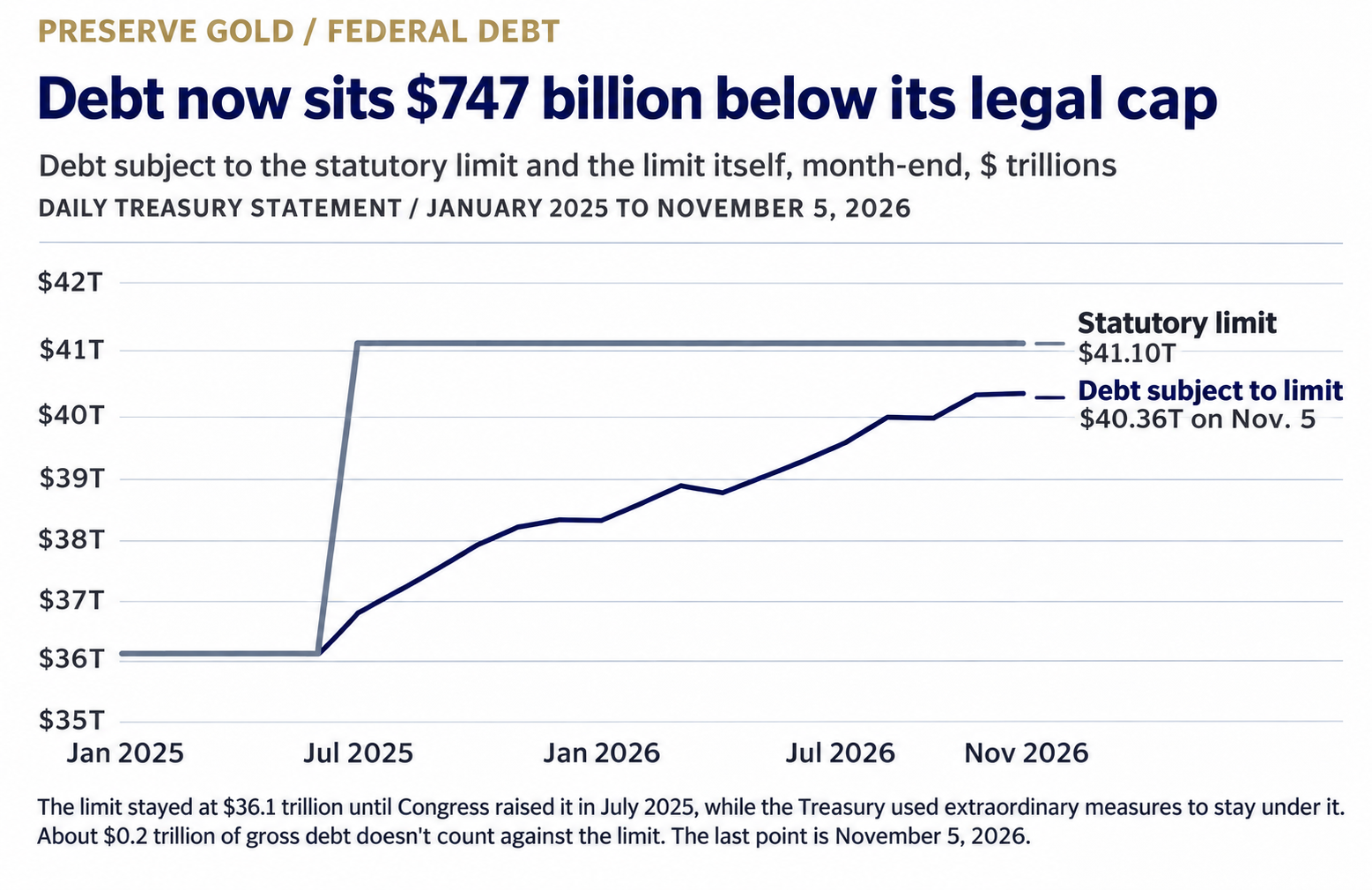
Source: U.S. Treasury, Daily Treasury Statement, November 5, 2026.
A debt ceiling caps how much the Treasury can borrow to pay for obligations Congress already approved. It doesn’t set the tax and spending laws that create those obligations. The fight over raising it will likely hand a divided government its first big fiscal test sometime next year.
Bond investors may end up setting the timetable instead. If buyers demand persistently higher yields to absorb a growing supply of Treasurys, the interest bill grows faster. A slow political problem then becomes an immediate budget constraint. This year’s climb in long-term rates suggests the era of nearly free government borrowing won’t return on its own.
Bringing the debt under control will require some combination of higher taxes, slower spending growth, and changes to federal benefits. Inflation could also reduce the real value of existing debt, though that would shift part of the burden onto households and savers through weaker purchasing power.
The question is how much of that adjustment lawmakers will choose to make voluntarily, and how much will be forced upon them by rising borrowing costs.
None of the available fixes get easier with time. Congress has understood the choices for years, yet the underlying obligations keep growing. Elections may change who controls Washington, but they don’t reset the government’s debt, its interest payments, or the deadlines approaching for major federal programs.