By Preserve Gold Research
The five largest cloud and technology companies are set to spend more than $1 trillion on AI-related capital expenditures across 2025 and 2026. That figure comes directly from the BIS 2026 Annual Economic Report, published in late June. It arrives not as a milestone worth celebrating but as the anchor for a financial stability warning. If returns on that spending disappoint, the Bank for International Settlements argues, financing could abruptly pull back and convert today’s capex surge into a prolonged bust.
AI investment has grown large enough to move GDP, shape credit conditions, and absorb a meaningful slice of corporate bond issuance. Analysts warn that a downturn wouldn’t stay in Silicon Valley. It would travel through debt markets, private credit funds, utility planning, and household balance sheets through channels that are already difficult to map from outside the firms involved.
Circular Financing Turns Growth Into a Closed Loop
The BIS report focuses on a pattern it calls circular financing. In this kind of arrangement, a chip company or hyperscaler may take an equity stake in an AI lab or cloud provider. The recipient then commits to years of chip purchases or computing power from the original investor. Data-center construction is outsourced to third-party developers who lease back facilities under long-term contracts, often with exit clauses that aren’t clearly disclosed.
The result is a closed loop of capital moving through the same ecosystem. On paper, it can look like broad, independent demand. In practice, some of that demand may exist because the buyer first received funding from the seller.
In a normal vendor relationship, a purchase commitment usually signals real need. In a circular structure, the same commitment can be harder to read. The buyer may be committing because the seller supplied the capital that made the purchase possible. The BIS warns that these arrangements can also create risks tied to the same asset being pledged more than once.
Limited disclosure makes the problem difficult to judge from the outside. A network of customers, suppliers, lenders, and counterparties may look diversified, even when much of it depends on a smaller base of actual end demand. According to the BIS report, these multiyear commitments were widespread across the AI ecosystem as of April. At that scale, they appear to be a central part of how AI infrastructure is financed.
The valuation risk is particularly important. Circular revenue can affect reported earnings and the metrics investors use to decide how much exposure they are willing to take. A hyperscaler that reports strong revenue growth from a partner it helped finance can use those numbers to support more bond issuance, a higher equity valuation, and deeper commitments across the same ecosystem. The feedback loop runs through valuations, credit markets, and future spending plans.
Part of what distinguishes the current cycle from ordinary corporate cross-holdings is the layering of instruments. A typical equity stake creates one link. In AI infrastructure deals, the links can include equity warrants, guaranteed purchase agreements, compute commitments, real estate lease arrangements, and co-investment rights, all stacked within a single partnership.
Each piece can look reasonable on its own. Taken together, they create a structure in which the true risk exposure and collateral claims are difficult to assess without full disclosure. The BIS concern is that this disclosure remains limited.
J.P. Morgan Asset Management drew the historical parallel in a 2025 analysis of whether AI deal circularity signals a bubble. It compared today’s arrangements with the vendor-financing deals of the late 1990s telecom boom, when equipment companies lent money to their own customers so those customers could buy their gear. The structure inflated demand figures and reported revenue until the cycle turned. The technology was real. Some of the demand was not.
The same J.P. Morgan note argues that today’s AI spenders are stronger than the telecom companies of that era. They’re more profitable, more cash-generative, and more connected to genuine underlying demand. It says AI is “monetizing as it builds” and sees limited near-term risk of overbuilding.
The firms at the center of this cycle are large, profitable, and deeply embedded in the financial system. The BIS warning doesn’t depend on fraud or bad faith. It depends on a simpler risk: circular assumptions can unwind faster than investors, lenders, or executives expect. The more capital committed on those assumptions, the harder the adjustment becomes.
The telecom parallel shows why the damage can last. Capacity took years to build, while financing conditions changed much faster. Once funding dried up, the physical infrastructure already in motion could not be easily reversed. The AI buildout carries a similar mismatch between construction timelines and financial market patience.
Private Credit Fills the Gap Cash Flow Can’t
AI-linked lending has grown from less than 1% of total outstanding private credit volume to almost 8%, according to a BIS Bulletin on AI financing, with lending by private credit funds to AI-related sectors now above $200 billion. The same Bulletin notes that “equity prices have run far ahead of debt market pricing.” That gap implies either equity investors are extrapolating too much upside, lenders are underpricing risk, or both.
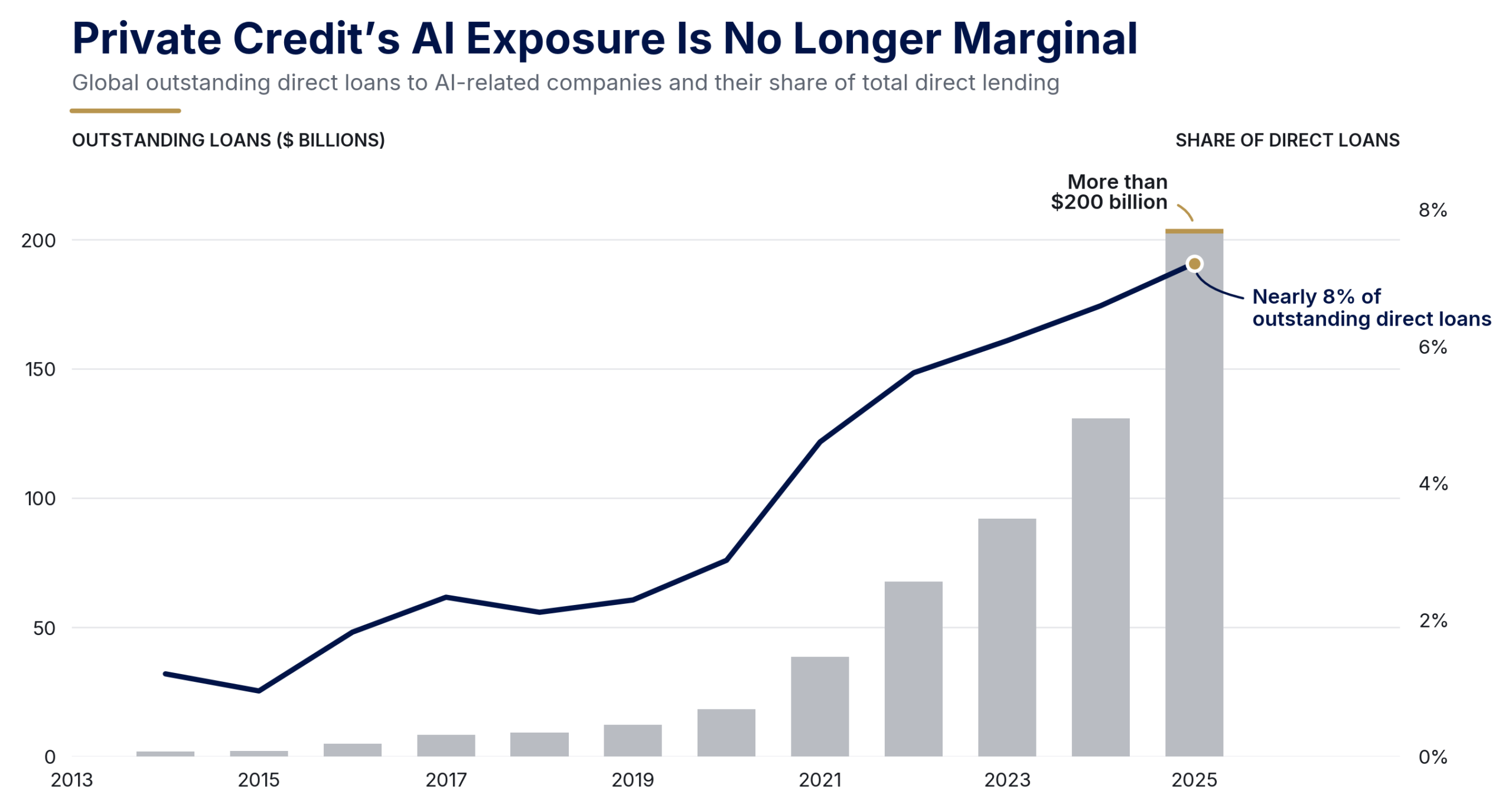
AI-related private credit has climbed from near zero to more than $200 billion and almost 8% of outstanding direct loans. The speed of the build-up shows how quickly the AI investment cycle has spread beyond public equity markets. Source: Bank for International Settlements, BIS Bulletin No. 120, Financing the AI Boom: From Cash Flows to Debt; PitchBook.
Private credit at that scale needs context. This is lending done largely outside regulated bank channels, typically to borrowers who don’t qualify for, or prefer not to use, public bond markets. The loans carry less disclosure. Valuations update quarterly rather than continuously. Redemption terms are often restrictive. The Financial Stability Board’s 2026 report on private credit vulnerabilities estimates the sector at roughly $1.5 trillion to $2 trillion globally and notes plainly that it remains “untested to a prolonged economic downturn.” It’s a large, fast-growing pool of financing with no meaningful history of stress testing.
The Bank of England has been unusually direct about what that means in practice. At an April event at Harvard Law School, Deputy Governor Sarah Breeden described private credit’s leverage as a “layer cake” stacked at the borrower, fund, and sponsor levels simultaneously, with limited transparency at each layer.
The Bank’s March 2026 Financial Policy Committee added that AI disruption risks were already showing up in software-sector valuations, uncertainty in fund valuations, and liquidity pressure at some private credit funds. A major central bank doesn’t describe emerging liquidity pressure without reason.
Leverage stacking has real consequences that are easy to miss in the financial structure. If an underlying AI infrastructure asset falls by 15% to 20%, a relatively modest decline for a speculative investment, the losses can intensify at each layer. By the time they reach the most exposed investors, a manageable drop in the asset’s value can threaten the solvency of an entire fund. Limited visibility across those layers also means regulators could miss the extent of the risk until redemption pressure or covenant breaches bring it to the surface.
The connection between private credit and regulated banking is also tighter than it looks from the outside. The FSB estimates roughly $220 billion in drawn and undrawn bank lending to private credit funds, along with credit lines, warehouse financing, and overlapping equity stakes. When private credit was a niche corner of finance, those links were usually ignored. At today’s scale, they’re a transmission channel. Stress in private credit can quickly move into the broader financial system.
How a Tech Repricing Reaches Ordinary Households
Most people with retirement savings didn’t make a conscious bet on AI. They don’t need to. Federal Reserve flow-of-funds data puts U.S. household equity exposure, including indirect holdings through mutual funds and retirement accounts, at roughly 46% of total financial assets as of early 2026. The BIS adds that U.S. stocks now account for about 64% of the MSCI Global Index, meaning a correction driven by U.S. tech valuations wouldn’t remain domestic.
Equity markets also tend to pull credit markets in the same direction. The Federal Reserve’s May Financial Stability Report noted that forward price-to-earnings ratios remained in the upper range of their historical distribution, while corporate bond spreads remained low by historical standards.
Bond issuance among the largest investment-grade cloud computing firms neared $100 billion in just the first quarter of 2026 and met strong investor demand. That demand is its own signal. Low spreads reflect a strong willingness to provide funding, but that willingness can disappear quickly, often before businesses have time to adjust their spending commitments.
When household equity wealth falls as corporate borrowing costs rise, the effects extend far beyond financial statements. Consumers spend less. Companies delay hiring. Small businesses facing higher financing costs pull back on investment. A construction boom built around expectations of continued AI capital spending can come to an abrupt halt when credit conditions tighten.
The pullback in business investment makes the problem worse. When AI-related companies face declining stock valuations and rising borrowing costs simultaneously, they have less money available for future expansion. Orders for semiconductors, networking equipment, power infrastructure, and construction services can all slow together.
Supply chains built around AI-scale demand are difficult to repurpose quickly. A slowdown that appears manageable at the top can hit much harder further down, where companies and workers have made long-term commitments based on demand that never reaches the expected level.
Power Costs and Inflation Add a Second Pressure Track
AI’s physical needs make the financial risk harder to contain within the sector. The BIS report warns that fast-growing demand for computing power is already pressuring electricity prices and input costs, with possible spillovers to inflation. A speculative boom that also tightens real-world supply can weaken the broader economy before the investment cycle unwinds.
The energy projections bear this out. The Energy Information Administration’s Annual Energy Outlook 2026 identifies data-center load as the dominant driver of long-term U.S. electricity growth. The International Energy Agency’s Energy and AI analysis projects that global data-center electricity consumption will more than double to around 945 terawatt-hours by 2030, with the United States accounting for the largest share of new demand. These aren’t speculative figures. They’re quasi-official assessments of demand already being contracted and built into grid planning.
When a food processor or cold-storage operator pays more for electricity because nearby data centers have taken up available grid capacity, AI investment is already affecting the wider economy. Higher energy costs flow through to producers and eventually reach consumers. Utilities managing uncertain demand, manufacturers facing rising input costs, and farmers making planting decisions based on energy prices are all dealing with the same capacity crunch created by the AI buildout. If electricity supply remains tight while AI demand continues to grow, the resulting inflation could affect families across the country.
The Macro Backdrop Leaves Fewer Clean Buffers
The BIS is concerned because the risks stretch well beyond a single sector, and the broader backdrop is already under pressure. Its Annual Economic Report warns that high public debt and the growing role of non-bank financial intermediaries have increased the risk of disruption in core government bond markets.
In the U.S. Treasury market, the BIS estimates that the probability of a stress event comparable to the 2008 financial crisis over any three-month period is roughly ten times higher when public debt is elevated than when it’s low. The report also notes that leveraged hedge funds have become critical intermediaries in sovereign debt markets, often relying on funding that can disappear quickly during periods of stress.
An AI bust would be most damaging if it occurred when Treasury market stability could no longer be taken for granted. If the Fed needs to deploy its balance sheet to stabilize Treasury markets during an AI-driven shock, its capacity to simultaneously fight inflation is constrained. The March 2020 experience showed that even a temporary seizure in Treasury markets requires a massive response. When that response is also needed to contain inflation expectations, central bankers are choosing between tools rather than deploying them in combination.
The IMF’s April Global Financial Stability Report adds its own layer. Global financial stability risks are elevated, the Fund says, and AI investment could slow significantly under adverse conditions, weighing on firms along the full AI value chain even if the direct systemic impact appears modest for now.
IMF’s Tobias Adrian warned that stock-bond diversification has become less reliable since 2020. Stocks and bonds have moved in the same direction with increasing frequency during sharp selloffs. When conventional hedges weaken at the same time stress scenarios are multiplying, the margin for error in portfolio construction narrows considerably.
Why “This Isn’t 2000” Is the Wrong Reassurance
The differences between today and the dot-com era are real. The BIS Bulletin acknowledges that macroeconomic and financial stability risks from the AI boom “appear moderate” for now because the primary spenders are profitable firms with real customers and strong cash flow. The IMF has reached a similar conclusion about the direct systemic impact of circular financing. The Fed’s May 2026 report also notes that total business and household debt relative to GDP has fallen to levels last seen in the early 2000s. The balance-sheet rot that preceded 2008 is not present in the same form today.
That stronger starting point can also make the boom more seductive. When the companies at its center are large, profitable, and strategically important, investors become more willing to accept opacity. Pension funds, insurers, retail asset allocators, and corporate treasury departments are unlikely to remain on the sidelines of a boom anchored by familiar companies with real earnings. They move deeper into it. Passive index investing has expanded that exposure in ways many investors may not fully appreciate.
The largest AI-adjacent companies now account for a substantial share of major equity indices. An investor who owns a broad U.S. stock index fund therefore carries meaningful exposure to the AI capital cycle without making an active allocation to AI. Because those positions are replicated across pension funds, sovereign wealth funds, and retirement accounts, a repricing would affect the savings of millions of households that believed they were simply owning “the market” rather than a concentrated investment theme.
There’s a quieter risk embedded in the way long-only institutional investors have built their positions over the past two years. A pension fund or endowment that increased infrastructure allocations in 2023 and 2024, driven by AI capex tailwinds, may find those holdings correlated with its private credit book and its large-cap equity exposure. The diversification benefit that justified each individual position may not survive when all three categories move together under stress.
The physical nature of the buildout also makes it harder to absorb the correction. Data centers, power-purchase agreements, semiconductor fabrication contracts, grid interconnection commitments, and long-term leases can’t be canceled as easily as software subscriptions.
If returns disappoint, the adjustment doesn’t stop at a stock ticker. It moves through bond markets, commercial construction pipelines, utility capital budgets, and regional labor demand, potentially for years. The BIS describes this scenario as a “protracted investment bust.” That distinction has practical consequences. Employment, local tax revenue, and regional capital allocation are affected very differently by a temporary market selloff than by a multiyear decline in investment.
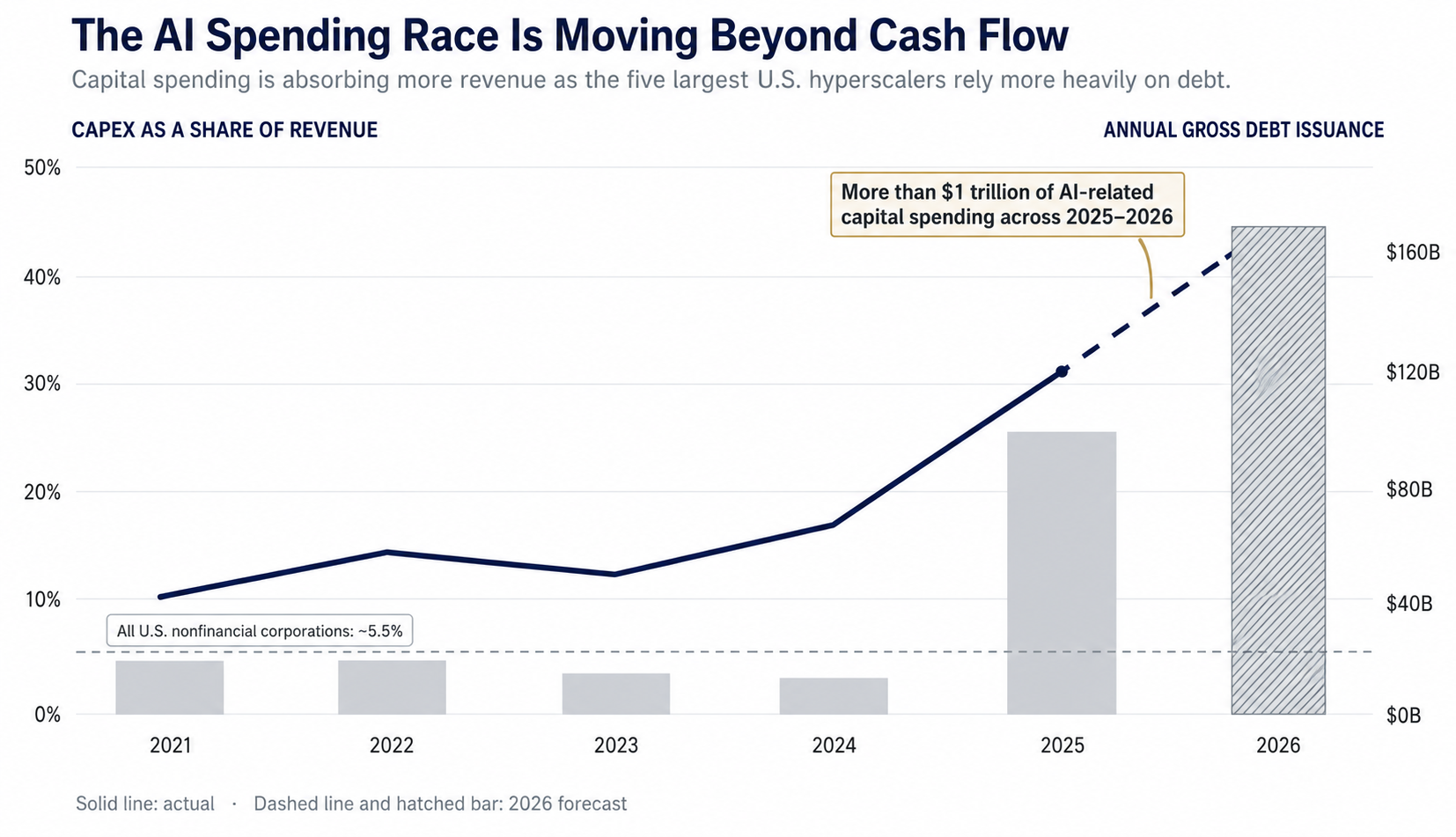
The five largest U.S. hyperscalers are devoting a rapidly rising share of revenue to capital spending while turning more heavily to debt markets. That shift makes the AI buildout more sensitive to any disappointment in expected returns. Source: Bank for International Settlements, Annual Economic Report 2026; S&P Global Market Intelligence; Bank of America; company communications.
Where Policymakers Are Placing Their Bets
The regulatory response is beginning to take shape, though it remains behind the current cycle. The FSB, IMF, and Bank of England have emphasized similar priorities: better disclosure of cross-holdings and purchase commitments in AI-related structures, greater supervisory visibility into bank exposures to private credit funds, and clearer accounting when the same collateral supports multiple financing arrangements.
Supervisors can’t stop a financing cycle by demanding better paperwork. But they can reduce the amount of hidden leverage that converts a valuation problem into a systemic one. That’s the difference between a sector correction and a wider credit event.
BIS General Manager Pablo Hernández de Cos put the broader stakes plainly at the June 2026 report launch, warning that “delay will only make the necessary adjustments more costly and worsen future trade-offs.” His remark addressed the broader policy mix rather than AI specifically, but it applies directly to private credit oversight. Opaque financial connections are far harder to map after a cycle has already turned.
Concentration Risk, Reserve Behavior, and Hard Lessons
For Americans, the implication isn’t a call to exit equity markets. It’s a call to audit what diversification actually means in 2026. A portfolio spread across U.S. large-caps, investment-grade corporate bonds, and private credit funds with exposure to AI infrastructure can appear diversified but may not be due to concentration risk. All three categories could be drawing from the same underlying assumption about AI-driven growth.
When the same assumption runs through public equities, corporate credit, private lending, data-center construction, and utility investment plans, the risk spreads. It can be hidden inside portfolios that still appear balanced on paper. The real question is how much money has already been committed as if the AI payoff is guaranteed. That’s where the BIS warning matters most.