
By Preserve Gold Research
Washington just put a price on political survival. Keep Republicans in control of Congress this November and the government will send $5,000 to every adult American citizen.
Analysts estimate the cost at roughly $1.35 trillion, adding to a federal debt burden that has already crossed $40 trillion. Tariffs, meanwhile, are expected to generate only about $125 billion in net revenue, leaving a wide gap between the promised benefit and the money available to pay for it.
Fiscal populism runs on a simple asymmetry. A $5,000 deposit is felt immediately. It shows up in a checking account, where a household can spend it, save it, or use it to pay down debt. The borrowing required to finance that payment is far less visible. Each household’s share is buried inside trillions of dollars in Treasury securities, future interest costs, and federal budgets that may not come due for years.
The idea isn’t new, and it doesn’t belong to one party. Cash rebates, refundable tax credits, subsidized loans, and debt relief all share the same shape. Each is a benefit citizens can see today, financed by costs that land, if they land at all, on someone else’s future ledger.
The $1.35 Trillion Price Tag Behind a $5,000 Check
Put the payment beside the federal budget and the size becomes clearer. CBO’s February baseline projected a $1.9 trillion deficit for fiscal 2026, equal to 5.8% of GDP. A $1.35 trillion payment, financed entirely through new borrowing, would run close to a quarter of the government’s expected revenue for the year. It would also exceed two-thirds of a deficit that was already historically large before any plans to cut checks were made.
By early September, CBO’s monthly budget review showed the government had run a $2.0 trillion deficit through the first 11 months of fiscal 2026. After adjusting for a shift in payment timing around the Labor Day holiday, the shortfall was running $82 billion ahead of the same period a year earlier.
This doesn’t mean that a large government payout is automatically unaffordable. Congress could pair it with new taxes, spending cuts, asset sales, or some other offset. Deficit spending isn’t inherently reckless, either. It can do good during recessions, wars, or a sudden collapse in private demand.
What matters more is the starting point. Lawmakers are debating an unusually large new transfer program while the government is already borrowing heavily. The economy isn’t in recession, and it isn’t facing a pandemic-scale shutdown.
That trajectory only gets steeper from here. CBO’s baseline puts debt held by the public, the share the Treasury actually borrows from banks, pension funds, and other outside investors, at 101% of GDP this year. That ratio climbs toward 120% by 2036 under current law.
A ratio that high hasn’t been tested in generations. The only period that comes close was the end of World War Two, when wartime borrowing pushed debt above 106% of GDP. It took decades to work that level back down.
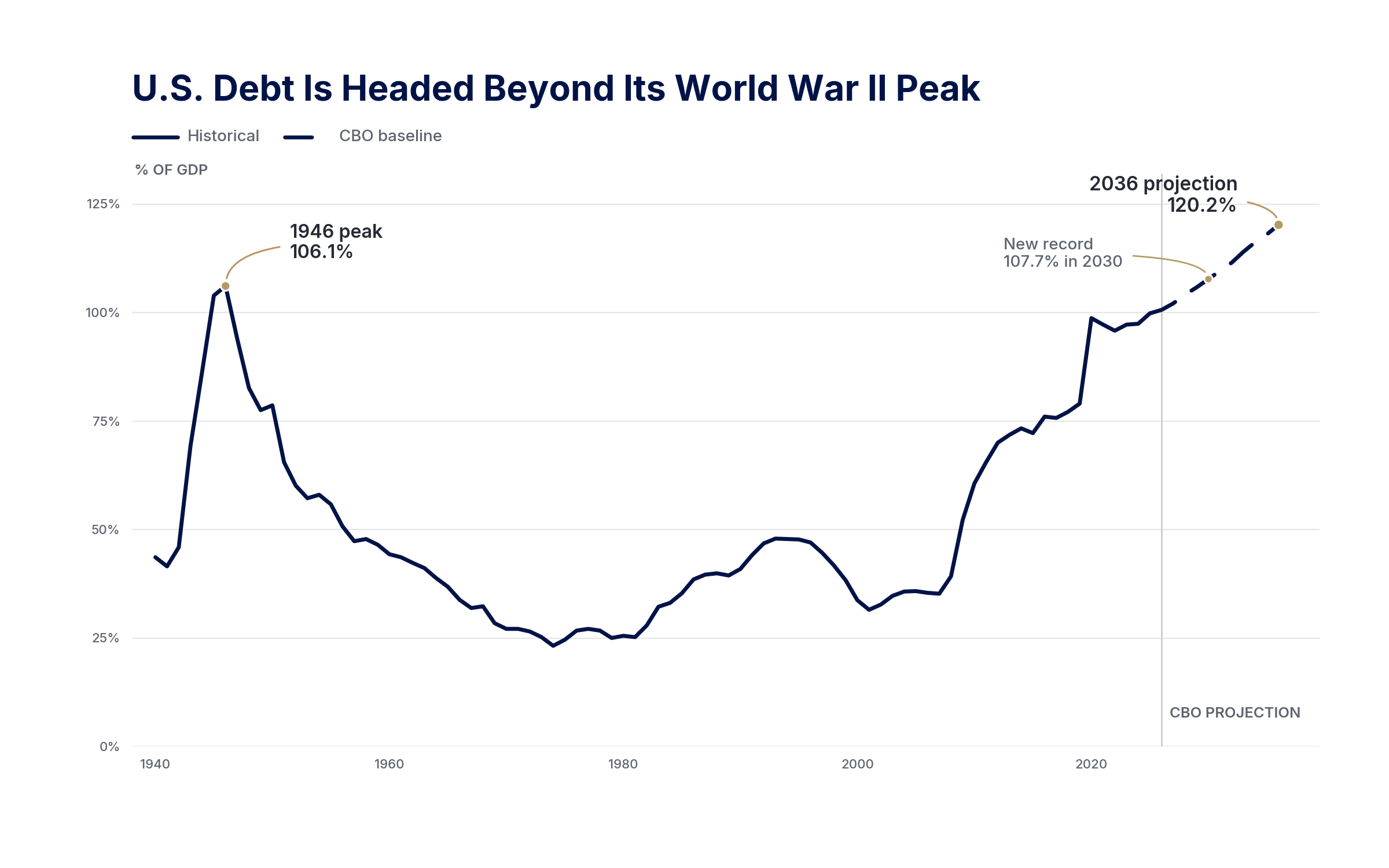
Federal debt held by the public is projected to surpass its post-World War II record around 2030 and continue climbing, reaching roughly 120% of GDP by 2036. Source: Congressional Budget Office, The Budget and Economic Outlook: 2026 to 2036; Office of Management and Budget.
Why Borrowing Makes Political Promises Easier to Make
Cash payments, rebates, and targeted subsidies let politicians attach a specific dollar figure to something voters can feel. There’s nothing inherently irresponsible in that. Whether a program makes sense depends on its design, its timing, and the condition of the economy when it arrives.
The trouble starts when the system rewards delivering a benefit faster than paying for it. A tax increase creates an identifiable loser who remembers the vote. A spending cut creates a constituency ready to fight it. Borrowing spreads the cost so thin that most people can’t remember the moment they were actually asked to pay for it.
Fiscal space can vanish this way, gradually, long before it vanishes all at once, like slack disappearing from a line pulled a little tighter every year.
The Fed’s July monetary policy report described the federal budget deficit as running around 6% of GDP in both fiscal 2025 and fiscal 2026. The Fed called that level “notably larger” than before the pandemic. It tied the gap to spending that already exceeds revenue, plus rising debt-service costs from higher interest rates and a larger debt load.
When debt is small, and interest rates are low, adding a new program barely moves the interest bill. Once both the debt stock and the rates paid on it have climbed, every new dollar borrowed carries a bigger shadow.
Interest has started acting like a mandatory program that Congress never explicitly voted to expand. Treasury’s Fiscal Data service recorded roughly $1.17 trillion in interest expense on the debt through July 2026, close to 19% of total federal spending for the period. That money doesn’t build a bridge. It doesn’t fund a research grant or cover a Social Security check. It just services promises made in earlier budgets.
As interest eats a bigger share of revenue, policymakers’ options narrow. Raise taxes, cut other spending, accept larger deficits, or hope faster growth improves the math. None of those choices is politically easy, which helps explain why postponement has become the default in Washington.
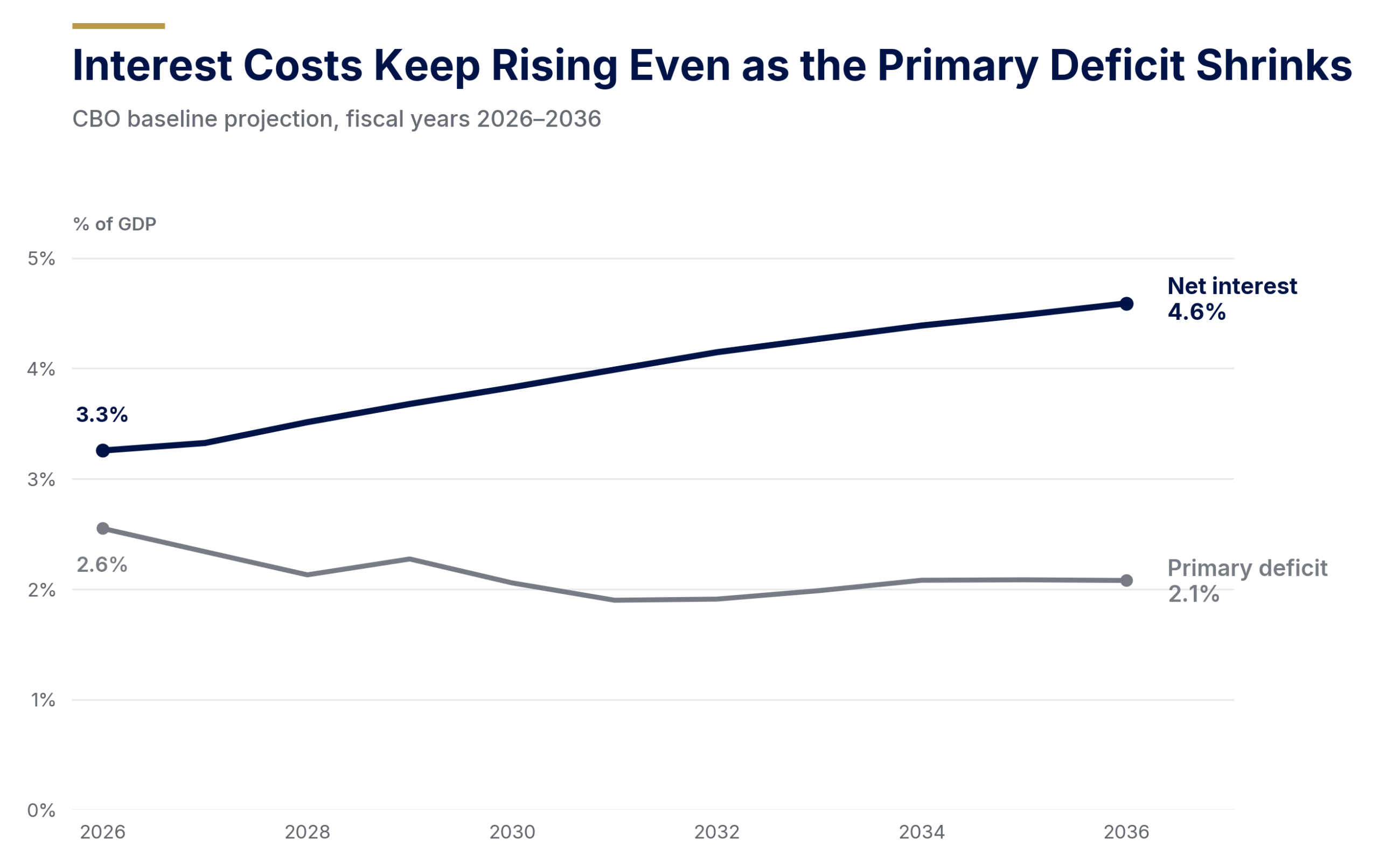
CBO expects the government’s underlying primary deficit to narrow over the coming decade, but rising interest costs more than offset that improvement, pushing the overall deficit higher. Source:Congressional Budget Office, The Budget and Economic Outlook: 2026 to 2036, Figure 1-1 and underlying budget projection data.
How Washington’s Borrowing Pushes Into the Treasury Market
Federal borrowing has limits, even if those limits aren’t always obvious. Every new dollar Washington borrows eventually becomes Treasury debt that investors have to buy at the yield the market demands.
On August 3, Treasury said it expected to borrow $739 billion in privately held debt during the July-through-September quarter. That was $68 billion more than it had projected in May. It penciled in another $628 billion of borrowing for the following quarter.
Large issuance by itself doesn’t create a funding crisis. Treasury securities remain core collateral for banks, pension funds, insurers, and foreign reserve managers worldwide. But demand has a price, and that price has been climbing.
The Treasury’s own daily yield curve showed the 10-year yield near 4.95% and the 30-year yield at 5.37% on September 10. Matt Maley, chief market strategist at Miller Tabak, warned that his firm remains “concerned about the Treasury market.” He pointed to rising fiscal deficits, heavy debt issuance, and corporate borrowing, all pressuring long-term yields.
Investors can be willing buyers of Treasuries while still demanding higher yields to hold them. On tens of trillions of dollars of debt, even a small rate increase becomes expensive as maturing bonds are refinanced at higher borrowing costs.
CBO measured that sensitivity in April. If interest rates ran just 0.1 percentage point higher each year than its baseline assumed, cumulative deficits from 2027 through 2036 would grow by $379 billion. The deficit in 2036 alone would be $60 billion larger.
Larger deficits require more borrowing. More borrowing raises the pool of debt exposed to whatever rate the market charges that year. Higher debt-service costs then widen future deficits, which require still more borrowing.
This feedback loop keeps repeating.
Households Feel the Bill Before Washington Does
A rising Treasury yield doesn’t stay contained to the bond market. Mortgage rates, auto loans, small-business credit lines, and credit-card rates all take some cue from the same long-term borrowing costs the government is competing for.
A homeowner refinancing this fall doesn’t experience a debt-to-GDP ratio. They experience a quoted rate that’s higher than it otherwise would be. The government is also in that same market, borrowing hundreds of billions of dollars every quarter. A small manufacturer renewing a line of credit faces the same problem on a shorter timeline, with far less room to absorb it.
The proposal’s timing looks awkward against that backdrop. Add a large, deficit-financed payment into household budgets on top of it, and the risk compounds. The government is already competing hard for lenders’ money. A payment funded by more borrowing could push those same rates higher for the very households that just received a check.
The Fed Won’t Absorb Washington’s Bill for Free
Borrowing is only one channel for a deficit-financed transfer. Inflation is another, though the link isn’t automatic or one-to-one. What happens to a $5,000 check depends on several things.
Does the household spend it or save it? How fast can businesses expand supply to meet new demand? How much slack still exists in the labor market?
During a deep recession, extra demand can lift output and jobs more than prices. In an economy already running close to capacity, the same demand can show up as higher prices or prompt a tighter Federal Reserve.
The current backdrop matters here. BLS data put consumer prices up 3.4% through August, with core inflation, which excludes food and energy, running 2.4% annually. Prices haven’t been climbing as fast as they were a year earlier, but they also haven’t returned to the Fed’s target.
That gap between the goal and the reality isn’t just a line on a chart the Fed watches. It’s the reason a small-business owner refinancing a loan this fall can’t count on falling rates just because Washington needs them to fall.
The Fed held its benchmark rate at 3.5% to 3.75% on July 29, according to its FOMC statement, citing inflation that remained above its 2% goal. “The Committee will deliver price stability,” the FOMC said in its statement, with three officials dissenting in favor of an immediate rate increase.
Fed Chair Kevin Warsh reinforced that message weeks later. Speaking at the Jackson Hole symposium on August 28, he called the central bank’s 2% inflation goal a “firm, fixed target.” He said it was “the Fed’s job to deliver stable prices.” He added that households with little savings or investments bear the highest cost when inflation runs too hot, or the job market suddenly weakens.
This is where fiscal and monetary policy can collide. Congress and the White House can pump demand into the economy through spending or tax policy. The Fed, working under a separate mandate, may decide that demand is already running ahead of supply. Its main lever is the short-term interest rate, and it can lean on that lever regardless of what elected officials just promised voters.
If fiscal policy adds fuel while inflation sits above target, the Fed may cut rates less than it otherwise would. It could also hold its restrictive stance longer than planned. Households then feel both sides of the same policy at once, a benefit check in one hand and a higher borrowing cost in the other.
The government faces its own problems that come with higher rates. When the Fed raises rates to control inflation, the Treasury eventually has to refinance more of its debt at those higher borrowing costs. CBO estimated in April that a scenario with higher inflation and correspondingly higher interest rates would add roughly $311 billion to cumulative deficits between 2027 and 2036.
That doesn’t mean the Fed should keep rates low to make Washington’s debt easier to finance. Doing so would risk unmooring inflation expectations. The problem is that a government carrying this much debt has become more exposed to the same interest-rate tool the Fed relies on to fight inflation.
The Real Limit on U.S. Debt May Come From the Bond Market
The United States has a statutory debt ceiling and a formal appropriations process. But these are legal constraints, and when enough lawmakers agree, Congress can change them.
Economic limits are different. The country could keep running large deficits for a long time without a single failed auction. Investors could demand more yield to hold long-duration debt. As a result, the dollar could drift. Private borrowers could get crowded out as they compete for the same capital while interest expenses keep eating a bigger share of revenue.
That’s why the debate can’t be reduced to a simple question of whether America can still borrow. A government can retain full access to financial markets while steadily losing room to maneuver. It can pay every bill on time while discovering that new programs cost more to finance, recessions are harder to respond to, and it needs more tax revenue to service earlier commitments.
CBO’s baseline shows how this plays out over the next decade. Deficits keep climbing under the agency’s existing-law projections, reaching $3.1 trillion by 2036, or 6.7% of GDP. Rising net interest costs, CBO said, “drive much of that increase.”
Faster growth could change that path. The Fed’s July report found business productivity had grown about 2.1% a year since late 2019, above the prior cycle’s 1.5% average. But relying on that outcome is different than budgeting for it. Productivity gains can expand fiscal room. They can also tempt politicians to spend the expected gains before they ever show up in a tax return.
Bringing the $5000 dividend proposal back into view, supporters can reasonably argue citizens deserve a share of national prosperity. Critics can reasonably ask whether a government already running trillion-dollar annual deficits has any surplus left to distribute in the first place.
A corporate dividend, by definition, gets paid from profits left over after every other obligation is settled. A federal payment issued while spending already exceeds revenue works differently, unless it’s matched by new revenue or genuine spending cuts elsewhere. The label matters less than the accounting. If the money is borrowed, today’s household benefit becomes tomorrow’s government liability, whatever name Washington puts on the check.
The same logic reaches well past this one proposal. Any political coalition can reach for fiscal populism, whether that be cash payments, tax cuts, subsidies, debt cancellation, or protection from rising costs. What they share is a visible benefit today, financed by a cost most voters can’t quite see yet.
What Persistent Deficits Could Mean for the Dollar
For Americans, the question isn’t whether the United States is about to run out of money. A government that borrows in its own currency doesn’t face the same kind of cash constraint a household does.
The real question is what form the eventual adjustment takes. It can come through higher taxes. It can come through slower spending growth. It can come through faster real growth, higher borrowing costs, or, over long stretches, a quiet erosion in what a dollar actually buys.
Treasury securities stay valuable because they’re a contractual promise of future dollar payments, backed by the U.S. government. Stocks represent claims on businesses that can, imperfectly, raise prices and revenue to keep pace with inflation. Inflation-protected bonds adjust their principal with the CPI. Cash offers safety and speed. Foreign assets spread out the country-specific risk.
Gold sits in a different category because it isn’t a promise from anyone. Unlike a Treasury bond, a bank deposit, or a corporate note, an ounce of gold doesn’t depend on the federal government’s willingness to tax or borrow. It doesn’t depend on any particular monetary policy either.
That becomes more relevant as federal obligations keep growing. A portfolio built around the assumption that inflation stays the same or that the dollar remains stable is making several bets at once. Gold offers exposure to something that doesn’t rely on those same conditions.
Persistent fiscal expansion doesn’t guarantee any particular outcome. What it does is widen the range of possible outcomes. Higher taxes, slower spending growth, stronger inflation, higher interest rates, or some combination of them could all become part of the adjustment over time.
The $5,000 dividend may never reach a bank account. But what the proposal proved is that Washington can add a new promise on top of a $40 trillion debt without anyone asking who pays for the old one.