By Preserve Gold Research
Brent crude settled at $100.69 a barrel on July 23, its first close above $100 since May. Iran’s Revolutionary Guards said an explosion had set a tanker ablaze on the southern edge of the Strait of Hormuz that same week. As the news spread, the national average price of gasoline climbed to $4.09 a gallon.
These are the clearest signs yet that the war in the Middle East is beginning to reach deeper into the U.S. economy. If energy prices remain high, the pressure could continue to move beyond the pump and into trucking costs, airline fuel hedges, grocery bills, and household inflation expectations across the country.
The price shock also points to something larger. Iran doesn’t need to become an economic power to become a major geopolitical one. It only needs to stay indispensable to the world’s biggest vulnerabilities. Those vulnerabilities include energy chokepoints, sanctions workarounds, and cracks in the financial system that a fractured world now depends on to function.
The International Monetary Fund described the global economy in July as being pulled by the lingering effects of the energy shock from the war in the Middle East. A technology boom offset some of the damage. Petya Koeva Brooks, the IMF’s deputy research director, said that the global outlook is being shaped by “two powerful forces pulling in opposite directions.” Iran sits near the center of one of them.
A state can be poor, sanctioned, and internally strained and still gain strategic weight. It needs only to disrupt an energy chokepoint, widen cracks in the payments system, deepen ties with other revisionist powers, and force everyone else to price in uncertainty. That’s the story unfolding in Iran, and it carries real consequences for American households.
A Chokepoint Gives Iran Leverage It Never Earned
Start with geography. Oil flows through the Strait of Hormuz averaged 20 million barrels a day in 2024, according to EIA analysis. That’s equal to about a fifth of global petroleum liquids consumption. Roughly a fifth of global LNG trade transited the same strait that year, most of it from Qatar. When one waterway carries that much of the world’s energy, the country sitting on one side of it matters globally, whether or not its own economy is thriving.
Iran has never held formal control over that waterway. The strait meets the definition of an international strait under the U.N. Convention on the Law of the Sea. Article 37 of that treaty grants every ship a right of transit passage that “shall not be impeded.” Iran signed the convention decades ago but never ratified it, and it has no equivalent of Turkey’s treaty-based authority over the Bosphorus, either. “There is no ‘Strait of Hormuz Convention,'” a Just Security legal analysis concluded, “and Iran cannot conjure one through unilateral assertion.”
None of that has stopped Iran from acting as though it holds the waterway. Iran’s Revolutionary Guards laid mines in the strait beginning in March. Vessels have hit them as recently as July 18, when the Guards said two tankers caught fire on the southern route near Oman. Drone strikes and missile attacks have followed the same pattern. Iranian forces fired at least two missiles at a Qatari liquefied natural gas tanker and a Saudi-flagged crude carrier on July 7, Al Jazeera reported. Iran has also charged ships as much as $2 million a crossing for safe passage. That fee has no basis in the treaty it never ratified.
A ceasefire brokered in mid-June calmed nerves, albeit briefly. Trump and Iranian President Masoud Pezeshkian signed a 14-point memorandum on June 17. It ended a naval blockade and reopened the strait, and required Iran to use its best efforts for safe passage without charge for 60 days.
But the relief didn’t last. Iran launched a drone strike on a ship just eight days later, after the cargo vessel attempted to navigate around the Iranian-administered territorial waters. By July 7, it had struck another three vessels. Washington revoked Iran’s oil-export license in response, and within two days Trump declared the ceasefire “over” after ordering strikes on dozens of Iranian targets.
The reprieve never returned. Iran rejected a mediator-brokered ten-day ceasefire in late July, arguing that any deal leaving the strait’s control unresolved wasn’t worth signing. Markets had priced in an open strait for as long as the truce held.
Iran also ranks second in the world for natural gas reserves and fourth for proven crude oil reserves. That matters less for what Iran can sell than for what it can threaten to interrupt.
Saudi Arabia, Kuwait, Iraq, Qatar, Bahrain, and the United Arab Emirates all remain exposed to traffic through Hormuz. Only about 2.6 million barrels a day of Saudi and Emirati pipeline capacity could bypass the strait if it closed, the EIA estimated. That capacity helps. But it comes nowhere close to replacing a real closure.
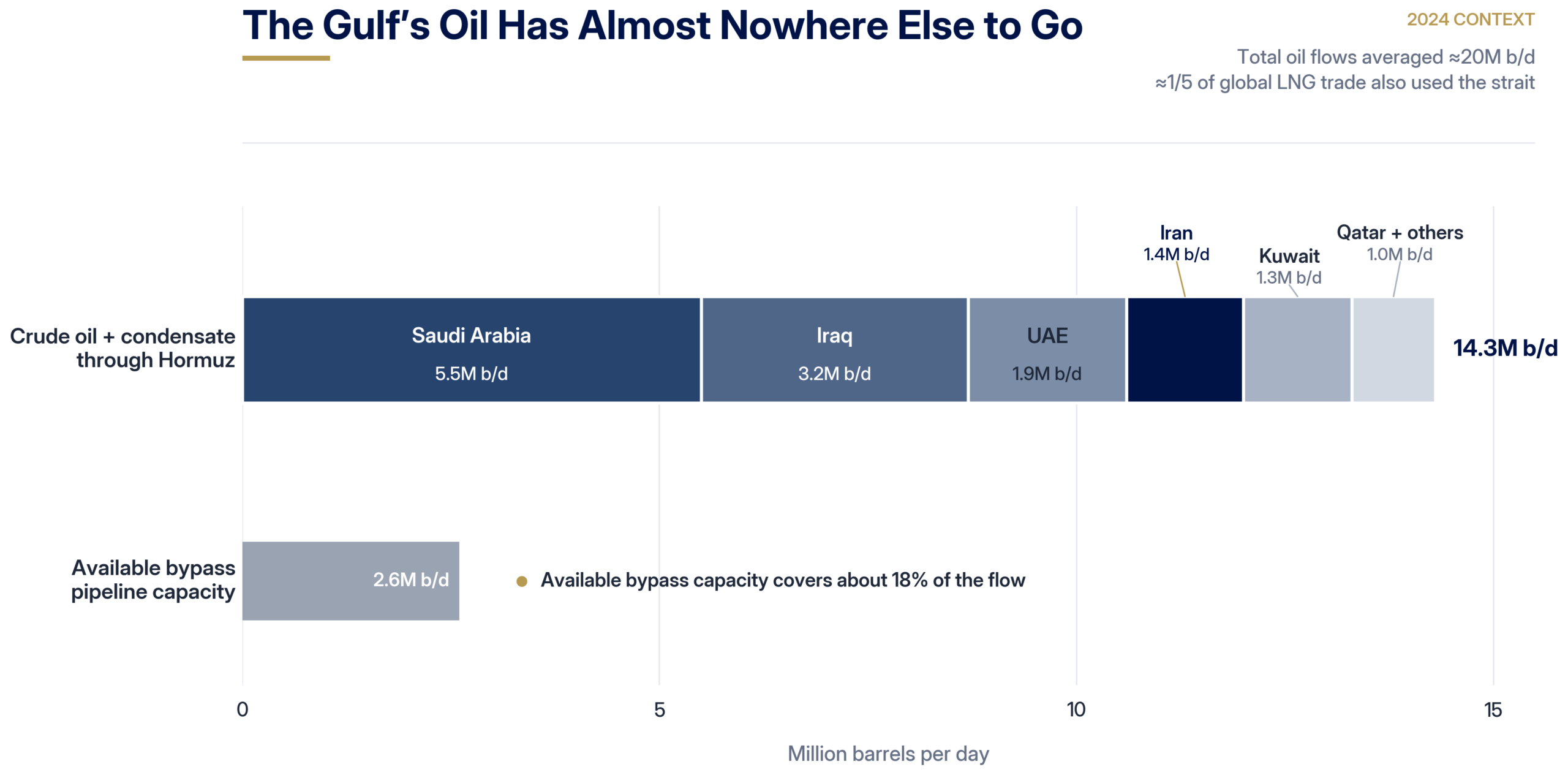
Nearly 14.3 million barrels of crude oil and condensate passed through the Strait of Hormuz each day in 2024. Available Saudi and Emirati pipeline capacity could reroute only about 18% of that volume, leaving the Gulf’s largest exporters heavily dependent on the same narrow exit. Source: U.S. Energy Information Administration, Short-Term Energy Outlook, and EIA analysis based on Vortexa tanker-tracking data.
Energy supply chains can’t reroute themselves on command. Producers around the Persian Gulf shut in an estimated 8.3 million barrels a day of crude production in June, according to the EIA’s July forecast. That was down from 11.2 million barrels a day in May, but it still represented a major supply loss as the war was already pushing energy prices higher.
The U.S. Treasury’s Office of Foreign Assets Control issued an alert in May. It warned of Iranian threats to shipping and demands for “toll” payments in exchange for safe passage through Hormuz. A country that can credibly threaten to tax a fifth of the world’s petroleum consumption has moved into the realm of system-level influence, whatever its GDP says.
The IMF projects U.S. growth at 2.3% in 2026, insulated in part by America’s status as a net energy exporter. Insulation isn’t immunity, though. Higher fuel costs are already flowing into retail prices, and global disinflation has stalled. Iran doesn’t need to sink the U.S. economy. It only needs to keep injecting enough energy uncertainty to complicate the Federal Reserve’s next move and squeeze household budgets a little further.
Iran’s Economy Is Collapsing as Its Leverage Grows
The paradox is that all of this is happening while Iran’s domestic economy falls apart. Iran’s currency depreciated 44% in early March, and inflation reached 62.2% year over year in February, according to the World Bank. Food inflation was even sharper, hitting 99% over the same period. A large share of Iranians were already living on less than $8.30 a day in 2021 purchasing-power terms before the war deepened the strain.
Those numbers rule out any simple story about Iranian strength. Tehran hasn’t solved development or stabilized prices. High inflation, falling real incomes, damaged infrastructure, and chronic water and power shortages are suppressing activity.
Poverty is expected to keep rising as the conflict worsens import shortages and food pressure. A collapsing currency also makes sanctions-evading trade more attractive at home, since dollars and yuan hold value the rial no longer can.
That’s leverage without prosperity.
Modern geopolitics rewards countries that can shape the downside of other people’s forecasts. Iran’s collapse at home hasn’t stopped it from becoming more expensive for the rest of the world to ignore. Growth across the Middle East and Central Asia is projected to fall to just 0.7% in 2026 before rebounding in 2027, the IMF’s July update found.
The reason is that Hormuz disruptions have run longer than expected. Deniz Igan, an IMF official, told reporters that directly affected oil exporters face longer disruptions across oil, gas, refining, logistics, transport, and tourism.
Productive strength and disruptive strength don’t always move together in a fragmented world. Russia showed that after its 2022 invasion of Ukraine. Iran is showing it now. Sanctions pressure hasn’t stopped Tehran’s oil exports from improving. Iran’s 2026 growth forecast was actually revised upward from April, the IMF said.
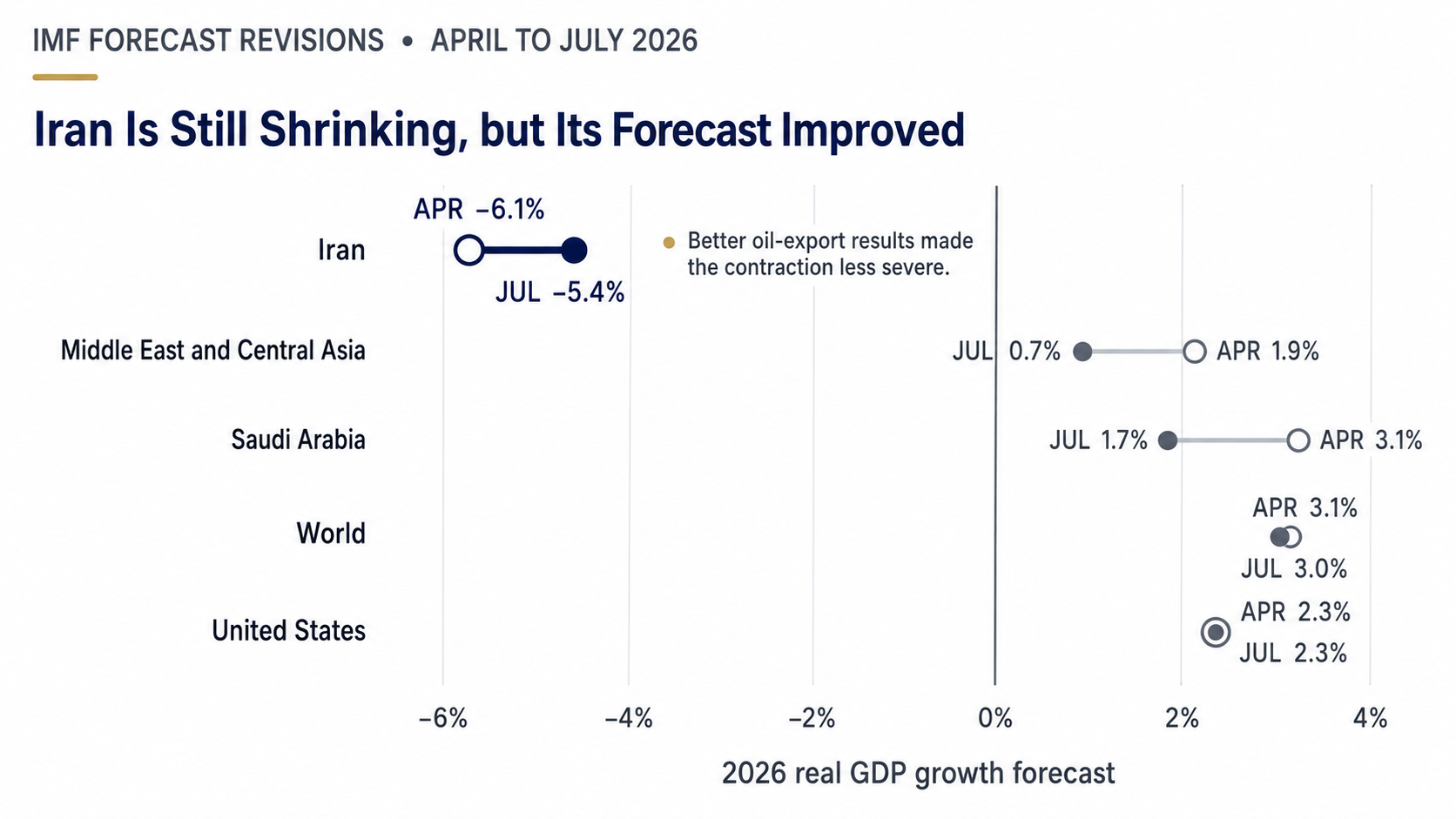
Iran remains the clear economic outlier, with the IMF still forecasting a severe contraction. But while the regional outlook deteriorated between April and July, stronger oil exports made Iran’s expected decline slightly less severe. Source: International Monetary Fund, World Economic Outlook, April 2026, and World Economic Outlook Update, July 2026.
The revision reflected stronger oil-export results and what Igan called “some relaxation of the restrictions on the country’s exports.” The Treasury’s OFAC issued General License U and then General License X in 2026, authorizing limited sales of Iranian-origin crude, petroleum, and petrochemical products. A war economy can force selective exceptions even from the government writing the sanctions.
Sanctions Built a Shadow System Iran Now Controls
Years of pressure have pushed Tehran to build systems designed to function without Western approval. A Treasury press release from April said China-based “teapot” refineries continue to play a vital role in sustaining Iran’s oil economy. It named one refinery, Hengli, as among Iran’s largest customers.
The Treasury also called Iran’s shadow fleet the “critical link” between Iranian producers and buyers in Asia. Together, committed refinery customers and a shadow shipping network create a durable sanctions workaround. Once those arrangements begin generating profits for participants on both sides, they become far harder to dismantle.
The Treasury sharpened that point in May. Iranian exchange houses facilitate billions of dollars in foreign-currency transactions each year, while shadow-banking networks help Tehran evade sanctions and move funds tied to oil and petrochemical sales.
Treasury Secretary Scott Bessent said Iran’s shadow banking system “facilitates the illicit transfer of funding for terrorist purposes.” His policy answer was more sanctions. The market reality is different. Even under maximum pressure, Iran still moves oil, money, insurance risk, and shipping through a growing web of opaque intermediaries.
A shipping insurer pricing war-risk premiums on a tanker transiting the Gulf is pricing exactly this kind of opacity into every contract. So is a commodities trader hedging against a shadow-fleet vessel that goes dark for a week.
Every barrel sold through those routes carries a second purpose. Iranian oil revenue is tied to ballistic-missile and advanced conventional-weapons production and to UAV proliferation in third countries, a February Treasury sanctions release said. Shadow-fleet vessels serve as the regime’s primary source of revenue. Each transaction that slips through an opaque channel is a commercial event and a piece of a security problem at the same time.
Tehran has been explicit about wanting to formalize this. Speaking to a summit of Eurasian Economic Union leaders, President Masoud Pezeshkian said the Iran-EAEU free trade agreement had created “exceptional opportunities.” He argued that using it fully would require “independent and anti-sanction banking infrastructure.” He called for financing joint projects through the Eurasian Development Bank and for a settlement system built on national currencies rather than dollars.
Eurasian Allies Are Giving Iran a New Foundation
The broader monetary backdrop makes Tehran’s push look less isolated than it once did. BRICS leaders have welcomed greater use of local currencies and discussed a new cross-border settlement infrastructure called BRICS Clear. The European Central Bank noted this in a 2025 report on the euro’s global role. China’s Cross-Border Interbank Payment System grew 22% in 2024 to around $6 trillion in fourth-quarter transaction value alone. These systems don’t threaten dollar dominance on their own. They do, however, give sanctioned states more room to survive and, at times, coordinate with one another.
War accelerates that adoption. Countries that might have drifted gradually toward local-currency settlement now have a reason to move faster. Iran benefits even though it didn’t build the system, because it’s one of the first large test cases for how these alternatives perform under pressure. Surviving inside those channels makes Tehran more useful to partners who also want a hedge against Western financial leverage. Each additional partner that transacts with Tehran outside dollar channels makes the next round of U.S. sanctions slower to bite and easier to route around.
The diplomatic shift began before the current war. Chinese Foreign Minister Wang Yi said the Beijing Agreement’s restoration of ties between Saudi Arabia and Iran had set off a “wave of reconciliation” across the Middle East. He called it a “major victory for dialogue and peace.”
China’s mediation produced more than a symbolic handshake. It showed that Iran could return to regional diplomacy through a channel centered on Beijing rather than Washington, giving China a larger role in shaping the Middle East’s political balance.
Formal bloc politics followed. The 2024 Kazan Declaration says BRICS sees “new centers of power” shaping a “more equitable, just, democratic and balanced multipolar world order.” It also urges continued work by finance ministers and central bank governors on alternatives to the current monetary system. This puts Tehran inside the most organized critique of Western financial primacy that exists outside a formal military alliance.
The Shanghai Cooperation Organization went further still. Member states called the military strikes on Iran unacceptable, the SCO Secretariat said in March. They expressed “solidarity with and support for the Government and the people of Iran.” The statement falls short of a military guarantee. However, it still makes Iran a beneficiary of collective political backing from a bloc spanning major nuclear powers and enormous Asian markets.
Russia has gone the furthest. The Iran-Russia Comprehensive Strategic Partnership Treaty commits both sides to deepen cooperation across security, defense, transport, and trade. It frames the partnership as a contribution to a “new just and sustainable multipolar world order.” The treaty even reaches into transport corridors linking the Persian Gulf to the Caucasus, Central Asia, Russia, and onward to Europe and South Asia.
Corridor politics rarely makes headlines, but it’s how a sanctioned state can turn geography into lasting influence over customs, warehousing, and settlement systems. Those networks may endure long after any single ceasefire.
Lost Nuclear Oversight Adds a Layer of Uncertainty
The war has provided little clarity on Iran’s nuclear program. Analysts say, if anything, it’s made them harder to answer. The International Atomic Energy Agency said it stopped in-field verification activity in Iran in February because of the military conflict. Lower visibility leaves Iran’s actual nuclear capability an open question, and open questions force adversaries to price in worst-case scenarios.
That loss of visibility ripples well beyond the nuclear program. It affects the perceived risk to energy infrastructure, the cost of maritime insurance, shipping security, and the willingness of outside powers to escalate the conflict.
Weaker oversight and a growing flow of weapons reinforce one another, making both problems harder to contain. Insurers, defense planners, and energy traders are all trying to price the same uncertainty from different directions. None of them can afford to wait for clarity that may come too late.
There is a broader lesson buried in that fact. A country gains bargaining power simply by proving coercion has limits. Bombing and sanctions haven’t restored nuclear transparency, ended oil flows, dissolved proxy networks, or pulled Iran’s partners away. External pressure has raised Tehran’s risk premium without removing Tehran from the table. That makes Iran harder to intimidate and more central to every negotiation over ceasefires, shipping, and sanctions enforcement going forward.
Whether Iran is “winning” depends entirely on how the question is framed. If winning means prosperity for its citizens, the data say no. If it means more diplomatic relevance, deeper Eurasian ties, and a greater capacity to impose costs on others, the picture is far more troubling for Washington.
Central Banks Are Already Pricing In the Fallout
For Americans, the first consequence is that Iran has become a transmission line for economic volatility. Global growth will run at 3.0% in 2026, the IMF’s July update projects, with the war shock weighing hardest on energy importers and already-vulnerable economies. Global headline inflation has also been revised up to 4.7%.
The second consequence is that sanctions now operate in a more contested world. Several countries have pushed for alternative cross-border payment systems, and fragmentation in the international monetary system keeps growing, the ECB’s 2026 report on the euro’s global role found.
In a related release, ECB President Christine Lagarde said central banks had continued adding to gold holdings amid persistent geopolitical tensions even as alternative payment systems spread. Iran isn’t the cause of all that fragmentation. But it is one of the reasons the fragmentation keeps getting harder to ignore. A more fragmented reserve system also complicates U.S. deficit financing, since fewer captive buyers can be assumed to show up at every Treasury auction on the old terms.
The third consequence is strategic, and it challenges one of Washington’s long-held assumptions. Conventional thinking suggests that enough pressure will eventually leave a hostile state isolated, weakened, and easier to contain. That’s not the case for Iran.
A sanctioned state with valuable geography, large energy reserves, covert shipping networks, willing buyers, and support from major non-Western powers becomes harder to manage over time. Pressure can damage the domestic economy while also pushing the country to build new trade routes, financial channels, and political alliances beyond Washington’s reach.
The World Bank and the IMF document the damage inside Iran. The Treasury, the SCO, BRICS, and the text of the Russia-Iran treaty document the adaptation outside it. Together they describe a state growing weaker at home and more consequential abroad in the same stretch of time.