
By Preserve Gold Research
The Bureau of Labor Statistics erased 103,000 jobs from its May and June counts on August 7. The same morning, it reported that payrolls fell by 23,000 in July. The unemployment rate slipped to 4.1%. Average hourly earnings for private workers rose just two cents, to $37.62.
Revisions of that size suggest a labor market that has moved beyond routine cooling. May’s payroll gain was cut from 129,000 to 63,000. June, first reported at 57,000, was revised down to just 20,000, according to BLS. Hiring has slowed to a standstill even as large-scale layoffs remain somewhat rare. That leaves the labor market with very little room to absorb whatever comes next.
While this doesn’t mean a recession is imminent, several signals now point in that direction. Hiring is weak. Fewer people are working or looking for work. Wage growth is cooling. Earlier job gains keep getting revised away. Together, these trends suggest the labor market is losing momentum beneath a headline unemployment rate that still looks relatively stable.
The Hidden Revision That Erased Three Months of Hiring
BLS estimates that a single month’s payroll number carries a margin of error of about plus or minus 122,000 jobs, according to the agency’s release. That’s roughly a 90% confidence band. A reported drop of 23,000 can’t, by itself, prove the economy shed jobs across the board.
The newest estimates are also incomplete by design. BLS builds each monthly figure from employer surveys that keep arriving for weeks after the initial release. A number isn’t considered final until two rounds of revisions have caught up with nearly all of the sample.
But that caveat cuts in both directions. July could still be revised higher. The same report that carries that possibility also confirmed that May and June were weaker than anyone believed at the time. The revision process is part of the warning here.
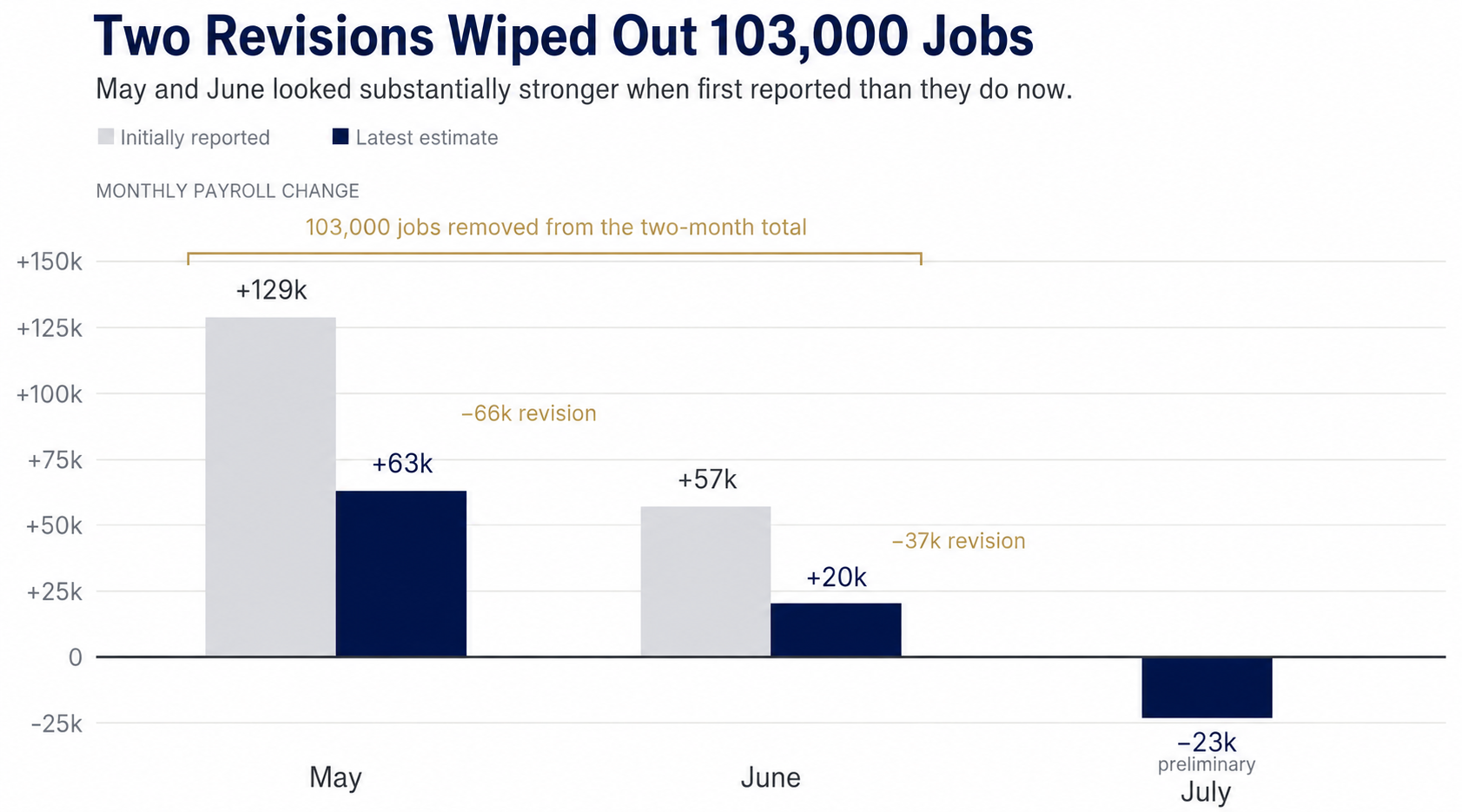
May and June initially appeared to add 186,000 jobs. After revisions, that gain was cut to 83,000, a 103,000-job difference, before payrolls turned negative in July. Source: U.S. Bureau of Labor Statistics, Current Employment Statistics, Employment Situation – July 2026.
Federal Reserve Vice Chair for Supervision Michelle Bowman laid out how she reads data like this in a May speech. Monthly figures move around and get revised often, she said. That’s why she watches the average gain over several months, along with the mix of hiring, openings, layoffs and wages, according to her remarks.
Measured her way, the picture has worsened. The three-month average change in payrolls fell to just 20,000 in July, down from 77,000 the month before, according to TD Economics. Forecasters were nowhere close. Economists had expected an increase of about 80,000 jobs, and the miss was large enough to move markets within minutes, Reuters reported.
The weakness wasn’t spread evenly. Government payrolls fell by 53,000, with local government education accounting for 50,000 of that drop. Retail lost about 19,000 positions, and leisure and hospitality shed 40,000, according to BLS.
A worker laid off from a school cafeteria doesn’t experience any of this as an average. They experience it as a job search in a market where openings have grown scarce, and employers can afford to be picky.
Private payrolls rose by 30,000, led by a 22,000 gain in construction, BLS figures show. Thomas Feltmate, director and senior economist at TD Economics, offered a useful qualifier. He called July a “soft report, but perhaps not as dire as suggested by the headline payrolls print.” The local-government decline may not repeat, he said, and some of the leisure and hospitality drop could reflect a pullback from earlier World Cup-related hiring.
That’s a fair caution that doesn’t undo the larger concern. Feltmate also said the size of the downward revisions reinforced TD’s view that hiring earlier in 2026 had been overstated.
The next test of that view arrives soon. BLS will publish its preliminary annual benchmark revision on August 28. The correction draws on unemployment-insurance tax records covering nearly every employer, not survey responses. A final version follows in February 2027. If those tax records confirm hiring was weaker than the monthly surveys showed, July stops looking like it’s a one-off.
The Jobless Rate Fell While the Workforce Shrank
At first glance, a falling unemployment rate alongside disappearing jobs looks like a contradiction. Part of that comes from how BLS builds these numbers. Payroll employment comes from a survey of businesses. The unemployment rate comes from a separate survey of households, and the two can diverge sharply, especially around turning points.
The bigger reason is simpler. The labor force itself shrank in July.
The civilian labor force fell by 264,000. Household employment dropped by 87,000, yet the ranks of the officially unemployed fell by 178,000, according to BLS. Someone who stops actively looking for work generally stops counting as unemployed at all. A falling jobless rate can exist next to a weakening job market, as long as enough people step back from the search.
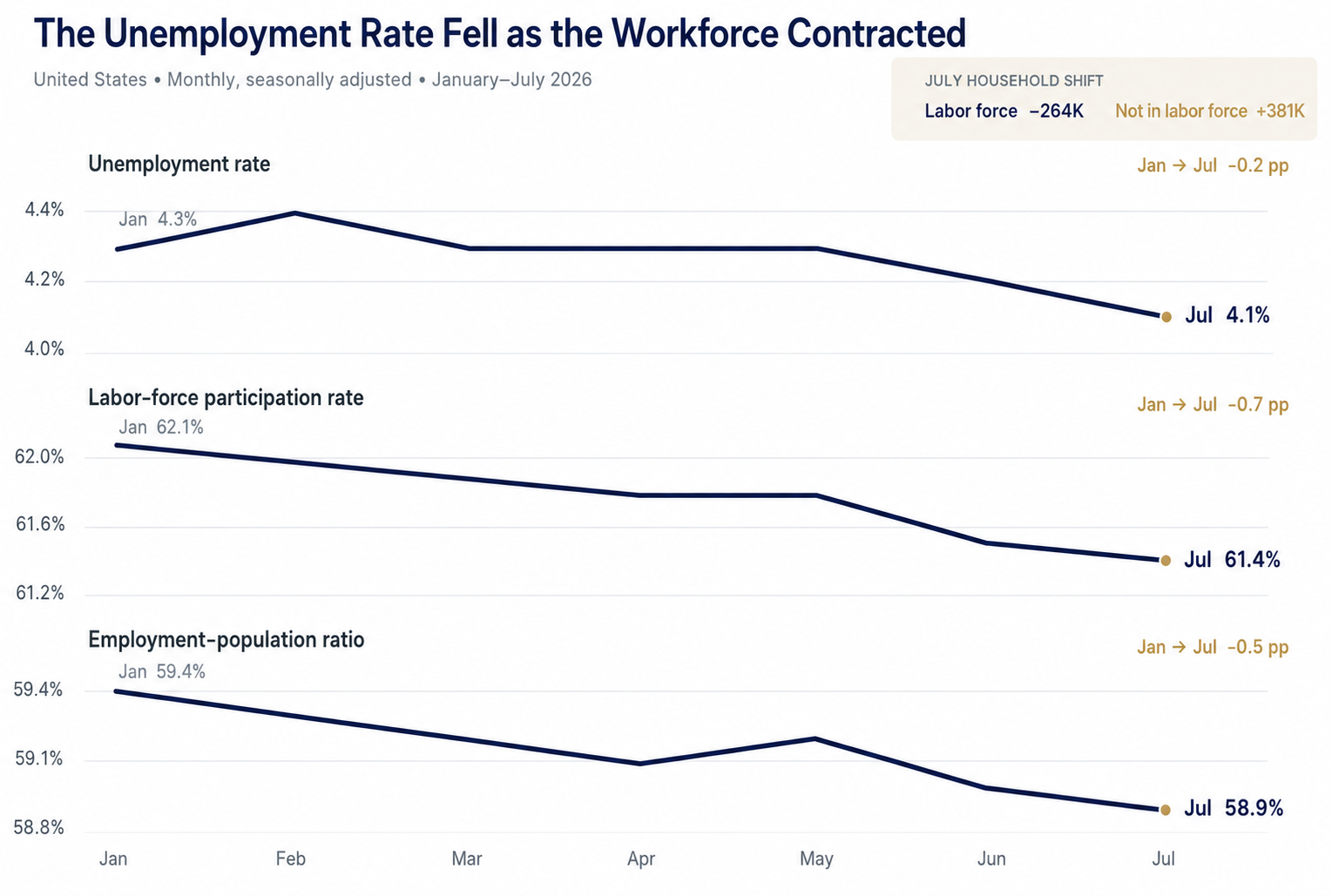
The headline unemployment rate improved even as fewer Americans were participating in the labor market and a smaller share of the population was employed. July alone saw the civilian labor force shrink by 264,000. Source: U.S. Bureau of Labor Statistics, Current Population Survey; FRED, Federal Reserve Bank of St. Louis.
The labor-force participation rate slipped to 61.4% in July, down 0.7 percentage point since January. The share of the population actually employed fell to 58.9%, BLS reported.
Behind those two numbers are real people. BLS counted 5.9 million Americans outside the labor force in July who said they still wanted a job. Another 4.8 million were working part time only because they couldn’t find full-time hours.
Some of that decline reflects demographics, not discouragement. The Fed’s July report to Congress linked slower population growth, driven by reduced immigration and an aging workforce, to cooling labor-force growth.
A slower-growing workforce needs fewer new jobs each month just to hold the unemployment rate steady. That helps explain why joblessness can sit near 4% even as payroll growth approaches zero. But it doesn’t make weak hiring painless.
According to many analysts, the more accurate view of the current job market is low-hire, low-fire. Government data on job openings and turnover, a survey known as JOLTS, put openings at 7.4 million in June, with 5.3 million hires, according to BLS. The hiring rate stood at 3.4%.
Quits totaled 3.2 million, a rate of 2.0%. Layoffs and discharges held at 1.8 million, or 1.1%, the same survey showed. Those figures describe employers who aren’t cutting staff but also aren’t in any hurry to add.
Vanguard reached a similar conclusion using its own data before BLS released the July numbers. Drawing on anonymized 401(k) participant records, the firm estimated private employers added only 9,000 jobs in July. Vanguard senior economist Adam Schickling described the labor market as “defined by a lack of hiring rather than a shortage of jobs.”
For someone with a paycheck already, low-fire conditions can feel like nothing has changed. For a recent graduate, a career-switcher, or anyone who loses a job, the same market can feel brutal. Vacancies don’t easily convert into offers when employers can hold out for a perfect match.
Bowman flagged that exact vulnerability back in May. She said the rate at which unemployed workers find new jobs had been declining. Hiring gains, she added, had become concentrated in less cyclical corners of the economy like health care and social assistance.
Paychecks Are Losing Ground Even as Prices Stay High
The payroll shortfall drew most of the attention. For household budgets, the wage numbers buried in the same report may matter just as much.
Average hourly earnings for private workers rose only two cents in July, and annual wage growth slowed to 3.2%, according to BLS. Average weekly hours held flat at 34.3, leaving weekly pay nearly unchanged at $1,290.37.
That fell well short of forecasts. Economists surveyed by FactSet had expected hourly earnings to rise 0.3% for the month and 3.5% from a year earlier, Barron’s reported. A single month of hourly-earnings data can be skewed by which industries are hiring or cutting staff. A steadier gauge, the Employment Cost Index, strips out those shifts in the mix of who is working.
That measure tells the same story. Private-sector wages and salaries rose 3.1% over the year ending in June. Once adjusted for inflation, that same measure of pay actually fell 0.4% over the year.
That’s an uncomfortable position for households, because inflation hasn’t cooperated. The Fed’s preferred inflation gauge rose 3.7% over the year through June, with the core measure, which excludes food and energy, up 3.3%, according to BEA. Pay is losing momentum while prices sit well above the Fed’s comfort zone.
That squeeze can hurt families before any layoffs happen. A smaller raise, fewer overtime hours, a spouse who can’t find work, or a diminished shot at switching jobs can all make a household more cautious about spending. And savings offer only so much cushion. BEA put the personal saving rate at 2.7% of after-tax income in June. Personal income rose just 0.2% for the month, while spending rose 0.3%.
For the Fed, slower wage growth is more complicated than it sounds. Cooling pay would normally ease inflation pressure and buy room to support jobs. But this round of inflation carries a real supply-side component, tied partly to energy costs, rather than coming mainly from wages running too hot. That leaves workers absorbing the worst of both worlds: softer hiring and weaker real pay, while inflation stays high enough to keep the Fed from easing quickly.
Growth Holds Up While Hiring Quietly Stalls
A weak jobs report naturally raises recession fears. But the broader growth data don’t yet support that conclusion. Real gross domestic product grew at a 1.5% annual rate in the second quarter, down from 2.1% in the first, according to BEA. A narrower measure that strips out volatile trade and inventory swings, real final sales to private domestic buyers, actually sped up to a 3.9% pace.
That gap suggests the part of the economy driven by households and businesses spending their own money is holding up better than the headline growth figure implies. Hiring, meanwhile, keeps stalling.
Productivity offers another piece of the puzzle. Nonfarm business output per hour rose at a 1.4% annual rate in the second quarter, as output climbed 1.7% while hours worked barely moved. An economy producing more without adding proportionally more labor hours is, over time, a good thing. It eventually raises living standards without stoking inflation. In the short run, though, it gives employers a reason to expand output without expanding headcount.
That dynamic comes at a cost that shows up in a different line of the BLS’s report. Real hourly compensation fell at a 3.1% annual rate in the quarter. Labor’s share of nonfarm output slipped to 52.9%, the lowest reading since the series began in 1947, BLS said.
That single figure, the lowest labor share on record, is a reminder that stronger output per hour doesn’t automatically flow back to the people producing it. This isn’t a classic recession setup. It looks more like a slower, quieter adjustment, one where businesses keep investing while headcount becomes the lever they’re reluctant to pull. But for someone job hunting, that distinction doesn’t offer much comfort. An economy can look resilient in the aggregate while the job market underneath it stays hard to break into.
AI Is a Suspect, But the Evidence Isn’t Clean
Artificial intelligence is an obvious place to point whenever hiring weakens in office jobs or entry-level roles. The evidence deserves attention, but it doesn’t yet support pinning July’s job losses on AI specifically.
A Federal Reserve staff study published in March used job-postings data from Lightcast alongside a Census Bureau survey of businesses. It found no evidence that companies or industries adopting AI more heavily had cut their overall job postings. The broader, post-pandemic decline in postings didn’t appear to be driven mainly by AI either. The researchers added an important caveat. They looked at total postings across firms and industries, not specific occupations, so AI could still be hurting particular workers even if companies shifted hiring toward other roles.
More troubling evidence comes from Stanford researchers who reviewed payroll data in July. They found that early-career hiring had dropped noticeably in occupations most exposed to AI, including software development and customer service. Older workers in the same fields held up better, according to the Stanford Institute for Economic Policy Research.
Federal Reserve Governor Lisa Cook warned that the economy could be approaching what she called the “most significant reorganization of work in generations.” AI-driven job losses, she cautioned, could show up before any offsetting job creation.
AI doesn’t need mass layoffs to weaken a worker’s bargaining position. A company can leave a role unfilled, shrink entry-level recruiting, or expect current staff to handle more with new tools. That kind of response shows up first as weaker hiring, not large job cuts, which fits the low-hire, low-fire pattern already visible in the openings data.
Vanguard’s Schickling adds a related caution. Past technology shifts, he argues, rarely destroyed large numbers of jobs until new tools combined with redesigned workflows and new business models, according to Vanguard’s research.
ATMs reduced the number of tellers needed at individual bank branches in the 1980s, but lower operating costs also allowed banks to open more branches. This left total U.S. teller employment broadly stable for decades. The larger employment decline came later, when mobile banking changed the entire way customers interacted with banks rather than simply automating one task.
The combination that Schickling warned about may still be ahead of the U.S. economy. If so, AI’s effect on jobs could show up gradually, visible in who gets hired and how many workers a given output level requires.
The Fed Is Now Squeezed From Both Directions
Nine days before the July jobs report, the Fed described the labor market as if it were steady. On July 29, the Federal Reserve held its benchmark rate at 3.50% to 3.75%. Its statement declared that “job gains have kept pace with the workforce” and that economic activity was expanding at a solid pace.
That was reasonable given what policymakers knew on July 29. But it looks far less certain after the revisions and July’s payroll decline.
A weak jobs report doesn’t solve the Fed’s inflation problem. The same July statement noted that inflation remained above the Fed’s 2% target, partly because of supply shocks including energy costs. Three voting members, Beth Hammack, Neel Kashkari and Lorie Logan, dissented in favor of a quarter-point rate increase.
That leaves the Fed boxed in from both sides. Raise rates aggressively, and policymakers risk deepening a labor slowdown that’s only now becoming visible in the revised data. Cut too soon, and inflation that’s already running above target could become more entrenched. Bowman’s May framework applies just as much now. Lean too heavily on the newest, volatile data, she warned, and policymakers risk falling behind the curve once revisions catch up.
Markets responded almost immediately to the news. Treasury yields fell, and the dollar weakened as traders trimmed their bets on a September rate increase. Gold rose as the dollar slipped. One trading session doesn’t make a trend, but the next inflation report could easily shift those bets again.
An economy where pay is weakening, the labor force is shrinking, and inflation sits above target doesn’t offer investors a clean direction to bet on. Some look beyond the banking system for ballast when growth and policy credibility wobble together, and gold tends to draw increased interest at these moments.
The next few weeks will offer more evidence than usual, starting with July inflation and real-earnings data, followed by August’s jobs report on September 4.
None of this guarantees a recession. Productivity remains strong, private demand is still growing, and the Fed still has room to maneuver. But a 4.1% unemployment rate looks reassuring only in isolation. July’s report showed how little room the labor market may have left to absorb another setback. A second bad surprise would be much harder to dismiss.