
By Preserve Gold Research
Borrowing just got a little more expensive for most Americans. The 30-year Treasury yield climbed to 5.34% on September 18, and the 10-year touched 5.01%, according to the Treasury’s benchmark yield curve. Those same yields stood at 4.86% and 4.19% at the start of the year.
The increase came even with the Fed already keeping short-term rates restrictive and inflation still running above its target. At the same time, investors have been asked to absorb an unusually large supply of new government debt.
But rising borrowing costs are becoming bigger than the Fed. That same week, the European Central Bank and the Bank of Japan also tightened policy, each responding to different economic pressures. Meanwhile, governments are borrowing heavily, and the enormous capital demands of the global AI buildout are adding another major competitor for available savings.
All of them are drawing from the same global pool of capital. When demand for that capital rises faster than the supply of savings willing to fund it, long-term borrowing becomes more expensive, even if a central bank eventually lowers its overnight rate.
For much of the two decades after the 2008 financial crisis, the world didn’t work that way. Abundant savings, low inflation, and aggressive central-bank support pushed the cost of capital lower almost every year investors could remember. Cheap capital became so persistent that businesses, governments, markets, and households had years to grow accustomed to it.
The question worth asking isn’t only how high the Fed will push its overnight rate from here. It’s whether the underlying price of long-term capital has shifted to a new, higher baseline.
Why the Fed, ECB, and Bank of Japan Are Tightening at the Same Time
On September 16, the Federal Open Market Committee raised its benchmark rate a quarter point, to a range of 3.75% to 4.00%. “Inflation remains elevated,” the committee said in its September statement, arguing the move would support a faster return to its 2% target.
The “last mile” inflation problem, assumed to be mostly under control in 2025, has started to look more like a marathon. BEA data for July 2026 already put annual inflation at 3.7%, with the core measure that strips out food and energy at 3.3%.
The Fed hasn’t been acting alone either. The European Central Bank raised all three of its policy rates a quarter point on September 10, taking its deposit rate to 2.50% effective September 16. “The conflict in the Middle East continues to generate inflation pressures,” the ECB said, projecting headline inflation of 3.0% for 2026.
Japan followed days later. The Bank of Japan lifted its policy rate to around 1.25% on September 18, its highest level since 1995. It cited oil prices, a weaker yen, and AI-related demand pushing producer prices higher. The bank said it would keep raising rates and “adjust the degree of monetary accommodation” as conditions warranted.
Three major central banks tightening within days of one another points to a broader problem. Much of the inflation isn’t the result of consumers spending too much. Some of it is coming from the supply side. Energy disruptions can push prices higher while weakening economic activity. Rebuilding strained supply chains requires more capital. Defense spending absorbs industrial capacity. The AI buildout is adding another major source of demand for electricity, semiconductors, and construction labor.
Higher interest rates can’t produce more oil, more electricity, or more computer chips. They can only restrain demand enough to keep a supply shock from turning into broader, more persistent inflation. The IMF warned in April that the war in the Middle East had already pushed up energy prices, bond yields and expected policy rates. The fund said the shock was raising the risk of a wider tightening in global financial conditions.
That leaves central banks with less room to repeat the rescue sequence that defined much of the past two decades. Growth weakens, inflation cools, rates are cut, and financial conditions loosen.
Governments and AI Are Competing for the Same Pool of Capital
Governments and technology companies are now bidding for the same pool of capital, and neither side is bidding modestly.
Global public debt climbed to just under 94% of world GDP in 2025 and is on track to reach 100% by 2029, according to the IMF’s Fiscal Monitor. The fund tied the buildup to spending on social programs, defense, strategic autonomy and the rising cost of servicing debt already on the books.
The United States shows the scale involved. The Treasury said that it expected to borrow $739 billion in privately held debt just for the July-September quarter. That figure was $68 billion more than it had projected back in May.
That doesn’t mean a funding crisis is inevitable. U.S. government debt remains the backbone of global collateral markets, and the world’s safest borrower can usually still find buyers. The real question is price. When Washington issues debt this aggressively while other borrowers offer increasingly attractive alternatives, even the federal government has to pay a yield investors are willing to accept.
The IMF has also pointed to changes beneath the surface of the sovereign-debt market. Its Fiscal Monitor highlighted the growing role of leveraged nonbank investors and signs that the traditional safety premium attached to Treasuries may be weakening. The fund warned that those shifts could make future moves in bond prices more abrupt.
At the same time, technology companies are funding one of the largest infrastructure buildouts in years. U.S. hyperscalers issued more than $100 billion in bonds during 2025 to fund AI infrastructure, BIS researchers found, with most of that debt carrying maturities beyond five years. Credit-default swap spreads on the weaker-rated hyperscalers widened as the borrowing grew, a sign some investors are starting to price in doubt about whether these projects pay off.
Much of the borrowing doesn’t even show up on a hyperscaler’s balance sheet. The BIS described special-purpose vehicles that raise debt from private-credit firms and insurers to build data centers. The technology company typically holds only a minority stake, offering guarantees instead of carrying the loan directly. The financing is one step removed, but the economic obligation is still there.
A new data center now competes for financing, construction crews, and grid capacity with a housing project or a factory that has nothing to do with artificial intelligence.
The result is a broader competition for scarce resources. A new data center isn’t only competing with other technology projects. It’s also competing with factories, housing developments and infrastructure projects for financing, construction workers, electricity and grid capacity.
European Central Bank President Christine Lagarde put a number on the strain in a September 14 speech. AI-related borrowing accounted for roughly a quarter of the growth in credit to euro-area companies during the first quarter, she said. Those same firms plan to devote around 10% of all 2026 investment to artificial intelligence. She also noted that American technology firms have become significant borrowers in European bond markets, spreading the U.S. AI boom’s financing pressure beyond American investors. European savers, she added, hold roughly €440 billion in U.S. technology stocks, capital not financing Europe’s own buildout.
Why a 5% Treasury Yield Changes the Federal Debt Equation
The 10-year Treasury yield doesn’t stay on Wall Street. It works its way into mortgage rates, corporate borrowing, municipal debt, and the valuations investors are willing to place on stocks worldwide.
Treasury yields put the 1-year rate at 4.44% and the 2-year at 4.76% on September 18. Those shorter maturities tend to move closely with expectations for Federal Reserve policy. The longer end tells a different story. The 10-year yield had climbed about 82 basis points since the start of the year, a jump too large to explain through the Fed’s moves alone.
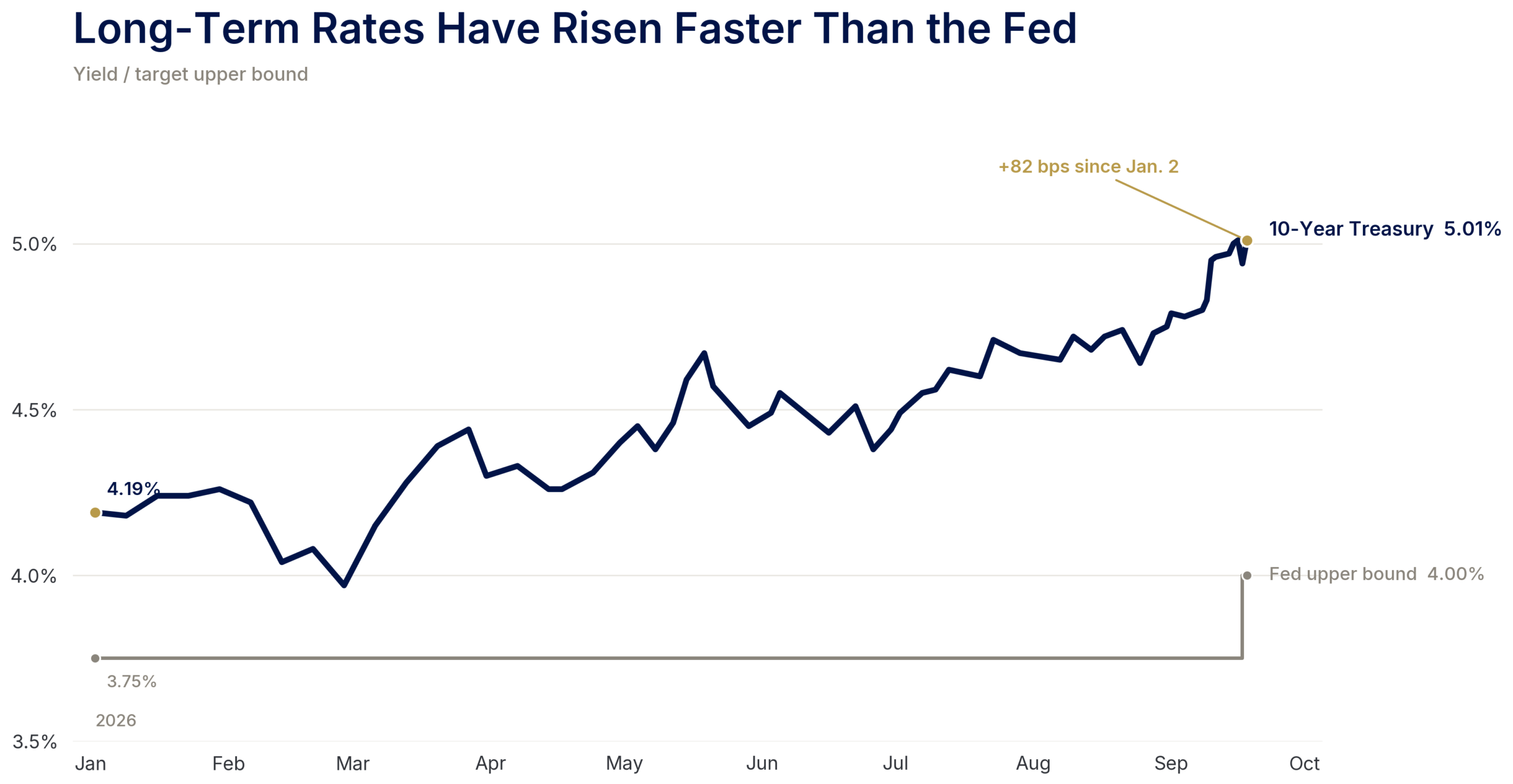
The Fed has raised its policy ceiling only modestly in 2026, but the 10-year Treasury has moved much further. That gap shows how inflation expectations, heavy borrowing and the price investors demand for long-term capital can keep financing costs elevated independently of the overnight rate. Source: U.S. Department of the Treasury, Daily Treasury Par Yield Curve Rates; Board of Governors of the Federal Reserve System.
The Fed controls a short-term overnight rate. It doesn’t decide what investors will demand to lend the U.S. government money for 10 or 30 years.
Long-term yields move with expectations for future short-term rates, inflation, and growth. They also reflect the extra compensation investors want for tying up money for decades instead of months. That last piece grows more important once investors start worrying bonds won’t provide the safety they used to. The IMF noted that more frequent supply shocks have weakened the old pattern of bonds rallying whenever stocks fall. That raises the odds that both can lose money at the same time.
For Washington, higher yields eventually turn into higher interest payments as older debt matures and gets refinanced at today’s rates. The pass-through takes time, since federal debt comes in a range of maturities. But it doesn’t stop. Treasury’s Fiscal Data service tracks that expense month by month.
That creates an uncomfortable feedback loop. Larger deficits require more borrowing. More borrowing means investors must absorb more Treasury securities. If they demand higher yields, the government’s interest bill rises. Unless spending falls, taxes rise, or stronger economic growth offsets the difference, those interest costs feed back into future deficits.
Imagine the Fed cutting its rate a full percentage point because inflation finally cools. If the Treasury is still issuing heavily, AI spending keeps accelerating, and investors still want extra protection against inflation, the 10-year yield may not fall much. Mortgage and business borrowing costs would stay painfully high even while the Fed tries to help.
There’s a complication on the rescue side too. Large-scale bond buying could, in theory, push long rates back down. But using it to fight high long-term yields gets harder to justify when inflation sits above target. If investors begin to view bond buying as an effort to ease the government’s financing burden rather than stabilize the economy, inflation expectations could rise. That, in turn, could push longer-term yields back up and weaken part of the relief the policy was meant to provide.
How Higher Interest Rates Are Reaching Mortgages, Credit Cards, and Households
So far, the U.S. credit system doesn’t look like a classic freeze. The Fed’s July loan office survey found banks had left commercial and industrial lending standards mostly unchanged during the second quarter. Demand strengthened among large and middle-market firms for equipment, working capital, and acquisitions.
That’s reassuring, but only up to a point. Credit can tighten through price even when lenders are still willing to lend. A company that can borrow at 7% still has access to capital, but its investment hurdle, acquisition math, and acceptable debt load look very different than they did when financing cost 3%. The same Fed survey found tighter conditions across every category of nonbank financial institution it tracks, including private-equity funds and business-credit lenders.
Households feel this cycle more directly than corporate borrowers do. Freddie Mac’s weekly survey put the average 30-year fixed mortgage rate at 6.95% for the week ending September 17, up from 6.26% a year earlier.
On a typical $400,000, 30-year loan, that gap adds roughly $182 to the monthly principal-and-interest payment, before taxes and insurance.
The gap is much larger for homeowners who locked in mortgages near 3% during the pandemic. Selling often means giving up a cheap loan and taking on a much more expensive one. Multiply that decision across a metro area and housing turnover slows. Some homeowners delay moves for new jobs, growing families or other life changes, while first-time buyers face monthly payments that make the same home much less affordable than it was a few years ago.
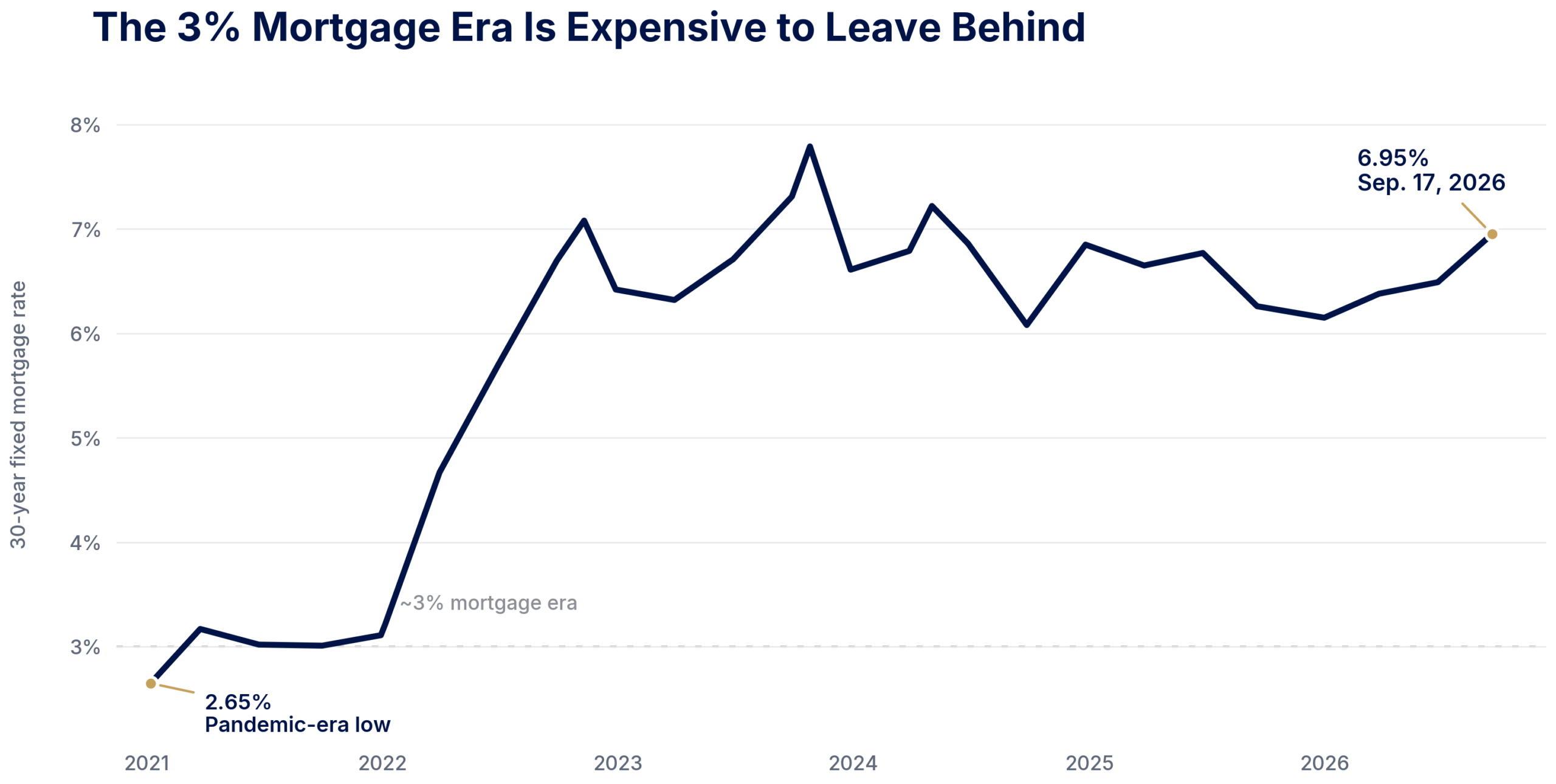
Mortgage rates have climbed from a historic 2.65% low in early 2021 to 6.95% as of September 17. For homeowners already financed near 3%, moving can mean giving up unusually cheap debt and replacing it at more than twice the rate. Source: Freddie Mac, Primary Mortgage Market Survey; Federal Reserve Bank of St. Louis.
Consumer credit is showing similar strain. The Fed’s July survey found banks tightening credit-card standards during the second quarter, while demand for auto loans weakened. New York Fed data put total household debt at about $18.8 trillion at the end of the second quarter, with credit-card balances alone at $1.26 trillion.
New delinquencies for auto loans and credit cards “remain at elevated levels, a trend we’ll continue to monitor,” said Joelle Scally, an economic policy adviser at the New York Fed. The broader household system is still functioning. Costly revolving debt is creating visible strain at the margin, all the same.
That’s how a prolonged high-rate cycle tends to spread. It doesn’t hit everyone at once. Homeowners with fixed-rate mortgages can remain insulated for years. Cash-rich companies earn more on their liquidity. Savers benefit from higher yields.
The pressure falls first on whoever has to borrow or refinance now. That means the first-time homebuyer, the household carrying a credit-card balance from month to month, the small business renewing a loan, and the private-equity sponsor refinancing an older deal. If borrowing costs stay high long enough, that group will gradually grow.
The Yen’s Cheap-Money Era Is Ending Too
Synchronized tightening doesn’t mean that there’s less currency volatility. It just changes what drives it.
Exchange rates move on relative interest rates and expectations, not on whether a central bank is hiking. With the Fed, the ECB and the Bank of Japan all moving higher, markets have to keep reassessing which central bank will tighten the most, which economy can absorb the pressure and where inflation is likely to prove most persistent.
Energy makes that calculation harder. A jump in imported energy costs can worsen a country’s trade balance, slow growth, and stoke inflation, at the same time. That can force a central bank to raise rates into an economy that’s already weakening. Under those conditions, higher rates don’t necessarily produce the currency strength that would normally follow tighter policy.
Japan is of particular importance. Years of near-zero interest rates made the yen one of the world’s preferred funding currencies for carry trades. Investors could borrow cheaply in yen and move that money into higher-yielding assets elsewhere. As Japanese rates rise, that trade becomes less attractive.
That doesn’t mean that an unwind is certain. But it does mean one of the world’s longest-running sources of cheap leverage is becoming less dependable. The IMF’s April stability report specifically warned that carry-trade unwinds and capital outflows could amplify currency stress in emerging markets during episodes of broader turmoil.
For the United States, the effects cut both ways. High Treasury yields can pull global capital toward the dollar, and so can geopolitical stress elsewhere. But if higher U.S. long-term yields increasingly reflect fiscal risk or inflation compensation rather than superior growth, the usual link between yields and a strong dollar can weaken.
Either direction carries trade-offs. A stronger dollar helps contain imported inflation but tightens financial conditions abroad. A weaker dollar supports U.S. exporters but raises import costs.
The Fed’s September projections show how narrow the path has become. Policymakers’ median forecast still called for 3.7% inflation in 2026 alongside 2.3% real economic growth. For now, that combination gives the Fed room to keep prioritizing inflation.
What Structurally Higher Borrowing Costs Mean for Investors
Investors don’t need to believe rates stay high forever for their behavior to change. The more useful question is whether borrowing costs have settled at a higher level than markets became accustomed to over the past two decades.
For years, markets operated around near-zero policy rates, low bond yields, and the expectation that central banks would step in when conditions deteriorated. That environment rewarded a certain kind of behavior. Investors were willing to pay more for companies whose profits might not arrive for years. Debt was inexpensive. Refinancing seemed less threatening because borrowers could often expect lower rates to return before their old loans came due.
Higher capital costs change that math. Profits earned today become more valuable relative to profits that may not arrive for years. Strong balance sheets matter more. Companies that generate enough cash to fund their own growth have an advantage over those that must repeatedly borrow or raise new capital.
Government bonds change too. Higher yields can make high-quality fixed income more attractive to savers, but they also bring more exposure to inflation surprises and shifts in how investors price fiscal risk. With the long end of the Treasury curve above 5%, investors are being paid more to hold duration because duration now carries more visible risk.
For much of the past two decades, investors could assume that sufficiently serious market stress would eventually bring cheaper money. That expectation influenced asset prices and portfolio decisions across the financial system.
This doesn’t mean high rates are permanent. A recession could still pull yields lower, and stronger productivity could ease some of the pressure. What’s becoming harder to assume is that falling rates will always return quickly enough to rescue balance sheets built around cheap money.