
By Preserve Gold Research
Portland entered its 2026-27 budget season facing a general-fund shortfall of more than $160 million, according to Mayor Keith Wilson’s budget message. New York City adopted a legally balanced budget. Yet the city comptroller projects a $4.22 billion gap by the end of fiscal 2026, with wider gaps in the years ahead.
Kansas City spent months cutting a projected shortfall of roughly $100 million but still adopted a budget with about a $64.1 million deficit. Three cities, three different shortfalls, and the same underlying habit: close this year’s gap and let next year handle the rest.
The resident forced to wait longer for an ambulance feels that immediately. So does a parent watching a library cut its hours. Both are the visible edge of a much bigger argument that mostly happens out of the public’s view.
That argument comes down to one mechanism. Balanced-budget laws mostly test whether this year’s revenue matches this year’s spending. They rarely force a government to book the full cost of pension promises, retiree health care, worn-out infrastructure, and multiyear labor deals. The bill is created long before it arrives.
The pattern isn’t limited to three cities. Pew found that at least 20 of the nation’s 25 largest cities have reported budget gaps for fiscal 2026 since January 2025, often stretching into later years too. Chicago, Los Angeles, San Francisco, and Washington all took credit downgrades over the same stretch.
The mood among city finance staff has shifted alongside the numbers. The National League of Cities reports that only 45% of finance officers felt optimistic about meeting fiscal needs in FY2026. That’s down from 64% a year earlier. Federal aid is fading while sales-tax growth has flattened. Accounting standards built around annual results often miss fiscal problems that develop over decades.
A Legally Balanced Budget Can Hide a Broken One
Balance in a city budget usually means that adopted spending doesn’t exceed projected revenue for the coming fiscal year. That’s the number that dominates budget-season headlines. Portland’s $160 million gap is this kind of problem. So is Kansas City’s.
Beneath that annual test lies a deeper problem. The Government Finance Officers Association defines structural balance as recurring revenue matching or exceeding recurring spending, year after year, without one-time fixes like selling land or draining reserves. Those measures may close a budget gap temporarily, but they do nothing to repair a system in which ongoing costs continue to exceed ongoing income.
GFOA is blunt on this point. A budget can meet every statutory definition of balance and still, in the organization’s words, “may not, in fact, be financially sustainable.”
Residents rarely see that distinction. They see closed libraries, delayed trash pickup, or a higher property-tax bill. They don’t see an actuarial discount rate or a pension amortization schedule. The public fight happens over visible services. The slippage happens quietly, on the balance sheet.
Layer bond debt on top of that, and the picture gets murkier. Debt can be the right way to pay for a road, a water system, or a transit line that serves residents for decades. The Washington State Auditor’s reporting guidance notes that capital-related borrowing reduces a government’s net investment in its own assets even as it finances something new. A city can point proudly to a new bridge and still be underwater. It has simply stacked new claims on cash that hasn’t arrived yet.
Then come the promises that don’t show up as debt at all, like pensions and retiree health care. These make a budget look most balanced in the short run and least balanced over time. The NASRA Public Fund Survey put the largest pension systems at $5.13 trillion in assets against $6.45 trillion in liabilities at the end of fiscal 2024.
NASRA’s separate research found that state and local governments contributed roughly $226 billion to pensions in fiscal 2023. Pension spending has stayed above 5% of total state and local spending every year since fiscal 2017.
Retiree health care is easier to overlook, mostly because it draws less political attention than pensions. The Governmental Accounting Standards Board adopted its rule requiring governments to report these obligations. As the board put it, they “represent a very significant liability for many state and local governments.” New York City’s plan reported a total retiree-health liability of $103.3 billion as of June 30, 2024.
The city comptroller has been blunt about this. The city’s Retiree Health Benefits Trust, often treated in public debate as a rainy-day cushion, “is not a true rainy-day fund.” It exists to cover exactly those long-term health costs.
The least visible item on this list may be the most expensive over time. GFOA treats asset upkeep as a recurring expense rather than an optional one. When a city delays resurfacing a street or replacing an aging pipe, the cost doesn’t disappear. It moves into the future, where it is usually much higher.
Add these pieces up, and a government can look balanced while underfunding the benefits its own workers are earning right now.
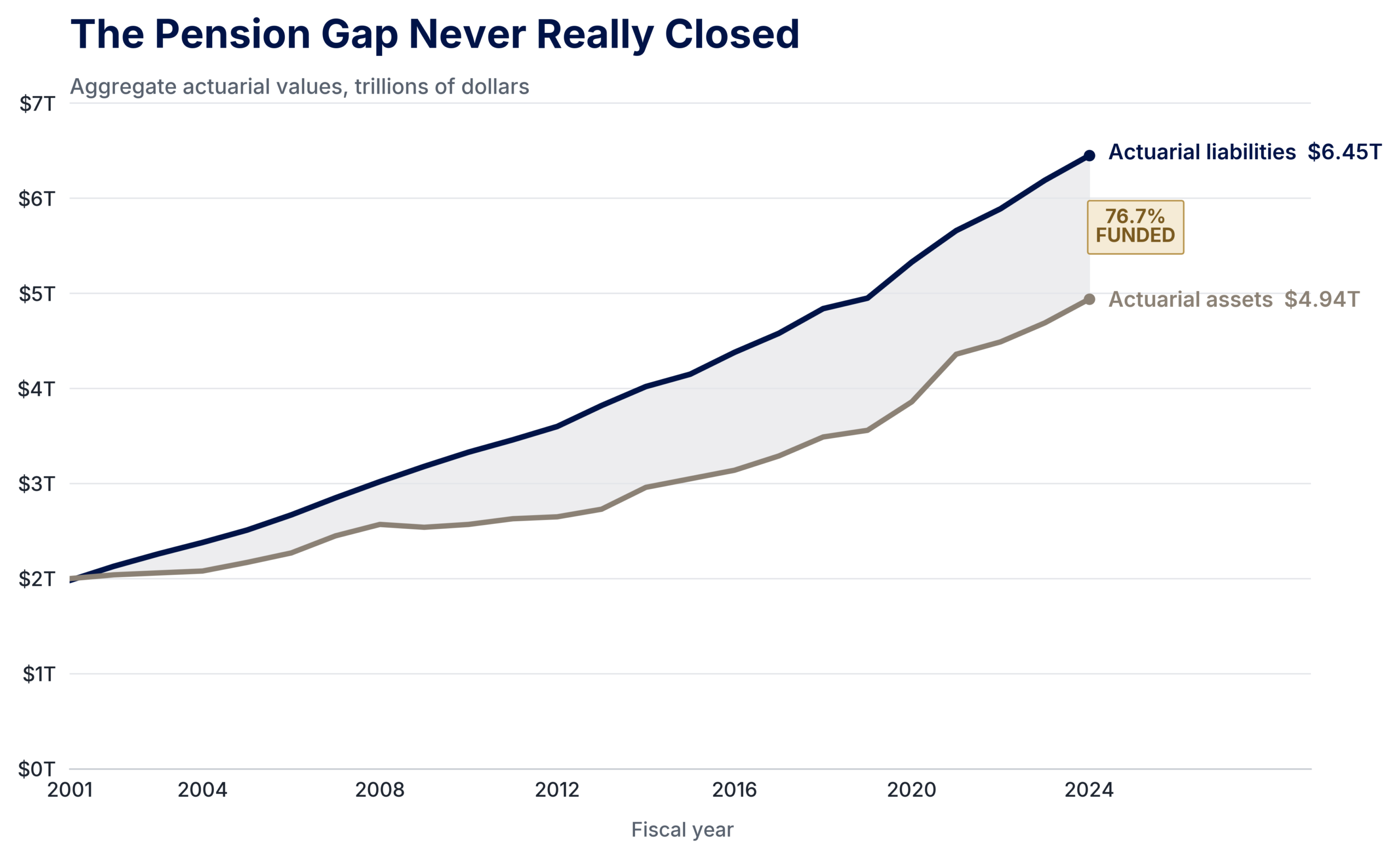
Public-pension assets have grown substantially, but they have continued to trail the promises they are meant to fund. In FY2024, plans in NASRA’s survey held actuarial assets equal to 76.7% of their liabilities, leaving a gap of roughly $1.5 trillion. Source: National Association of State Retirement Administrators, Public Fund Survey, Summary of Findings for FY2024.
What “Interperiod Equity” Actually Protects
GASB has said, for decades, that this isn’t what public accountability looks like. In its foundational Concepts Statement No. 1, the board argues financial reporting should let citizens judge whether this year’s revenue covers this year’s services. It should also show whether future taxpayers will be stuck covering services already delivered. The board calls that idea, interperiod equity, “a significant part of accountability” and “fundamental to public administration.”
Truth in Accounting pushes the argument further than most mainstream public-finance groups, though its balance-sheet method is one accounting approach, not the definitive word on deficits. Its 2026 report on the five largest U.S. cities is still useful, because it measures what annual budgets tend to hide. TIA found that all five had enough legal balance to keep operating but not enough assets to cover their bills under its stricter test.
The shortfall it calculated came to $240.4 billion, the gap between what those cities owed and what they had on hand. Most of that traced to compensation promises rather than physical infrastructure. Pensions accounted for $92 billion of the total, and retiree health care for $112 billion.
TIA excludes capital and restricted assets from the funds available to cover bills, making its test stricter than the legal standard most cities use. Even so, the larger point holds. When a government keeps services running by downplaying the cost of long-term promises, “balanced budgets” no longer reflect a city’s true financial health and instead start serving as permission to keep spending.
New York shows the gap between the two ideas clearly. Its adopted FY2026 budget is balanced under law. However, the comptroller still warns of rising multiyear gaps and flags that several major labor contracts are expiring soon. The current labor reserve, meanwhile, funds annual wage increases of only 1.25%, far below what recent contracts have delivered.
Cities usually get into trouble because annual budgets capture only a fraction of what long-term solvency actually costs.
Nobody Is Watching the Ledger That Matters
Local government runs the part of public life people actually live inside. Property taxes hit household budgets directly, and city finance still competes for scrutiny against presidential politics, war, and cable news. Importance rarely wins that contest.
Municipal government is also just hard to follow. The Census Bureau’s 2025 count of local governments documented 39,555 special districts and 12,546 independent school districts nationwide. Many of those entities run their own budgets, with real independence from the city government residents think of as “the city.”
That fragmentation makes even simple comparisons unreliable. Truth in Accounting’s own city report notes that New York includes its school district in its financial statements, while Chicago reports its public schools separately. Even a diligent reader is often comparing governments that don’t draw their boundaries the same way.
Local journalism used to close that gap. Its retreat may be why capital markets now understand city finances better than voters do. In a paper first circulated through Brookings, economists Pengjie Gao, Chang Lee, and Dermot Murphy found that newspaper closures raise municipal borrowing costs. Offering yields rose by roughly 5.5 basis points in the three years after a closure. Secondary-market yields rose by 6.4 basis points, and revenue bonds moved even more.
That result is easy to shrug off, since five or six basis points doesn’t sound like it’s much. The same research links newspaper closures to higher government wages, larger deficits, and costlier refinancings. That’s evidence of weaker oversight once the local paper stops showing up to council meetings.
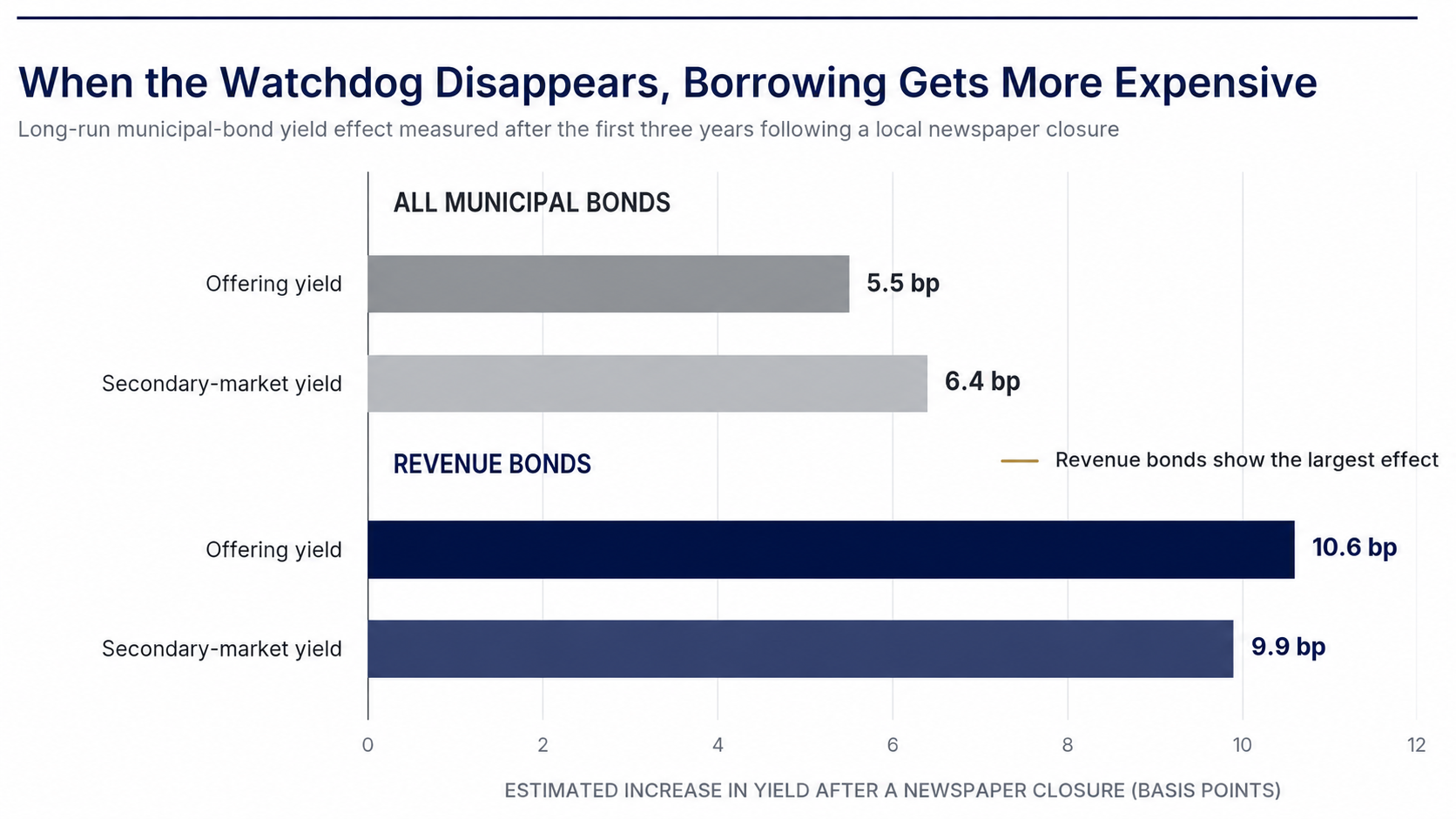
Municipal borrowing costs rose after local newspaper closures, with the largest increase appearing among revenue bonds, where monitoring of project finances matters most. The study estimates that an additional 10 basis points cost the average municipality in its sample roughly $650,000 per bond issue. Source: Pengjie Gao, Chang Lee, and Dermot Murphy, “Financing Dies in Darkness? The Impact of Newspaper Closures on Public Finance,” Journal of Financial Economics, 2020.
A more recent analysis from Rebuild Local News estimates that governments in today’s news deserts pay roughly $1.1 billion a year in extra borrowing costs. The report counts nearly 2,000 U.S. counties as news deserts under its own definition. That figure isn’t an official government statistic, but it points in the same direction as the peer-reviewed research. Less oversight makes public borrowing more expensive. Spread a budget across enough entities, accounting bases, and too few reporters, and officials never have to hide anything perfectly. They only have to keep the truth scattered.
Spending Has Lobbyists. Taxpayers Have Nobody.
The lazy explanation for municipal overspending is that voters want more services. That’s sometimes true, but it’s also too simple. A better explanation comes from public-choice economics. Mancur Olson’s The Logic of Collective Action made the point that large groups with spread-out interests struggle to organize, while small groups with concentrated stakes organize easily. Every spending line has an organized constituency behind it. Every tax bill lands on a large, loosely connected public that rarely shows up to argue about it.
Consider how a typical city budget gets defended in public. Municipal employees have a direct stake in protecting pay and benefits. Neighborhood groups defend the pool or bus route they use. Each of those groups knows exactly what’s at stake for them.
The average taxpayer faces the opposite problem. The cost is scattered across hundreds of programs and buried in a budget few residents have the time to study. Those who benefit from spending remain concentrated and vocal, while those who pay for it are diffuse, distracted, and often unaware of how quickly the obligations are accumulating.
The structure of spending reinforces this. NLC reports that public safety alone accounts for over half of general-fund spending nationwide. Categories like that are politically sticky. A budget increase gets spread quietly across departments. A cut closes a specific station or eliminates a specific position, and someone has to say so out loud.
Reserves are usually the first thing officials reach for, because drawing them down is easier politically than cutting a service in public. GFOA recommends cities keep at least two months of unrestricted general-fund balance and replenish depleted reserves within one to three years. The mere existence of a reserve fund, though, creates temptation.
Pew’s review of the 2025 budget cycle captured that dynamic well. Sarah Sullivant of S&P Global Ratings told Pew that cities entered the year with “very strong reserve positions.” Pew was careful to add that reserves aren’t a long-term fix for a structural gap. It pointed to Denver, where the rainy-day balance had already slipped below its own target as the city leaned on savings for ordinary operating costs.
Once a cost lands in the baseline, its politics change entirely. The original spending increase felt like a choice. Keeping it next year feels neutral, and cutting it now feels punitive. Portland’s mayor called the required budget adjustments “significant and painful cuts,” warning that council members would still face brutal decisions even after tapping reserves. The city isn’t really choosing whether to spend anymore. It’s choosing who gets disappointed first.
Houston’s city controller put it more bluntly. Chris Hollins was direct with Pew, saying flatly that “our budget is not structurally balanced and it has not been for some time.” Coming from a sitting finance official, that’s an unusually candid admission. A government can paper over a structural deficit for years with one-time money or favorable returns. The pain shows up only once those tools stop working.
The People Who Will Pay Later Aren’t in the Room
Beneath the accounting rules and the public attention problem lies a more basic question of fairness.
A city can promise pension benefits that won’t be paid for decades, or it can draw down reserves to avoid difficult cuts today. In either case, the people approving the decision may not be the ones who bear its full cost. Some residents will move away. Others will sell their homes before higher property taxes arrive. Future residents and homebuyers have no voice when the obligation is created, even though they may eventually be asked to pay for it.
GASB’s framework is clear on this point. Financial reporting should reveal whether future taxpayers will be required to fund services provided to an earlier generation. Municipal overspending, seen this way, is a question of consent as much as arithmetic. When today’s residents consume services and quietly shift part of the bill forward, they’ve changed who eventually pays for the decision.
New York’s numbers make the point concrete. The city holds roughly $5 billion in its Retiree Health Benefits Trust. Its OPEB plan, at the same time, reports a $103.3 billion total liability tied to future retiree health costs. When officials preserve today’s services partly by leaning on a fund meant for tomorrow’s retirees, they’re moving the burden across generations of taxpayers who never voted on the tradeoff.
The federal safety net softens this practice to an extent, though not because cities can print money, which they can’t. It’s that they can reasonably expect part of the downside to be socialized in a genuine crisis, which changes how much pain any single administration absorbs.
During the 2020 Covid-induced panic, the Federal Reserve’s Municipal Liquidity Facility was authorized to buy up to $500 billion in short-term notes from eligible states and large local governments. The New York Fed later concluded the facility helped calm the broader municipal market. That intervention may have been justified at the time, but it also set a precedent that markets don’t forget.
Economists Michael Bordo and John Duca, in an NBER working paper, warned that precedent could create moral hazard by dulling incentives to build rainy-day surpluses in calmer years. Backstops can prevent a genuinely destructive spiral, but repeated outside support does change expectations, and expectations eventually change behavior.
That’s the municipal version of a soft budget constraint. It doesn’t mean every city expects a bailout on demand. However, it does imply that the link between local choices and local consequences has gotten less firm than it looks on paper.
What Real Fiscal Discipline Would Actually Require
If that diagnosis holds, the fix isn’t simply spending less. It’s aligning budget law, public attention, and political incentive with the full cost of running a government, not just this year’s slice of it.
GFOA’s own guidance points toward the first reform. Cities should aim for structural balance, not just legal balance, and stop using reserves to cover recurring costs.
They also need to make long-term obligations easier to see. Pension costs, retiree health benefits, and deferred maintenance should sit beside new spending proposals. They shouldn’t disappear into appendices as they often do today. Clear ranges and simple reconciliations would do more than perfect forecasts ever could.
Accountability matters too. Special districts and independent school systems often blur responsibility, while weaker local reporting allows optimistic assumptions to go unchallenged. Cities face real obligations, and downturns may justify temporary support. But when organized beneficiaries have a stronger voice than a scattered taxpayer base, the system tends to protect today’s services and leave tomorrow’s residents with the bill.
Cities carry real obligations, and genuine economic shocks may justify temporary support. But a system built around organized beneficiaries and a scattered taxpayer base will usually protect today’s services by drawing down reserves or shifting costs into future tax bills.
Residents eventually feel that pressure. Credit downgrades raise borrowing costs, which means taxpayers pay more for the same roads, schools, and public services. Closer to home, fiscal strain appears in property taxes, utility rates, permit delays, and the slow deterioration of the conditions that support home values and small businesses.
Families can also mistake steady cash flow for financial strength while ignoring obligations still coming due. The answer is not panic, but resilience through liquidity, manageable debt, and assets that do not depend entirely on government policy or fiscal credibility. Gold and silver are among the stores of value some households use for that purpose.
Cities keep spending beyond what recurring revenue can support because the incentives favor the present. Organized groups defend their share, while the cost is spread across taxpayers who rarely see the full picture. A budget can meet every legal definition of balance and still leave a city financially weaker with each passing year.