By Preserve Gold Research
“Sever every economic lifeline that sustains this tyrannical regime until Tehran stands alone.” That’s how Treasury Secretary Scott Bessent described the goal of the new sanctions campaign unveiled on August 24. The same day, the Treasury widened the categories of Iran-related activity that could face secondary sanctions by issuing determinations across five sectors: digital assets, technology, gold, aviation, and shipping. The Office of Foreign Assets Control also sanctioned nearly 60 individuals, companies, and vessels across multiple jurisdictions.
The Treasury has called the effort Operation Economic Outcast, and it goes beyond the usual list of tankers and front companies. Foreign governments will be given a defined period to shut down Iran-related activity identified or risk losing access to U.S. banks and capital markets.
Every escalation forces the same choice on foreign banks, refiners and shipping firms. They can either keep clearing dollars through Washington’s network or keep trading with Tehran. The threat only works as long as leaving that network costs more than staying in it. China, Russia and a widening circle of Iran’s trading partners are now building alternatives that lower that cost, one payment channel and one blocking order at a time.
Washington Bets Bigger on Financial Isolation
Secondary sanctions work by forcing banks and companies with little direct interest in U.S. foreign policy to make a financial choice. A bank in Singapore may not have American owners or any interest in Iran policy. But it might still need dollar clearing, correspondent banking, or access to American capital markets. Ignoring Washington’s warning could cost it all of that.
That leverage has had teeth in the past. Iranian crude and condensate exports topped 2.5 million barrels a day in 2017, EIA figures show. By 2020, after Washington reimposed sanctions, exports had fallen below 400,000 barrels a day. Sanctions can gut a country’s main export revenue almost overnight, and Iran’s oil trade proved it.
However, the same EIA data also showed how trade adapted. More than half of Iran’s 2020 crude and condensate exports still reached China, often relabeled as Malaysian, Singaporean, Emirati, Iraqi, or Omani cargo. Moving oil through those channels raises costs. Traders may accept deeper discounts, longer voyages, opaque intermediaries, and insurance arrangements that legitimate cargoes generally don’t require. The oil still moves, but less efficiently and at a lower return to Tehran.
By 2024, the same fingerprints showed up again. China reported importing 1.4 million barrels of crude per day from Malaysia. Malaysia itself produces only about 600,000 barrels a day. EIA attributed much of that gap to Iranian oil relabeled or transferred at sea to hide its origin.
That’s the problem Washington keeps running into. Sanctions can inflict real damage, but they don’t guarantee an empty pipeline, and success ultimately depends on the goal the Treasury actually sets.
Treasury’s own 2021 review of its sanctions anticipated this problem. It said sanctions worked best inside a clear strategy that accounted for the effect on third parties. Its authors also wrote that sanctions are “most effective when coordinated” with allies capable of extending their reach.
China is where that coordination problem is put to the test.
China Is the Chokepoint Sanctions Can’t Avoid
China isn’t just another buyer of Iranian crude. It’s the market Iran has rebuilt its sanctioned oil trade around. The Treasury said in April that China was buying roughly 90% of Iran’s oil exports, most of it through independent refiners known as teapots.
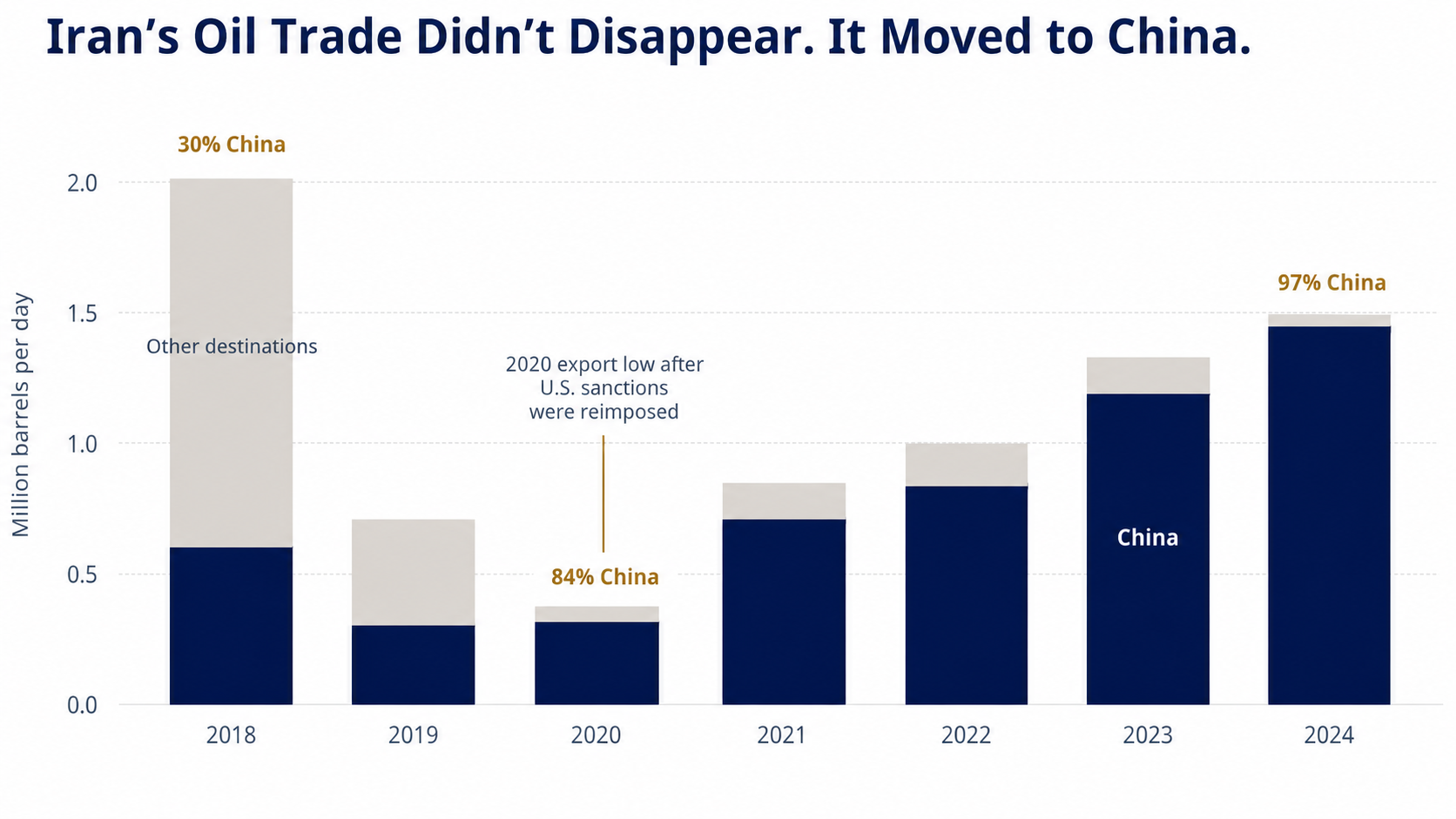
U.S. sanctions sharply reduced Iranian oil exports, but the trade rebuilt itself around a far narrower customer base. By 2024, EIA estimates indicate that nearly all of Iran’s crude and condensate exports ultimately flowed to China. Source: U.S. Energy Information Administration, 2025 Report on Iranian Petroleum and Petroleum Products Exports; Vortexa Analytics tanker tracker.
That concentration cuts two ways. It creates an obvious vulnerability for Tehran because losing its largest customer would be devastating. But it also concentrates the enforcement risk squarely on Washington’s relationship with Beijing.
The scale explains why. China imported 11.1 million barrels of crude a day in 2024, and its refiners processed 14.2 million barrels a day, making it the world’s largest crude importer. Iranian barrels enter that market at a discount, giving refiners a financial reason to keep buying even as the compliance risks rise.
The Treasury has responded by moving enforcement closer to the buyer. Since March 2025, OFAC has designated multiple Chinese teapot refineries that it says have collectively processed billions of dollars’ worth of Iranian-origin oil. An April 2026 warning to financial institutions detailed the methods involved, front companies, ship-to-ship transfers, falsified paperwork and vessel-identity manipulation, according to the Treasury.
A refinery caught in that net doesn’t just lose a customer. It loses dollar clearing, insurance access and the ability to buy American equipment, the kind of exposure that makes even a steep discount on Iranian crude expensive to defend.
The confrontation took a more serious turn in May. China’s Ministry of Commerce issued a blocking order covering five Chinese companies Washington had sanctioned over Iranian oil deals. The order instructed domestic firms not to recognize, implement or comply with the American measures, according to the ministry’s notice. Beijing separately said it opposed unilateral sanctions issued without United Nations authorization. It added that it would keep countering foreign measures it deems to overreach by issuing blocking orders of its own, according to a second ministry statement.
That’s more consequential than another tanker changing its flag. It turns sanctions evasion into a jurisdictional conflict, one where a company doing business in both countries can face orders that directly contradict each other, Washington demanding it stop, Beijing demanding it continue.
Sanctioning a small refinery with little U.S. business is one thing. Sanctioning a bank that clears dollars for thousands of multinational companies is another, and Washington has far more to lose the higher it climbs. Institutions that look too important to sanction become the ones evasion networks migrate toward.
This doesn’t make China immune to American pressure. The Treasury noted that some teapot refineries still relied on dollar transactions and American equipment, leaving real points of leverage. Large Chinese banks and multinational firms have far more to lose from U.S. exclusion than a small refiner operating near the edge of it.
But that distinction also points toward where analysts say the trade is likely headed. The more Washington raises the cost of dollar-linked Iranian commerce, the stronger the incentive becomes to move that activity toward companies, banks, and payment systems with less exposure to the US. Over time, sanctions push trade away from transparent, globally integrated institutions and toward actors specifically built to operate outside Washington’s reach.
Russia and Iran Are Building Their Own Pipes
Iran’s response to sanctions has moved beyond improvised smuggling. It’s being increasingly written into formal treaties with other sanctioned or sanctions-wary states. The clearest example is a pact with Russia.
The two countries’ Comprehensive Strategic Partnership Treaty commits them to oppose unilateral coercive measures and refrain from supporting sanctions directed at the other. More importantly, it calls for practical steps to reduce the effect of those restrictions on bilateral trade.
Iran and Russia’s Comprehensive Strategic Partnership Treaty commits both countries to oppose unilateral coercive measures and to refrain from backing sanctions aimed at the other. More notably, the two governments pledged practical steps to blunt the effect of such measures on their trade.
Article 20 goes further, calling for a payment infrastructure “independent of third states,” along with bilateral settlement in national currencies and closer interbank cooperation. A separate provision covers the International North-South Transport Corridor, energy swaps, and cooperation on gold mining and processing.
This doesn’t create an alternative to the dollar-based system overnight. But it does bake sanctions resistance into policy.
Russia has its own reasons to build this out. Years of Western financial restrictions have already pushed Moscow to redirect trade, settlement and reserves toward channels that don’t run through Western institutions. Iran brings decades of experience operating under sanctions, and the two countries’ incentives increasingly overlap even where their broader interests diverge.
BRICS offers a wider forum for some of the same experimentation. Iran now sits inside an expanded 11-member grouping that includes Brazil, Russia, India, China, South Africa, Egypt, Ethiopia, Indonesia, Saudi Arabia and the United Arab Emirates.
Membership alone doesn’t make BRICS an anti-American bloc, and it doesn’t mean every country wants to help Tehran dodge sanctions. However, it reveals a push to make cross-border finance less dependent on a single set of intermediaries. BRICS finance ministers and central bank governors used their 2024 joint statement to endorse further work on local-currency settlement, correspondent banking, and a possible payments and depository platform called BRICS Clear.
Iran doesn’t need a new reserve currency to sell another cargo of oil. It just needs enough buyers, banks, ships, and jurisdictions willing to complete a transaction without touching a vulnerable American node. Each new channel lowers the value of the next sanction Washington threatens to impose.
Why Every New Sanction Creates the Next Workaround
American sanctions power rests on a network, not just a legal authority. The dollar’s role in trade, funding and reserves gives Washington visibility into transactions most other governments can’t see. Correspondent banking, securities markets, insurers and compliance rules create chokepoints that foreign actors often can’t afford to lose access to.
That network is still the most powerful in the world. The dollar accounted for 57.13% of disclosed global foreign-exchange reserves in the first quarter of 2026, more than double the euro’s 20.03% share, with the renminbi still stuck in the low single digits. Those numbers leave little room for claims that the dollar has already been dethroned. The more relevant risk sits at the edges of the network, not the center.
IMF economists assessed that risk in 2024. They found that reserve diversification has increasingly favored a range of smaller, nontraditional currencies rather than a straightforward shift from dollars to euros or renminbi. They also warned that greater fragmentation into competing economic blocs could accelerate the trend.
Network effects explain the deeper pattern here. America benefits when everyone wants access to the same financial network. The more widely the system is used, the more valuable it becomes. Coercive use of that leverage, though, gives exposed participants a reason to insure themselves against being cut off. And that incentive isn’t confined to Washington’s adversaries.
Governments with no sympathy for Tehran can still dislike the extraterritorial reach of U.S. sanctions. Companies with no stake in Iran policy can still want legal certainty when American and local rules collide. A government might cooperate on one sanctions package while quietly investing in payment channels that preserve its own room to maneuver later.
Operation Economic Outcast leans directly into that dynamic. Every country is given a deadline to close identified Iranian activity, and the Treasury has said it will act against those that don’t comply. The policy succeeds only if resisting Washington costs more than severing ties to Iran.
The Oil Market Where Enforcement Gets Expensive
Financial coercion eventually runs into the physical limits of the oil market. Every Iranian barrel Washington succeeds in removing from sanctioned trade still has to be replaced somewhere in a global system constrained by production capacity, shipping routes, inventories, and refinery demand.
Geography makes that difficult. About 20 million barrels of oil moved through the Strait of Hormuz each day in 2024, accounting for close to 20% of global petroleum liquids consumption, according to the EIA. That makes Hormuz more than a regional chokepoint. It’s a share of global supply large enough that a disruption anywhere near it moves prices everywhere.
More than a quarter of all seaborne oil trade passes through the strait, and 84% of its crude and condensate flows head to Asian refiners, the same EIA analysis found.
The United States is less directly dependent on Gulf crude than it once was. American imports through Hormuz from Persian Gulf producers averaged about 500,000 barrels a day in 2024, roughly 2% of U.S. petroleum-liquids consumption.
But that relatively small share can give a false sense of insulation. A price spike anywhere near Hormuz can reach the gas pump, freight rates, airline tickets and grocery bills without a single barrel of Iranian or Gulf oil ever landing at a U.S. port. A trucking company renegotiating fuel surcharges feels the cost directly, regardless of what the customs data says about where the oil actually came from.
That creates a real tradeoff for sanctions enforcement. The more successful Washington becomes at stopping Iranian barrels from entering the market, the more pressure it places on available supply and the greater the bargaining power of other producers. And when enforcement also extends to shipping, insurance, and financial activity around an already contested waterway, traders and shipowners often demand a higher premium for the additional risk.
Compliance adds another cost. Banks facing complicated secondary-sanctions rules don’t have much incentive to investigate every borderline transaction. The safer response is often to reject activity that may actually be legal but is difficult to verify quickly. That kind of over-compliance can restrict real commerce while encouraging counterparties to migrate away from American financial institutions altogether.
The Treasury’s 2021 review anticipated this too, recommending that sanctions be calibrated to limit unintended effects on third parties. A campaign can win individual enforcement battles while worsening the broader environment for future sanctions. Iran replaces the stranded network. And China and Russia learn which links were vulnerable in the process. That knowledge doesn’t disappear once the sanctions list moves on.
The Tests That Will Decide Whether the Bet Pays Off
The real test of Operation Economic Outcast is whether other major governments cooperate or build new ways around it.
China is the first test. The Treasury estimated that roughly 90% of Iran’s oil exports were going to China as of April 2026. If Beijing pressures refiners and banks to pull back, Iranian revenue could fall sharply. If it expands blocking measures instead, more trade may shift toward institutions with little U.S. exposure.
Russia is the second. Its treaty with Iran calls for national-currency settlement, direct banking ties, and energy cooperation. But agreements matter less than actual transaction volumes. The key question is whether those systems grow large enough to handle meaningful volumes outside the U.S.-led financial network.
BRICS matters for the same reason. Its payment initiatives remain voluntary and unfinished, while countries such as India, the Gulf economies, Türkiye, and major Asian trading hubs have different relationships with both Iran and the United States. Their response will help determine whether Washington can build the broad coalition the Treasury says sanctions need.
Operation Economic Outcast could still reduce Iranian revenue if Washington can keep a broad coalition together. But the challenge is greater than it was previously because Iran and its trading partners have spent years building experience, legal protections, and financial channels designed to withstand U.S. pressure.
For markets, the larger risk is a more fragmented financial system and an acceleration in efforts to reduce dependence on the dollar. That doesn’t mean the dollar is close to losing its dominant role. It means more governments may invest in alternative payment systems, settlement currencies, and trade relationships that leave them less vulnerable to U.S. financial pressure.